Your eyes are working every moment you’re awake. They process light, color, depth, and motion simultaneously — all while being exposed to UV radiation, airborne debris, bacteria, and the cumulative wear of daily life. Yet most people give far more thought to protecting their skin than protecting the two organs responsible for roughly 80% of everything they perceive about the world around them.
Here’s what I find most encouraging as an optometrist: the vast majority of serious eye injuries and preventable vision loss are exactly that — preventable. A few consistent habits, applied at the right moments, can make an enormous difference in whether your vision stays sharp and healthy for decades to come.
These aren’t complicated protocols. They’re practical steps anyone can build into their daily routine. Let me walk you through them — and explain not just what to do, but why it actually matters for your long-term eye health.
In This Article:
- 1. Hand Hygiene: The Simplest Protection
- 2. Sunglasses with Real UV Protection
- 3. Safety Eyewear for Hazardous Tasks
- 4. Sports Goggles for High-Impact Activity
- 5. The Contact Lens Rules That Protect Your Cornea
- 6. Regular Dilated Exams — Especially If You’re Nearsighted
- 7. Lens Material That Works As Hard As You Do
- When to Come In — Eye Emergencies
- Frequently Asked Questions
1. Wash Your Hands — Every Single Time
It sounds almost too simple to mention. But hand hygiene is genuinely the single most effective thing you can do to prevent eye infections — and it’s the step most people consistently skip.
Your hands touch hundreds of surfaces throughout the day. Keyboards, phones, door handles, grocery carts. Most of that contact is invisible, but the bacteria and viruses that transfer to your fingertips are real — and your eyes are one of the most direct pathways into your body for those pathogens.
Wash with soap and water for at least 20 seconds before you do any of the following:
- Insert or remove contact lenses
- Apply eye drops or ointments
- Touch your eyes for any reason
The reason this matters so much for contact lens wearers specifically: when you place a lens directly on your cornea with contaminated hands, you’re essentially introducing bacteria into the most exposed tissue of your eye. Bacterial keratitis — a serious corneal infection — is one of the most common (and most preventable) causes of contact lens-related vision complications we see in our Illinois locations.
Plain soap and water, used properly, is more effective than hand sanitizer for eye-related hygiene. Make it non-negotiable.
2. Wear Sunglasses with Genuine UV Protection
Not all sunglasses are created equal — and a pair that simply looks dark is not the same as a pair that protects your eyes. The tint of a lens has nothing to do with its UV-blocking capability. A dark lens with no UV filter can actually be worse than no sunglasses at all, because your pupil dilates behind the dark lens and lets in more radiation.
Look for lenses labeled 100% UV protection or UV400, which blocks both UVA and UVB rays. Wraparound styles offer better coverage than standard frames.
Prolonged UV exposure without protection contributes to several serious conditions:
- Cataracts — UV radiation accelerates the clouding of your eye’s natural lens
- Macular degeneration — cumulative UV damage to the retina increases risk significantly; read our full AMD guide here
- Pterygium — a fleshy growth that can spread across the cornea and affect vision
- Photokeratitis — essentially a sunburn on the surface of your eye, causing pain, light sensitivity, and temporary vision loss
This applies year-round, not just at the beach in July. UV exposure is significant on cloudy days, in winter, and at higher altitudes. Snow reflects up to 80% of UV radiation back toward your eyes. Sunglasses are a 365-day habit, not a seasonal accessory.
Children need UV protection too — in fact, because kids spend more time outdoors and their lenses are more transparent, cumulative UV damage often begins in childhood.
3. Use Safety Glasses or Goggles When It Counts
According to the American Academy of Ophthalmology, more than 2 million Americans suffer eye injuries every year — and the overwhelming majority happen in situations where appropriate protective eyewear would have prevented the injury entirely.
Safety eyewear is not optional when you’re working with:
- Power tools — saws, grinders, drills, nail guns, and similar equipment produce fragments that travel at speeds your natural blink reflex simply cannot outrun
- Chemicals — cleaning products, solvents, automotive fluids, fertilizers, and pool chemicals can cause chemical burns that are among the most serious eye emergencies we treat
- High-debris environments — yard work, construction, woodworking, metalworking, and even certain kitchen tasks (frying, pressure cooking) create airborne particles
ANSI-rated safety glasses (look for Z87.1 certification) provide impact resistance far beyond standard prescription lenses or casual eyewear. If you wear prescription glasses, consider prescription safety glasses or fit-over safety goggles that seal around your existing frames.
The five minutes it takes to put on safety eyewear before starting a project is worth an immeasurable amount compared to the consequences of a preventable eye injury.
4. Wear Sports Goggles for High-Impact Activities
Sports-related eye injuries account for tens of thousands of emergency room visits each year in the United States. Many of these patients are young — and many are in activities you might not immediately think of as high-risk.
Basketball is actually one of the most common sources of sports eye injuries, ahead of activities people typically associate with eye hazards. Racquet sports, baseball, soccer, martial arts, hockey, and volleyball all carry meaningful risk of eye trauma from balls, elbows, fingers, and equipment.
Standard eyeglasses — including expensive prescription frames — offer no meaningful protection against impact. In fact, eyeglass frames can break on impact and cause additional injury. Prescription sports goggles, on the other hand, are specifically engineered for impact resistance, fit securely on the face, and won’t shift or fall off during contact.
For young athletes in particular, sports goggles are one of the most important pieces of protective equipment in their bag. If your child wears glasses and plays any contact or ball sport, this conversation is worth having at their next visit with us.
5. The Three Contact Lens Rules That Protect Your Cornea
Contact lenses are one of the most effective vision correction tools available — and one of the most commonly misused. The habits that seem harmless in the moment can create serious complications that take weeks or months to resolve, and in some cases cause lasting damage to the cornea.
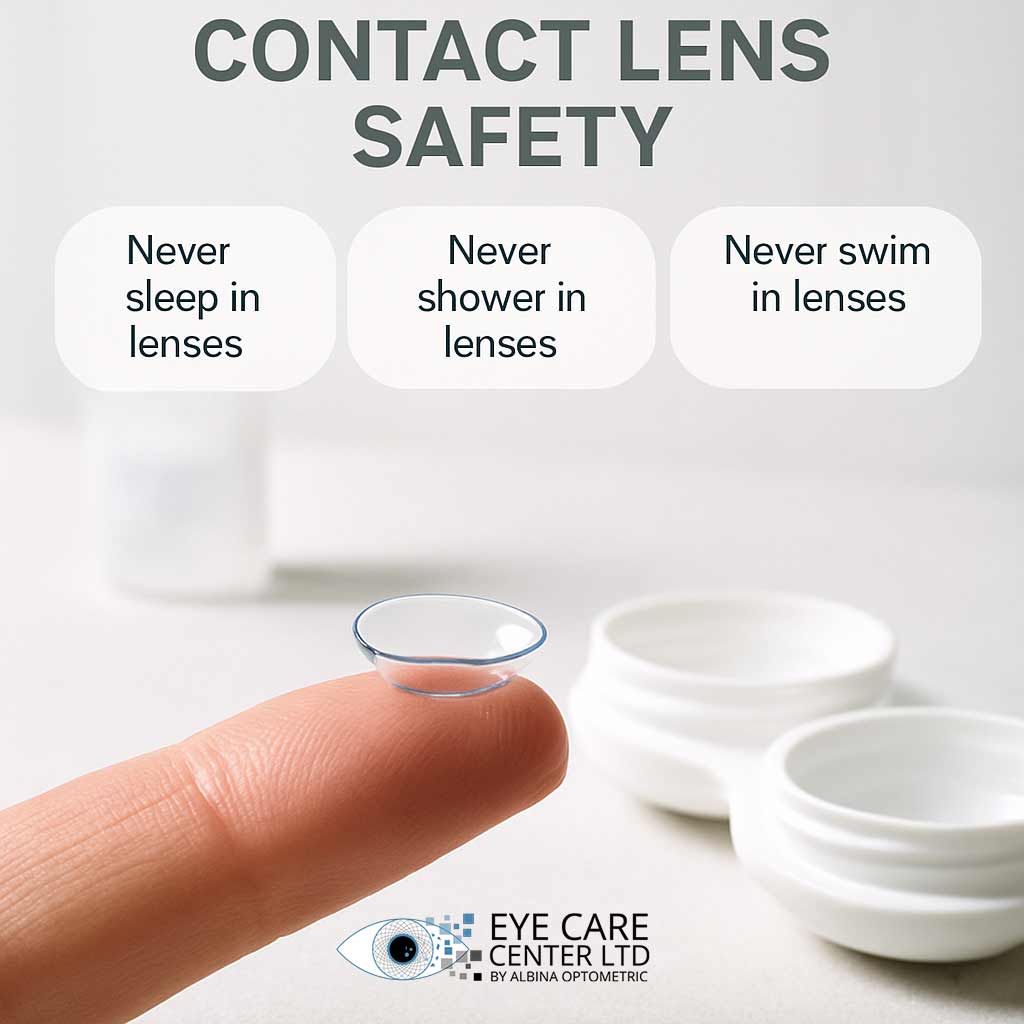
Three rules apply without exception:
Never Sleep in Your Contact Lenses
Your cornea receives oxygen directly from the air, not from blood vessels (the cornea is avascular — it has no blood supply of its own). When you sleep with lenses in, you dramatically reduce oxygen delivery to the corneal surface for an extended period. This creates the conditions bacteria love most: warmth, reduced oxygen, and a lens holding microorganisms in close contact with your eye for hours.
The risk of serious corneal infection increases significantly — some studies suggest by a factor of six to eight — when contact lenses are worn during sleep. Extended-wear lenses are designed for overnight use, but they still carry higher infection risk than daily removal. If you fall asleep in your lenses occasionally, it happens — but make it a rare exception, not a habit.
Never Shower in Your Contact Lenses
Tap water — including clean municipal water — can harbor an organism called Acanthamoeba, a microscopic parasite that can cause a devastating corneal infection called Acanthamoeba keratitis. This infection is notoriously difficult to treat and can cause permanent scarring and vision loss. It is almost exclusively found in contact lens wearers who expose their lenses to tap water or other non-sterile water sources.
Never Swim in Your Contact Lenses
This includes pools, lakes, rivers, hot tubs, and the ocean. All carry microorganisms — including Acanthamoeba — that can adhere to contact lenses and cause serious infection. If you must see clearly while swimming, prescription swim goggles are the right solution.
For more on contact lens options and care, ask about our contact lens fitting services at any of our three Eye Care Center locations in Addison, Burbank, and Willowbrook.
6. Don’t Skip Your Dilated Exam — Especially If You’re Nearsighted
A dilated eye exam is the only way to fully examine your retina — the light-sensitive tissue lining the back of your eye that makes vision possible. Without dilation, we see roughly 30-40% of your retina. With dilation, we see 90-95%.
That difference matters enormously, because the retinal conditions we’re most concerned about — tears, holes, thinning, and early detachment — often develop in the peripheral retina where we simply cannot see without dilating the pupil.
A Special Note for Nearsighted Patients
If you have a high myopic (nearsighted) prescription, this section is especially important for you. Myopia — even in moderate degrees — is associated with a physically longer eyeball. A longer eyeball means the retina is stretched more thinly over a larger surface area. Thinner retinal tissue is more vulnerable to developing holes, tears, and eventually detachment.
Retinal detachment is a true ocular emergency. The warning signs include a sudden increase in floaters, flashes of light in your peripheral vision, or a curtain or shadow moving across your visual field. If you experience any of these symptoms, do not wait for a scheduled appointment — contact us immediately.
Catching a retinal tear before it progresses to detachment is one of the most impactful things a dilated exam can do. A small tear can often be treated with in-office laser in a single visit. A full detachment requires surgery — and even with successful surgery, vision doesn’t always fully recover.
We recommend a dilated exam at least annually for most adults, and every visit for patients with diabetes, high myopia, or a family history of retinal disease. Learn more about what a comprehensive eye exam includes and what we look for.
7. Choose the Right Lens Material — Trivex Is Worth Knowing About
Most people choose their eyeglass frames carefully and put much less thought into the lens material inside them. But the material your lenses are made from affects not just optical clarity, but how well your glasses actually protect your eyes in the event of an impact.
We often recommend Trivex for patients who want a lens that balances exceptional optical performance with meaningful safety properties:
- Impact resistance: Trivex meets ANSI Z87.1 standards for safety eyewear — the same standard as industrial protective glasses. Standard plastic lenses do not.
- Optical clarity: Trivex has a high Abbe value, meaning it produces less chromatic aberration (color fringing) than polycarbonate lenses — especially noticeable in peripheral vision and at higher prescriptions
- Lightweight: Trivex is lighter than glass and comparable to polycarbonate, making it comfortable for all-day wear
- Scratch resistance: Durable under everyday conditions
- UV protection: Inherent UV400 protection built into the material, not applied as a coating
Trivex is an excellent choice for children (whose glasses take more abuse and whose eyes are still developing), patients with active lifestyles, patients with higher prescriptions, and anyone who wants the added confidence of knowing their lenses won’t shatter on impact.
At your next visit, ask our opticians about lens material options. The right lens for your prescription and lifestyle isn’t always the default — it’s worth a conversation.
When to Come In: Eye Emergencies We Treat at Eye Care Center
Following these seven habits will significantly reduce your risk of preventable eye injuries and long-term vision damage. But accidents happen, and some symptoms require prompt evaluation regardless of how careful you’ve been.
Contact Eye Care Center immediately — don’t wait for a scheduled appointment — if you experience:
- A sudden increase in floaters or the appearance of new floaters — this can indicate a posterior vitreous detachment or retinal tear; learn more about floaters here
- Flashes of light in your peripheral vision, especially in a dark room
- A curtain, shadow, or dark area across any part of your visual field
- Sudden vision loss in one or both eyes — even briefly
- Eye pain, redness, or discharge that is worsening or not improving
- Chemical exposure — flush immediately with clean water and call us
- Any trauma to the eye — blunt impact, foreign body, or laceration
Our optometrists at Eye Care Center in Addison, Burbank, and Willowbrook are trained to manage ocular emergencies. We have the diagnostic equipment to evaluate retinal tears, corneal injuries, acute infections, foreign body removal, and sudden vision changes — and we’ll see you the same day for urgent concerns.
Don’t let uncertainty about whether something is “serious enough” delay you from calling. When it comes to your eyes, it’s always better to have us look and find nothing than to wait and wish you hadn’t.
To schedule an urgent appointment or ask whether your symptoms need same-day care, call any of our three locations or book online here.
Frequently Asked Questions: Eye Safety
What are the most common causes of preventable eye injuries?
The most common causes of preventable eye injuries are workplace and home tool accidents, sports-related trauma, chemical splashes, and contact lens misuse. The majority of these injuries could be prevented or significantly reduced with appropriate protective eyewear and consistent safety habits. Protective eyewear is the single most effective intervention across nearly all categories of eye injury.
Can UV damage to my eyes be reversed?
Unfortunately, most UV-related eye damage is cumulative and not reversible. Cataracts caused or accelerated by UV exposure require surgical treatment once they significantly affect vision. Macular degeneration associated with UV exposure cannot be undone — only monitored and managed. This is why consistent UV protection throughout your life, starting in childhood, matters so much. The damage you prevent today is damage you will not be living with in your 60s and 70s.
Is it really that dangerous to sleep in contact lenses occasionally?
Even occasional overnight wear meaningfully increases infection risk. The cornea is uniquely dependent on atmospheric oxygen, and a contact lens acts as a barrier to that oxygen during sleep. Extended-wear lenses are designed for overnight use, but they still carry higher risk than daily removal. Sleeping in lenses a few nights a week over years accumulates risk. One serious corneal infection can cause scarring that permanently affects vision — it’s a risk that isn’t worth taking for the convenience of not removing your lenses at night.
Do children really need sunglasses?
Absolutely — and arguably more than adults. Children’s crystalline lenses are more transparent than adult lenses, which means more UV light reaches the retina in children than in adults looking at the same sky. Since most people accumulate the majority of their lifetime UV exposure before age 18, protective habits established in childhood have an outsized effect on long-term eye health. Quality UV-blocking sunglasses are as important for children as sunscreen.
What should I do immediately if I get a chemical in my eye?
Flush the eye immediately and continuously with clean water for at least 15-20 minutes. Do not rub the eye. Remove contact lenses if present before or during flushing if you can do so without interrupting the rinse. After flushing, call us or proceed to an urgent care or emergency room — even if the eye feels better after rinsing, chemical injuries require professional evaluation to rule out damage to the corneal tissue. Time matters with chemical exposure: irrigation within the first few minutes dramatically affects outcomes.
How do I know if my sunglasses actually block UV rays?
Look for a label or tag that specifically states “100% UV protection” or “UV400.” UV400 means the lenses block all light wavelengths up to 400 nanometers, which covers both UVA and UVB. The darkness of the tint is not an indicator of UV protection — a clear lens can be UV-protective and a very dark lens may offer none. If you’re unsure about sunglasses you already own, we can measure their UV transmission at Eye Care Center using a photometer at any of our locations.
When should a child get their first comprehensive eye exam?
We recommend a first comprehensive eye exam between 6 and 12 months of age, another between ages 3 and 5, and then annually once a child starts school. Vision problems in children are often invisible — children don’t complain because they have no reference point for what clear vision should look like. Undetected farsightedness, eye muscle imbalance, or early myopia can affect learning, reading, and development in ways that look like attention problems rather than vision problems. Early detection makes treatment far more effective. Learn more about the connection between vision and learning here.
Eye Care Center LTD serves patients throughout the Chicago metropolitan area at our three locations in Addison, Burbank, and Willowbrook. Whether you’re due for your annual exam, have a concern about your eyes, or want to talk through the best lens and contact options for your lifestyle, our team is here.
Schedule your appointment online or call us at 1-888-899-0816.