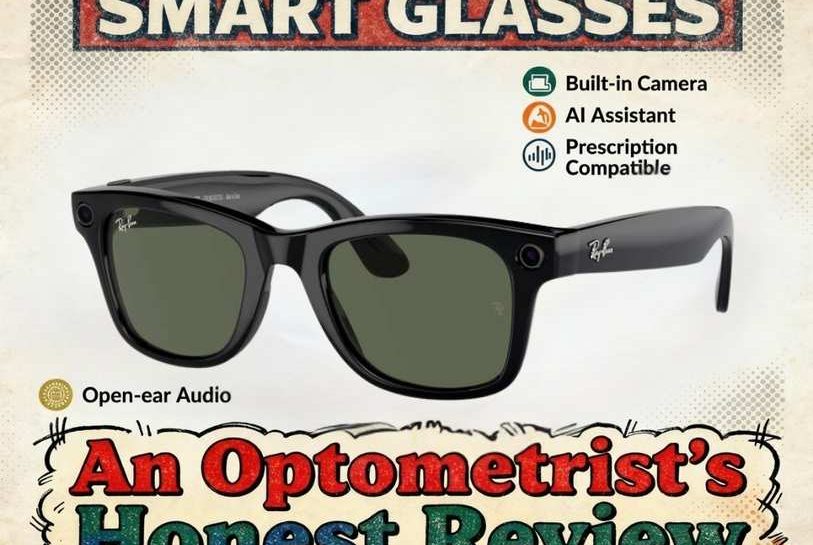
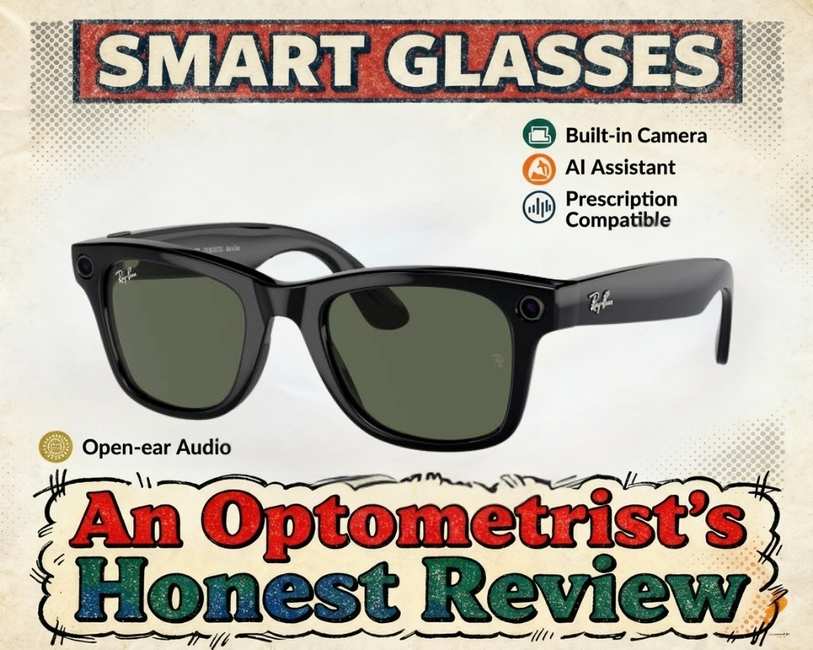
Here’s what nobody else is telling you about Meta Ray-Ban smart glasses from an actual eye care perspective. Not the tech reviewer hype, not the Meta marketing pitch – just straight talk from someone who fits glasses for a living and cares deeply about eye health.
Quick Navigation:
- What Are Meta Ray-Ban Smart Glasses?
- The Vision Care Perspective
- Can You Get Prescription Lenses?
- What Impresses Me As an Eye Doctor
- What Worries Me
- Who Should (And Shouldn’t) Consider These
- Where This Technology Is Heading
- My Verdict: Worth It in 2025?
What Are Meta Ray-Ban Smart Glasses? (The Quick Version)
Let’s start with the basics. Meta Ray-Ban smart glasses look like regular Ray-Ban Wayfarers, but they’ve got some interesting tech packed into the frames:
- 12MP ultra-wide camera built into the front of the frame for photos and videos
- Five-microphone array for clear voice calls and AI interactions
- Open-ear speakers built into the temples for audio without earbuds
- Meta AI assistant that can answer questions, identify objects, translate text, and more
- LED indicator lights that show when the camera is recording (privacy feature)
The current models start at $299 for non-prescription versions and go up from there depending on lens options and frame style. They come in several frame styles including Wayfarer, Headliner, and Skyler designs.
Here’s what they’re NOT: These aren’t augmented reality (AR) glasses with displays in front of your eyes. No holographic screens, no floating information. That technology exists (Apple Vision Pro, Meta’s upcoming AR glasses), but these Ray-Bans are focused on audio, camera, and AI functionality.
The Vision Care Perspective: What I Actually Care About
When tech reviewers evaluate smart glasses, they focus on camera quality, battery life, and AI features. That’s fine. But as an optometrist, I’m looking at completely different factors:
Optical Quality
Can these frames hold proper prescription lenses? Will the optical center align correctly with your pupillary distance? Is there enough frame depth for progressive lenses? These aren’t trivial questions – get them wrong and you’ll have headaches, eye strain, and blurry vision no matter how cool the tech is.
The good news: Ray-Ban (owned by Luxottica, the largest eyewear company in the world) knows how to make quality frames. The base optical quality is solid. The frames can accommodate most prescriptions, though there are some limitations we’ll discuss.
UV Protection
This is non-negotiable for me. Any sunglasses – smart or not – need proper UV400 protection blocking 99-100% of UVA and UVB rays. Meta Ray-Ban smart glasses do offer UV protection in their lens options, which is essential.
But here’s what concerns me: I’ve had patients come in with smart glasses where they opted for clear lenses instead of sun lenses because they wanted to wear them indoors. Clear lenses without UV coating offer zero protection. If you’re buying these primarily as sunglasses, make sure you’re getting actual sun lenses, not just clear lenses with a tint.
Frame Fit and Adjustment
Traditional glasses are endlessly adjustable. We can bend the temples, adjust the nose pads, tweak the angle – whatever it takes to get a perfect fit. Smart glasses? Not so much. The electronics limit how much we can manipulate the frame.
At Eye Care Center, we can do basic adjustments, but we’re much more constrained than with regular frames. This means the initial fit needs to be right, or you’ll be stuck with uncomfortable glasses.
Can You Get Prescription Lenses? (Yes – And Here’s How)
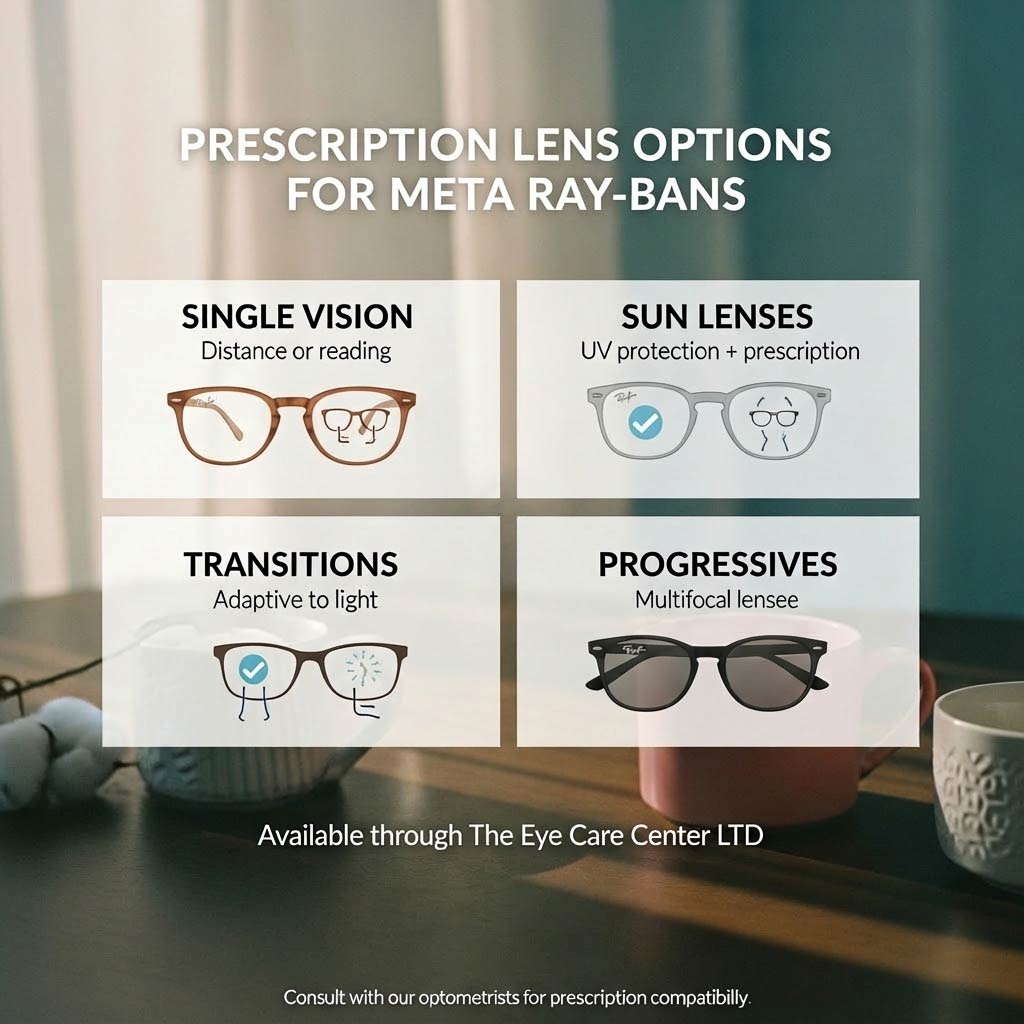
This is the question I get most often: “Can I actually use these if I need prescription lenses?” The answer is yes – with some important caveats.
Meta partnered with LensCrafters (also owned by Luxottica) to offer prescription lens options. Here’s what’s available:
Single Vision Lenses
If you need glasses for distance (like driving) or for close-up work (like reading), single vision lenses work great in these frames. Most prescriptions up to around ±4.00 diopters fit without issues. Beyond that, you’re looking at thicker lenses that may not work aesthetically or functionally with the frame.
Sun Prescription Lenses
This is probably the most popular option. You get your prescription in tinted sun lenses with full UV protection. Think of it as your regular prescription sunglasses, but with smart features built in.
Transitions Lenses
Yes, you can get photochromic (Transitions) lenses that darken in sunlight and clear up indoors. This gives you versatility – one pair that works in multiple lighting conditions. The catch? Transitions lenses can be slow to change in a car (since windshields block UV that triggers the change), so they’re not ideal for driving.
Progressive Lenses (Multifocals)
Here’s where it gets tricky. Progressive lenses are technically available, but I don’t recommend them for most people in these frames. Why? The frame style (Wayfarer) is relatively small and shallow, which doesn’t give you a lot of vertical space for the different viewing zones in progressives. You’d have a very limited reading area.
If you absolutely need progressives and want smart glasses, you might be better off with computer glasses or separate reading glasses for close work, and using the smart glasses primarily for distance and outdoor activities.
The Cost Reality
Let’s talk money. Base Meta Ray-Ban smart glasses without prescription: $299-$379 depending on style. Add prescription lenses through LensCrafters? You’re looking at another $300-$500+ depending on lens type, coatings, and your prescription strength.
So a fully equipped pair with prescription sun lenses, anti-reflective coating, and smart features? You’re easily at $600-$800+. That’s getting into premium eyewear territory.
What Impresses Me As an Eye Doctor
Despite my initial skepticism, there are aspects of these smart glasses that genuinely impress me from an eye health and safety standpoint:
Hands-Free Functionality Actually Matters
We’ve all seen people walking down the street staring at their phones, completely oblivious to their surroundings. As someone who cares about eye safety, this terrifies me. People walk into poles, trip on curbs, and create dangerous situations.
Smart glasses keep your hands free and your eyes up. Want to take a photo? Just tap the temple. Need to make a call? Voice command. Check the weather? Ask Meta AI. All while maintaining situational awareness.
For Illinois drivers dealing with distracted driving concerns, this is legitimately safer than holding a phone or even mounting one on a dashboard where you have to look down or away from the road.
Open-Ear Audio Design
Unlike earbuds that seal your ear canal, these glasses use directional speakers near your ears. You can hear your audio, but you can also hear everything around you – car horns, bicycle bells, people calling your name.
From a safety perspective, this is huge. Situational awareness prevents accidents. I’d much rather see patients using these while walking or biking than having AirPods blocking out the world.
They Might Actually Encourage Outdoor Time
Here’s an unexpected benefit: several of my patients report using their smart glasses primarily for outdoor activities – hiking, walking the dog, sightseeing around Chicago. The camera and AI features make being outside more engaging.
And as I discussed in my recent article on childhood myopia, outdoor time is protective for eye health. Bright natural light triggers beneficial biochemical responses in the eye. Anything that gets people outside more? I’m tentatively in favor of it.
Legitimate Eye Protection
If you choose sun lenses with proper UV protection, you’re getting real eye protection. UV exposure is cumulative and contributes to cataracts, macular degeneration, and other eye diseases. Wearing protective sunglasses isn’t just about comfort – it’s about long-term eye health.
The fact that these smart glasses can provide that protection while also being functional tech? That’s actually a win.
What Worries Me (And Should Concern You Too)
Now for the less comfortable part of this conversation. There are legitimate concerns about smart glasses that go beyond typical tech hype:
Are We Just Moving Screen Time, Not Reducing It?
One of my biggest concerns is that smart glasses might not actually reduce screen time – they might just relocate it. Instead of staring at your phone while walking, you’re constantly interacting with AI, taking photos, recording videos, checking notifications via audio.
The cognitive load is similar. The distraction potential is similar. We’ve just shifted the interface from a screen in your hand to speakers on your face.
I’m not convinced this is the net positive for attention and mental health that some people claim. It might actually make it harder to truly disconnect.
The Privacy Question
Look, I’m an optometrist, not a privacy advocate. But I can’t ignore the elephant in the room: cameras on people’s faces make others uncomfortable. Yes, there’s an LED indicator that lights up when recording. But how many people actually notice that?
In our Addison office alone, I’ve had staff members mention feeling uneasy when patients wear smart glasses with cameras during appointments. That’s a real social dynamic we need to acknowledge.
Durability and Repair Concerns
Traditional eyeglasses are remarkably durable and easily repairable. Bent temple? We fix it. Loose screw? Tightened in 30 seconds. Scratched lens? We replace it.
Smart glasses? Not so simple. You’re dealing with electronics, batteries, circuitry. Water damage is a concern (despite IP ratings). Drop them wrong and you might damage components we can’t fix at a regular optical shop.
And battery degradation is inevitable. After 2-3 years, that battery won’t hold a charge like it did new. Can you replace it? Maybe through Meta, but not at your local optometrist.
The Distraction Paradox
These glasses are meant to reduce distraction by keeping your phone in your pocket. But the AI assistant, camera, and audio features create their own distractions. It’s like having a notification system directly on your face.
I worry about people constantly fiddling with features instead of being present in the moment. The technology makes it so easy to document everything that we forget to simply experience things.
Who Should (And Shouldn’t) Consider These

After evaluating these from both a tech and eye care perspective, here’s my honest assessment of who these are (and aren’t) right for:
Great For:
Active adults who spend time outdoors: If you’re hiking, biking, traveling, or frequently outside in bright conditions, these make sense. You get sun protection, hands-free photography, and navigation assistance all in one.
Content creators and social media enthusiasts: The first-person perspective camera captures unique angles. If you’re documenting your life or creating content, the convenience is real.
Tech early adopters with disposable income: If you love being on the cutting edge of wearable tech and $600-800 isn’t a budget strain, go for it. Just know you’re paying premium prices for first-generation features.
People with mild to moderate prescriptions: If you’re in the -3.00 to +2.00 range, prescription options work well. Beyond that, you’ll face limitations.
Not Ideal For:
Children and teenagers: The camera privacy issues, cost, and durability concerns make these a hard pass for kids. Stick with regular glasses or sunglasses.
People with high prescriptions or complex vision needs: If you need strong progressives, prism correction, or have prescriptions above ±4.00, these frames won’t work well.
Budget-conscious shoppers: At $600-800+ for prescription versions, these are expensive. You can get excellent prescription sunglasses for $150-300 that might serve you better.
Anyone needing primary work glasses: If you’re at a computer all day or doing detailed near work, these aren’t your glasses. They’re supplemental at best.
Privacy-conscious individuals: If you’re uncomfortable with Meta collecting data on your activities, conversations, and photos, this isn’t the product for you.
Where This Technology Is Heading
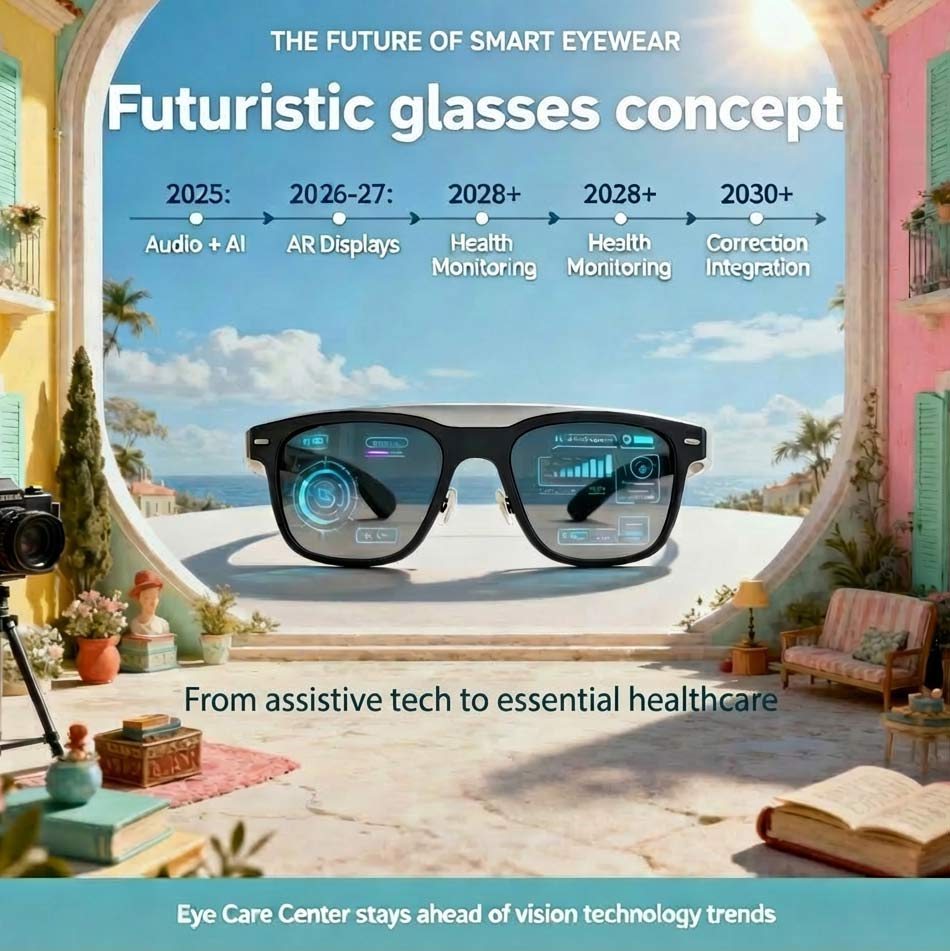
Here’s what gets me excited as both an eye care professional and someone fascinated by technology: Meta Ray-Ban smart glasses are just the beginning. The next 5-10 years will bring transformative changes to wearable vision tech.
True AR Displays Are Coming
Meta is working on actual AR glasses with displays that project information into your field of vision. Apple Vision Pro shows what’s possible (though at ridiculous size and cost). Within 2-3 years, we’ll see consumer AR glasses that are reasonably sized and priced.
From an optometry perspective, this is both exciting and concerning. Exciting because AR could help people with low vision by magnifying or enhancing their environment. Concerning because we’ll need to understand how prolonged AR use affects eye development, accommodation, and visual processing.
Health Monitoring Integration
Smart glasses will eventually monitor health metrics – blood glucose, intraocular pressure, even early signs of neurological diseases by tracking eye movements and pupil responses.
Imagine glasses that alert diabetics to blood sugar changes, or detect glaucoma pressure spikes before permanent damage occurs. That’s not science fiction – the technology exists, it’s just a matter of miniaturization and FDA approval.
Vision Correction Built Into Smart Eyewear
This is the holy grail: smart glasses with electronically adjustable focus. No more progressive lenses – your glasses would automatically adjust focus based on what you’re looking at. Research labs are working on this right now using liquid crystal technology.
When (not if) this technology matures, it will revolutionize eyewear. Everyone from young adults with mild myopia to older patients with presbyopia could benefit.
Contact Lens Displays
Even wilder: companies are developing contact lenses with built-in micro-displays and health sensors. You’d have AR capabilities, health monitoring, and vision correction all in a contact lens.
This technology is 10+ years away from mainstream, but the prototypes exist. As an optometrist, I’m tracking this closely because it will fundamentally change how we think about vision correction.
My Verdict: Worth It in 2025?
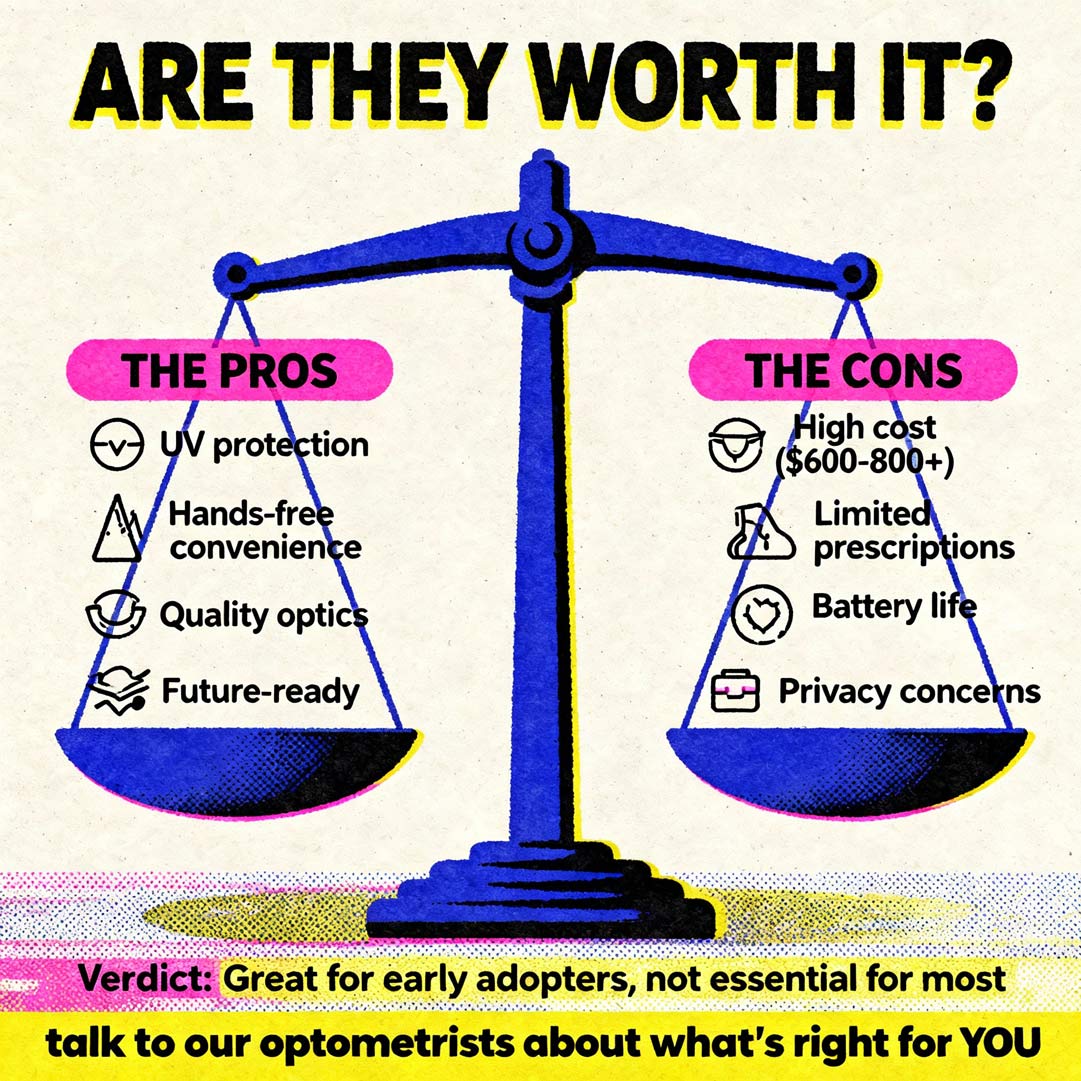
Alright, let’s bring this all together. Are Meta Ray-Ban smart glasses worth buying in 2025? My answer: it depends entirely on your priorities and use case.
As Sunglasses: Expensive But Functional
If you view these primarily as prescription sunglasses that happen to have smart features, the value proposition improves. You’re getting solid optical quality, UV protection, and a reputable frame brand. The smart features are a bonus.
But you’re still paying $600-800+ when excellent prescription sunglasses cost $200-400. That $400 premium buys you a camera, AI, and audio features. Worth it? Only if you’ll actually use those features regularly.
As Technology: Early Adopter Territory
These are first-generation consumer smart glasses from Meta (the Ray-Ban Stories predecessors were even more limited). Battery life is okay but not great. Features are cool but not essential. The AI is impressive but occasionally gimmicky.
If you love being on the cutting edge of wearable tech, go for it. Just know that Generation 2 will likely be significantly better, and Generation 3 will probably have actual AR displays.
As Prescription Eyewear: Convenient But Limited
For people with mild to moderate prescriptions who want stylish sunglasses with tech features, these work. For anyone with complex prescriptions, high powers, or specific optical needs, you’ll be frustrated by the limitations.
Don’t make these your only or primary glasses. They’re supplemental eyewear at best.
My Personal Recommendation
If you have $700+ of truly disposable income and you’re genuinely excited about the technology, buy them. You’ll enjoy experimenting with the features and you’re supporting the development of next-generation eyewear.
If you’re on a budget or your prescription is complex, wait. Let the technology mature, let prices come down, and let the next generation prove itself.
And regardless of whether you buy smart glasses or regular glasses, please get annual comprehensive eye exams. All the cool tech in the world doesn’t matter if you’re not monitoring your eye health.
Questions About Smart Glasses or Prescription Options?
At Eye Care Center, we stay on top of emerging vision technology so we can give our patients informed guidance. Whether you’re curious about smart glasses, need prescription recommendations, or just want a comprehensive eye exam, we’re here to help.
Here in our Addison, Burbank, and Willowbrook offices, we’ve seen just about every eyewear technology that comes through the door. We’ll give you honest advice about what makes sense for your vision, lifestyle, and budget.
Schedule your appointment at any of our three locations:
- Addison: 1250 W Lake St #19c, (630) 543-0607
- Burbank: 8525 S Harlem Ave, (708) 599-0050
- Willowbrook: 6300 Kingery Hwy #116, (630) 969-2807
And if you do end up buying Meta Ray-Ban smart glasses (or any smart eyewear), bring them in. We’ll make sure they fit properly and discuss how to use them safely while protecting your eyes.
The Bottom Line
Meta Ray-Ban smart glasses represent where eyewear is heading: toward integration of vision correction, eye protection, and wearable technology. They’re not perfect, they’re not for everyone, and they’re definitely not cheap. But they’re a legitimate step forward.
As an optometrist in the Chicago area, I see patients making all kinds of eyewear decisions every day. Some prioritize style, some prioritize function, some want the latest technology. There’s no wrong answer as long as you’re making an informed choice that protects your eye health.
Smart glasses are here to stay. The question isn’t whether you should ever buy them – it’s whether 2025 is your year to jump in, or whether you should wait for the technology to mature.
Either way, keep your eyes healthy, protect them from UV, and get regular comprehensive exams. That’s advice that never goes out of style, no matter how smart your glasses get.
Dr. Quentin Park
About Dr. Quentin Park
Dr. Quentin Park is a Doctor of Optometry at Eye Care Center LTD with a special interest in emerging vision technologies and their practical applications in everyday eye care. He sees patients at all three Eye Care Center locations throughout the Chicagoland area and stays current on the latest developments in wearable vision tech, digital eye health, and advanced diagnostic imaging.
References & Further Reading
- Meta. Ray-Ban | Meta Smart Glasses Official Product Information. 2025. https://www.meta.com/smart-glasses/
- American Academy of Ophthalmology. Ultraviolet Light and Your Eyes. 2024. https://www.aao.org/eye-health/tips-prevention/sun
- The Vision Council. Digital Eye Strain Report. 2024. https://www.thevisioncouncil.org/content/digital-eye-strain
- LensCrafters. Prescription Lens Options for Meta Ray-Ban Smart Glasses. 2025. https://www.lenscrafters.com/ray-ban-meta
- Review of Optometry. Smart Eyewear: The Future of Vision Correction and Augmented Reality. Review of Optometry. 2024;161(12):44-48.