

By Dr. Jenna Bacerra, O.D. | The Eye Care Center — Addison, Burbank & Willowbrook, Illinois
Every week in my exam room, I have the same conversation with parents. Their child’s myopia has progressed. The prescription has climbed again. They ask what they can do differently — and when I tell them one of the most evidence-backed tools available is simply sending their child outside every day, I can see the skepticism in their face. It sounds too simple. It sounds like the kind of thing a doctor says when they do not have a real answer. But the research on outdoor time and myopia prevention is some of the most consistent and well-replicated science in pediatric eye care, and I want parents in the Chicago suburbs to understand exactly what it says and why it matters for their children right now.
Spring is the natural entry point for this conversation. The days are getting longer, kids are already gravitating toward the door, and families are looking for ways to reset routines after months of indoor winter habits. There is no better time to build a daily outdoor habit than when the weather is working in your favor and your child is already motivated to be outside. What I want to give you in this article is the research that makes that habit worth protecting, a practical framework for making it stick, and an honest picture of how outdoor time fits alongside clinical myopia management.
This is not a replacement for specialized treatment. Children who already have myopia still benefit from specialty spectacle lenses, myopia-managing contact lenses, and regular monitoring at our offices. But daily outdoor time is something families can do right now, without a prescription, without a copay, and without a trip to the office — and the evidence says it makes a real difference. Let me show you what I mean.
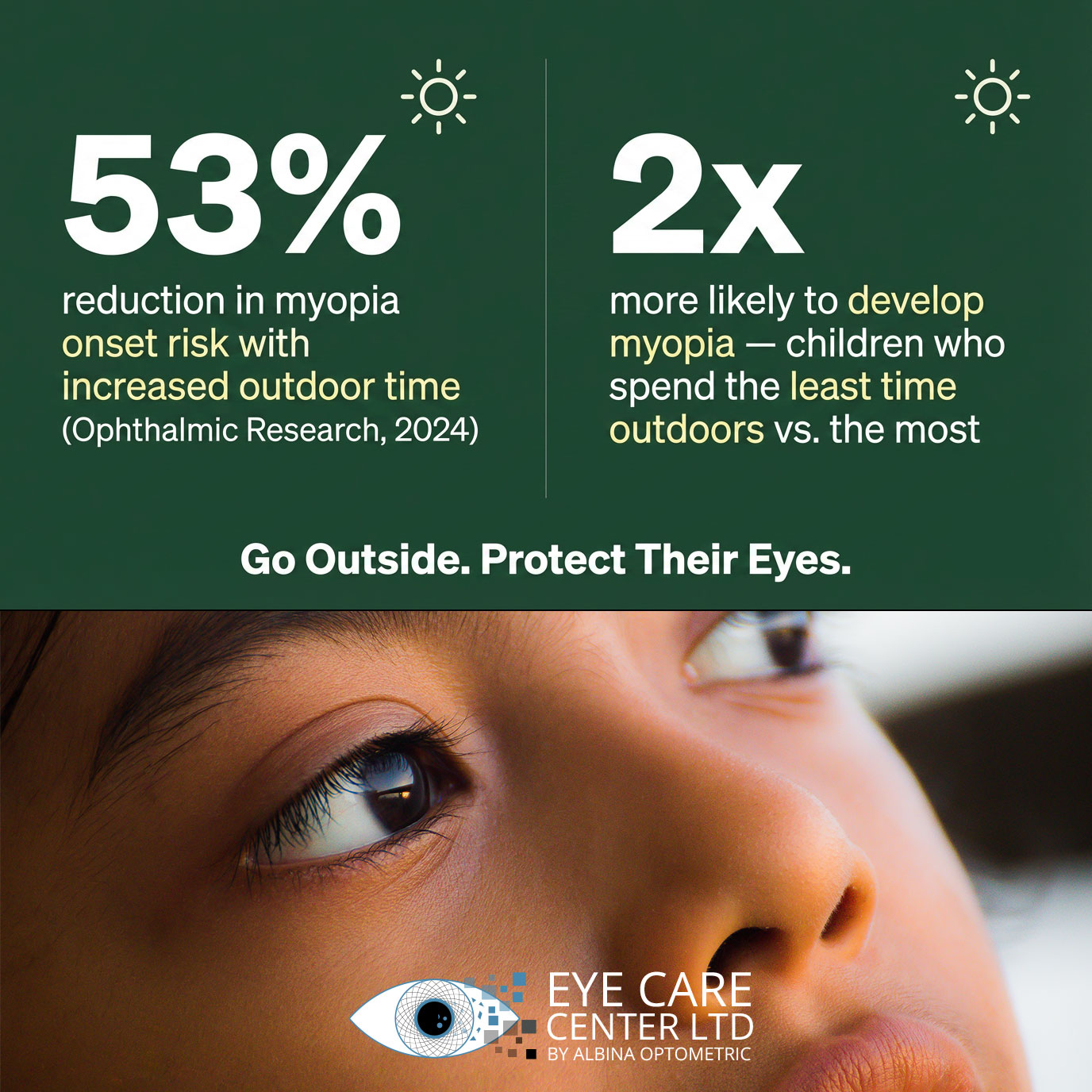
Children who get the most outdoor time have roughly half the risk of developing myopia compared to those who get the least — and a 2024 meta-analysis found that going from just 3.5 hours of outdoor time per week to around 16 hours per week was associated with a 53% reduction in myopia onset risk. That is not a rounding error. That is the most powerful behavioral intervention in pediatric eye care.
— Source: Ophthalmic Research, 2024 Meta-Analysis
What the Research Actually Says
I want to be specific about the science here, because vague wellness advice is not what parents need when they are making decisions about their children’s vision. The research on outdoor time and myopia is rigorous, replicated, and growing stronger with every passing year.
A 2024 meta-analysis published in Ophthalmic Research found that children with the highest levels of outdoor time had roughly half the risk of developing myopia compared to those with the least — and importantly, the researchers found a dose-response relationship. That means it was not a simple on-off switch. More outdoor time corresponded with progressively more protection. Going from approximately 3.5 hours of outdoor time per week to around 16 hours per week was associated with a 53% reduction in myopia onset risk. That is a clinically meaningful difference that no single supplement, screen filter, or classroom lighting change comes close to replicating.
A large school-based randomized controlled trial out of Shanghai reinforced these findings from a different angle. After two years, children in groups that increased their daily outdoor time showed meaningfully less myopic shift and less axial elongation — the physical lengthening of the eyeball that is the actual mechanical driver of myopia progression — compared to the control group. This is particularly important because axial elongation, once it has occurred, cannot be reversed. Slowing it down during the critical years of visual development is not just about today’s prescription number. It is about where that prescription ends up at age 18 and what that means for lifetime eye health risk.
A Cochrane review published in June 2024 added further weight. Across multiple randomized controlled trials, school-based programs that encouraged more outdoor time consistently showed lower incidence of myopia in intervention groups compared to controls, with results becoming more pronounced over two and three years of follow-up. The effect is not a fluke of one study or one population. It holds across different countries, different climates, and different study designs.
One nuance I always share with patients: outdoor time is protective for all children, not only those already myopic. For children without myopia yet, it strongly reduces the risk of onset. For children who are already myopic, consistent outdoor time is associated with slower progression. That means this habit is worth building and keeping at every stage of childhood, not just when a diagnosis has been made.
Why Outdoor Time Affects How Eyes Grow
The research is clear, but the question I get from parents is always: why? What is it about being outside that the inside of a school or a home cannot replicate?
Two primary mechanisms appear to be at work.
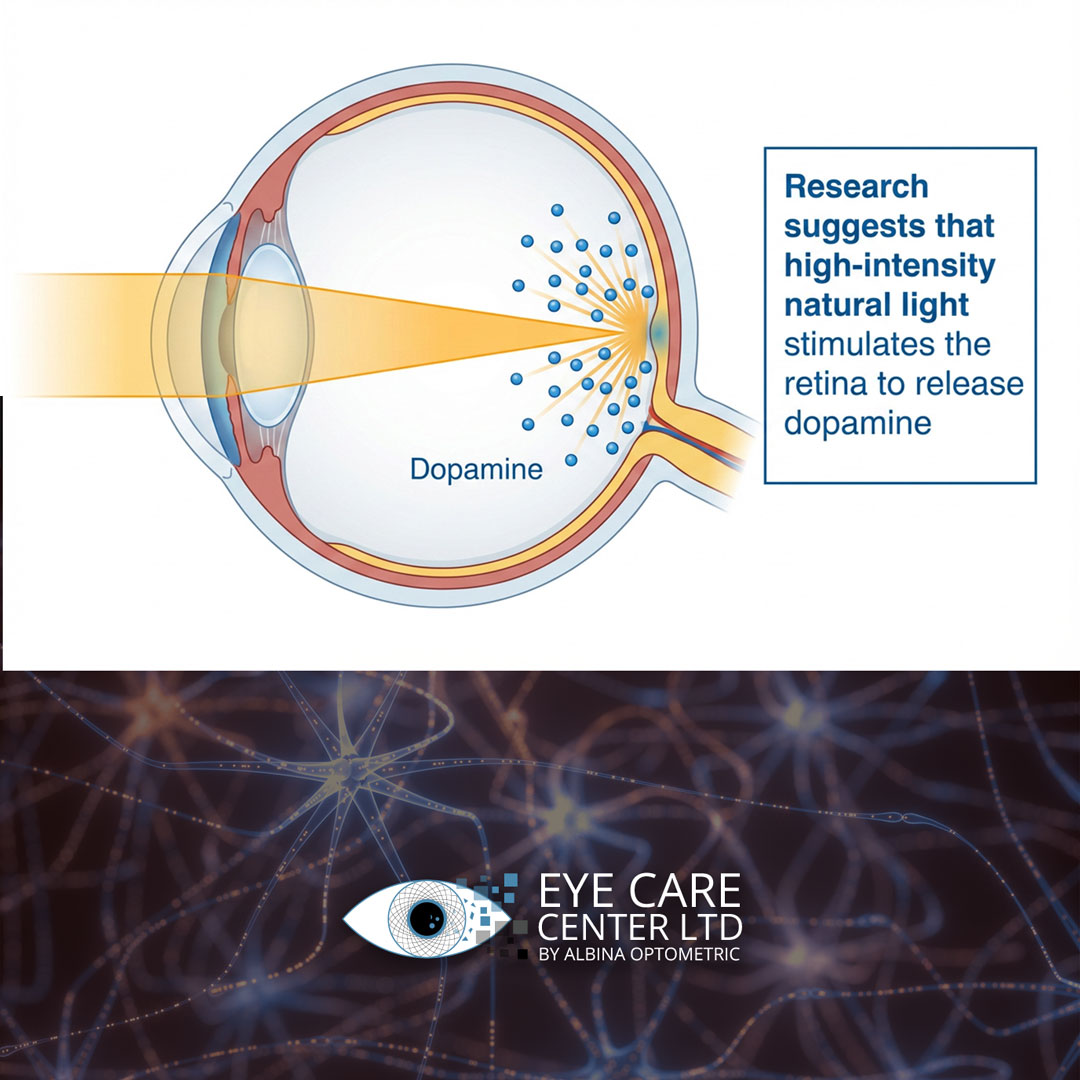
The first is light intensity. Natural outdoor light — even on an overcast day — is dramatically brighter than indoor lighting. A typical classroom or living room sits somewhere between 300 and 500 lux. Outdoor light on a cloudy day registers around 10,000 lux. Full sunlight is closer to 100,000 lux. That difference is not just about seeing more clearly in the moment. Research suggests that high-intensity natural light stimulates the retina to release dopamine, a neurotransmitter that appears to play a role in regulating eye growth. When dopamine is present in appropriate levels, the eye receives a signal that helps prevent the axial elongation associated with myopia. Indoor lighting, no matter how bright it seems relative to a dark room, simply does not produce enough retinal stimulation to trigger this response at the same level.
The second mechanism is distance. When a child looks at something far away — a tree, a field, clouds, a friend at the other end of a playground — the focusing muscles of the eye are relaxed. This is what the eye is designed for. By contrast, the near-work demands of reading, writing, tablet use, and schoolwork require sustained close-focus effort that some researchers believe contributes to the physical elongation of the eye over time. Outdoor play naturally cycles children through far-distance gazing in a way that a screen break indoors simply cannot match.
Indoor environments cannot replicate what outdoor light and distance vision provide together. That is not a criticism of school design or parenting choices. It is a structural reality of how eyes develop — and it is the reason that outdoor time, regardless of the activity, has consistently outperformed indoor alternatives in the research.
How Much Time Outside Is Enough?
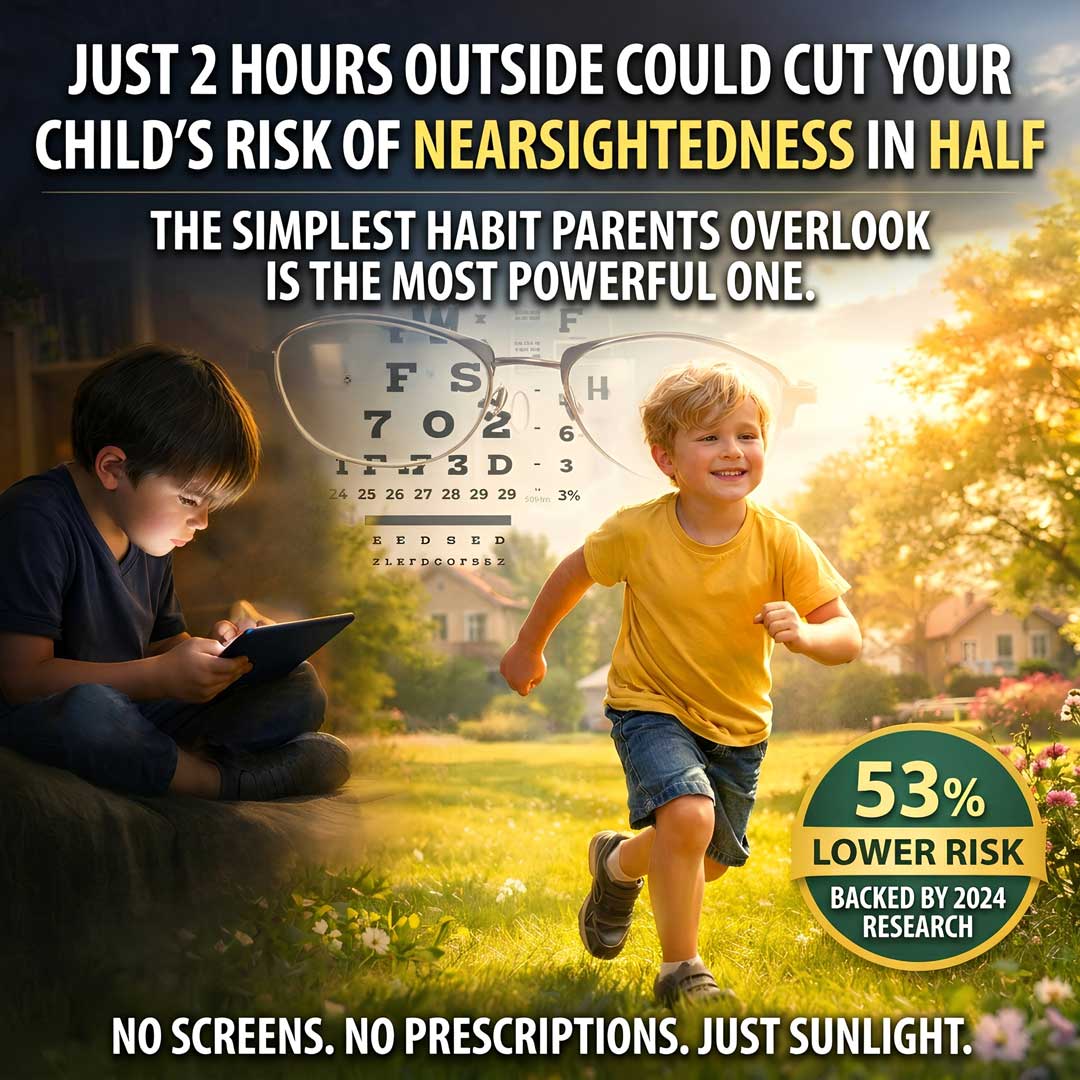
The research points to a meaningful threshold somewhere around 80 to 120 minutes of outdoor time per day — roughly 10 to 14 hours per week — as the range associated with measurable protective benefit. The 53% risk reduction figure came from studies comparing approximately 3.5 hours per week to 16 hours per week. For most children in school during the week, getting to the higher end of that range requires intentional planning.
What I tell parents is this: it does not have to be complicated. You do not need organized sports, a structured program, or long weekend excursions. Simple, unstructured outdoor time counts just as much as organized activity when it comes to the research outcomes. Playing in the backyard after school, walking to a nearby park, riding bikes around the neighborhood, eating lunch outside when the weather allows — all of it counts. The key variable is consistency and daily accumulation, not any single type of activity.
Twenty to thirty minutes of outdoor time each day, maintained consistently across the week, adds up significantly over months and years. A child who gets 25 minutes outside every school day and a bit more on weekends is accumulating close to 180 minutes per week before any planned family activities. That is a meaningful amount. It is also far more achievable than a single 90-minute outing on Saturday that gets skipped when something comes up. Small, consistent daily habits are easier to maintain than ambitious ones, and the research on myopia reflects that. The effect is cumulative and builds over time.
Using Spring as a Reset Opportunity
There is something genuinely useful about seasonal transitions as habit anchors. Just as January feels like a natural moment to reset routines, spring offers the same kind of motivational energy — and it comes with a significant practical advantage that January does not. Kids actually want to be outside. You are not fighting the weather, the daylight, or your child’s instincts. Spring is doing part of the work for you.
Families who build outdoor time into their spring routine before summer arrives tend to maintain it more consistently through the warmer months. The secret is positioning it correctly in the daily schedule. Outdoor time placed before homework or screen time begins is easier to protect than time carved out after those activities are already underway. A child who has been outside for 30 minutes before opening a book or turning on a device has already banked their exposure for the day, and the parent does not have to fight a battle later in the evening to get them to put the screen down.
A few things that help make the habit stick: keep it flexible and low-pressure so it does not feel like a chore, and get outside with your child when you can. The research on physical activity in children consistently shows that parental participation increases both duration and enjoyment. A 20-minute walk around the block with a parent is more likely to become a daily ritual than an instruction to go play outside alone. And for the times when schedules are tight, even a shorter outdoor break has value. Something is always better than nothing, and imperfect consistency over a long period outperforms perfect intention that never gets started.
The Full Picture: Outdoor Time and Clinical Care
I want to close with an honest framing of where outdoor time fits in the larger picture of myopia management, because I do not want any parent to leave this article thinking that going outside replaces clinical treatment.
For children who have already been diagnosed with myopia, outdoor time is one component of a multi-part strategy. Specialty spectacle lenses designed to slow myopia progression, myopia-managing soft contact lenses, and regular comprehensive monitoring at our offices all play roles that outdoor time cannot replicate. These clinical tools work at the level of how light focuses inside the eye, and they have their own strong evidence base. The goal is not to choose between clinical care and healthy habits. The goal is to combine them, because the evidence suggests they work better together than either does alone.
For children who do not yet have myopia, especially those with a family history, outdoor time is one of the most powerful preventive tools available — and it is something families can start today without waiting for a diagnosis. If your child has not had a comprehensive eye exam recently, spring is a good reminder to schedule one. Early detection of myopia allows early intervention, and early intervention is consistently associated with better long-term outcomes than waiting until the prescription is already climbing. A seasonal checklist worth keeping on the refrigerator: aim for daily outdoor time even in small doses, encourage breaks from close work and screens throughout the day, keep up consistent sleep and meal routines as spring schedules shift, and book a comprehensive eye exam if it has been more than a year.
If you have questions about your child’s myopia risk, their current progression, or the clinical options available at our Addison, Burbank, and Willowbrook locations, our team is here. This is one of the areas I am most passionate about in practice, because the window to make a meaningful difference is open widest when children are young — and spring is as good a time as any to walk through it.
Is Your Child’s Vision Ready for Spring?
Whether your child has already been diagnosed with myopia or you want to get ahead of it before it starts, our team at The Eye Care Center is here to help. We offer comprehensive pediatric eye exams, myopia risk assessments, and the full range of myopia management options available in 2026 — including specialty spectacle lenses and contact lens programs designed specifically for growing eyes.
Schedule your child’s comprehensive eye exam online or call us at 1-888-899-0816. We have locations in Addison (630-543-0607), Burbank (708-599-0050), and Willowbrook (630-969-2807), open Monday through Saturday.
Frequently Asked Questions
How much outdoor time does my child need to help prevent myopia?
Research points to approximately 80 to 120 minutes per day — or roughly 10 to 14 hours per week — as the range associated with meaningful protective benefit. A 2024 meta-analysis found that moving from about 3.5 hours of outdoor time per week to around 16 hours per week was associated with a 53% reduction in myopia onset risk. For most school-age children, 20 to 30 consistent minutes outside each day is a realistic and impactful starting point, especially when combined with longer outdoor time on weekends.
Does outdoor time help if my child already has myopia?
Yes. The research distinguishes between onset prevention and progression slowing, and outdoor time shows benefit in both. School-based trials that increased daily outdoor time showed not only lower rates of new myopia in children without it, but also slower axial elongation and less myopic shift in children who were already myopic. Outdoor time is a worthwhile habit regardless of whether your child has a diagnosis or not.
Does the activity matter, or is it just being outside?
The research consistently suggests that the key variable is the outdoor environment itself — specifically the intensity of natural light and the opportunity for distance vision — rather than the specific activity. Unstructured play, walking, riding bikes, and simply sitting outdoors all appear to confer similar benefit. Organized sports add value, but they are not required. Consistency and daily accumulation matter far more than activity type.
Can indoor time near a window substitute for outdoor time?
Unfortunately, no. Even a bright, sunny window dramatically filters the light intensity available to the retina. Outdoor light on an overcast day measures roughly 10,000 to 20,000 lux. A well-lit indoor environment typically measures between 300 and 500 lux. The difference is substantial enough that indoor exposure has not shown the same protective benefit in the research. Time outside, in actual natural light, is what the studies are measuring.
At what age should I start worrying about myopia in my child?
Myopia most commonly develops between ages 6 and 14, with the fastest progression typically occurring during middle school years when near-work demands are highest. However, risk factors — including a family history of myopia, significant time spent on close work, and limited outdoor time — can signal increased risk earlier than the onset of a diagnosis. A comprehensive eye exam at age 5 before kindergarten, then annually through the school years, is the standard I recommend. Early detection matters because early intervention consistently produces better long-term outcomes.
What clinical treatment options are available for childhood myopia at The Eye Care Center?
We offer a full range of myopia management options at our Addison, Burbank, and Willowbrook locations, including specialty spectacle lenses designed to slow axial elongation and soft contact lens programs developed specifically for myopia management in children and teens. These clinical treatments work alongside healthy habits like outdoor time, not instead of them. The best outcomes I see in practice come from families who combine consistent outdoor time with appropriate clinical care. A comprehensive exam is the right starting point to determine which options are most appropriate for your child’s specific prescription and progression pattern.