The Hidden Cost of High Myopia: What Every Parent Needs to Know About Their Child’s Future Vision
By Dr. Jenna Bacerra, OD | The Eye Care Center LTD | Serving Addison, Burbank, and Willowbrook, Illinois
I want to talk to you about something I see in my exam chair more often than I should. A child comes in with blurry distance vision. The prescription is measured, glasses are ordered, and everyone goes home feeling like the problem is solved. But here is what does not always make it into that conversation: a high myopia prescription is not just a number on a lens. It is a window into your child’s long-term eye health, and what happens over the next several years may have consequences that follow them into adulthood.
Myopia, or nearsightedness, is one of the most common vision conditions in the world and its prevalence among children is climbing. Researchers project that by 2050, nearly half the global population will be myopic. But what concerns me as a clinician is not the blurry vision itself. Glasses and contacts can correct that. What concerns me is the category of myopia we call high myopia, and the serious ocular complications that come with it when it goes unmanaged during childhood.
If your child has been told they are nearsighted or if you have noticed them squinting at the board in school or holding tablets uncomfortably close, this article is for you. Understanding childhood myopia risks now puts you in the position to act during the years when it matters most.
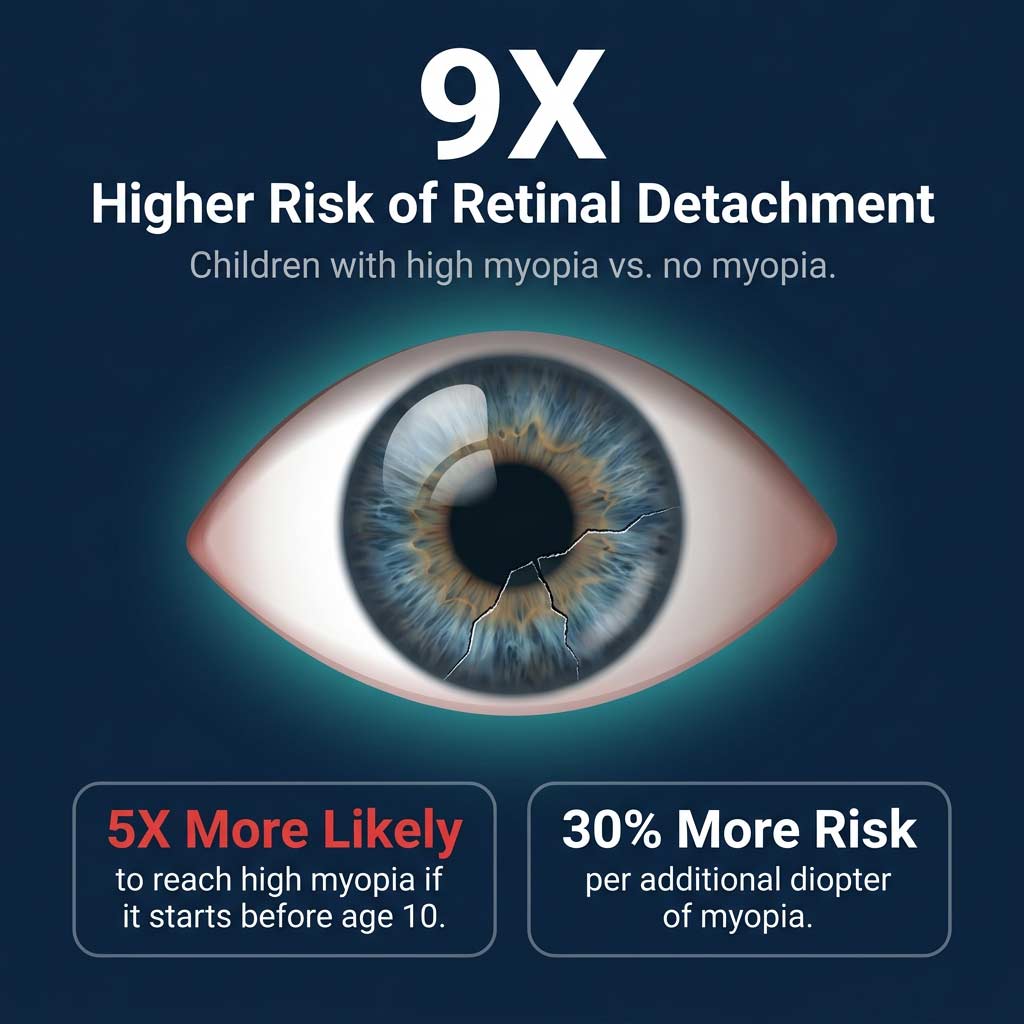
Mind-Boggling Fact: A child who develops myopia before age 10 is up to five times more likely to reach high myopia by adulthood than a child who develops it after age 12 — and every additional diopter of myopia raises the lifetime risk of retinal detachment by approximately 30%. A child who reaches -9.00 diopters carries roughly nine times the retinal detachment risk of someone with no myopia at all. The prescription on the lens is not just a number. It is a running total of preventable risk.
What Is High Myopia, and How Is It Different?
Myopia is measured in diopters, the unit used to describe the strength of a lens prescription. Mild myopia typically falls between -0.50 and -3.00 diopters. High myopia is generally defined as a prescription of -6.00 diopters or more. Pathologic myopia, the most severe category, refers to structural changes in the eye associated with very high prescriptions.
The distinction matters because high myopia is not simply a stronger glasses prescription. It reflects a physical change in the eye itself. In a myopic eye, the eyeball grows longer than it should. In high myopia, this elongation is significant, and that extra length places mechanical stress on the delicate structures at the back of the eye: the retina, the macula, and the optic nerve. Over time, this stress can have consequences far more serious than needing thick lenses.
A child who enters adolescence with moderate myopia that continues progressing unchecked is far more likely to reach high myopia by the time their prescription stabilizes in their early twenties. That trajectory is what makes early intervention so important.
Why Myopia Keeps Getting Worse During Childhood
Myopia typically begins between ages six and twelve and progresses through the teenage years. The rate of progression varies, but research consistently shows that children who develop myopia at a younger age tend to progress faster and reach higher prescriptions by adulthood.
Several factors contribute. Genetics play a role. If one or both parents are myopic, their child faces significantly higher odds of developing the condition. But environmental factors matter too, particularly the amount of time a child spends on near work such as reading, screens, and devices, relative to time spent outdoors. Studies suggest that outdoor light exposure has a measurable protective effect on myopia progression, and many children today are getting far less of it than previous generations did.
The concern I always raise with families in my Illinois practice is this: if we wait until the prescription stabilizes on its own, we may have allowed several years of preventable progression. Those are years that cannot be reversed.

This is the part of the conversation I want every parent of a myopic child to understand. The complications associated with high myopia are not hypothetical risks for a distant future. They are well-documented, increasingly studied, and directly tied to how high a child’s prescription grows.
Retinal detachment is one of the most urgent concerns. The mechanical stretching that occurs with a highly elongated eye can cause the retina to thin, develop tears, or separate from the tissue beneath it. This is a serious medical event that requires immediate treatment and can result in permanent vision loss if not addressed quickly. People with high myopia face a significantly elevated lifetime risk compared to those with mild prescriptions or no myopia at all.
Glaucoma is another concern. Elevated intraocular pressure combined with the structural vulnerabilities of a highly elongated eye increases the risk of optic nerve damage over time. People with high myopia are more likely to develop open-angle glaucoma and to develop it earlier in life.
Myopic macular degeneration is a progressive condition in which the central area of the retina deteriorates due to the physical strain of high myopia. Unlike age-related macular degeneration, which most people associate with elderly patients, myopic macular degeneration can begin affecting people in middle age and represents one of the leading causes of irreversible vision loss worldwide.
Cataracts also develop earlier in highly myopic individuals, often decades before they would appear in the general population.
None of this is intended to alarm you unnecessarily. What it is intended to do is make clear that a child’s myopia prescription is worth taking seriously beyond simply correcting their vision today.
The Window That Closes
The most important thing I want parents to take away from this article is the concept of a treatment window. Myopia management is most effective when it begins early, during the years when the eye is still actively growing and the prescription is still progressing. Once progression has plateaued in early adulthood, the opportunity to meaningfully slow that trajectory has passed.
Children as young as six or seven can begin myopia management. Research on interventions such as orthokeratology (specialty contact lenses worn overnight that temporarily reshape the cornea), atropine therapy, and soft multifocal contact lenses shows consistent results in slowing the rate of myopia progression. We are not talking about a marginal difference. Studies have demonstrated reductions in progression rates of 30 to 60 percent depending on the method and the individual patient.
Every diopter of prescription that does not develop is a meaningful reduction in the long-term risk profile for that child’s eyes.
What Myopia Management Actually Looks Like

When a family comes to me at one of our Illinois locations concerned about their child’s worsening prescription, the first step is a thorough evaluation. We want to understand the current prescription, the rate of progression based on prior records if available, the child’s age and lifestyle factors, and any family history that might inform risk. From there, a management plan is individualized to the child.
For some children, that means overnight orthokeratology lenses that provide clear daytime vision without glasses while actively working to slow axial elongation. For others, it means specialty soft contact lenses worn during the day. Low-dose atropine eye drops are another option, particularly for younger children or those who are not yet ready for contact lenses. In many cases, a combination approach yields the best results.
We monitor these patients regularly, typically every six months, to assess how well the current approach is working and to make adjustments as the child grows.
If you are in the Addison, Burbank, or Willowbrook area and your child has been told they are nearsighted, I would encourage you to ask specifically about myopia management at their next exam. A standard glasses prescription, while necessary, is not the same as an active management plan. There is a meaningful difference between correcting myopia and working to slow its progression.
The Conversation Worth Having Now
I understand that as a parent, it can feel overwhelming when a routine eye exam opens a door to a larger conversation about long-term health risks. But I would rather have that conversation with you now, when we can act on it, than after the prescription has climbed into ranges where the structural risks become much more tangible.
The good news is that myopia management is effective, well-tolerated by children, and available right here in Illinois. The families I work with at The Eye Care Center LTD who begin these programs early consistently report that they feel better knowing they are doing something proactive for their child’s future vision. That peace of mind matters.
If your child is nearsighted, has a family history of high myopia, or has not had a comprehensive eye exam in the past year, I encourage you to schedule an appointment at any of our three Illinois locations: Addison, Burbank, or Willowbrook. We will walk through the full picture with you, answer every question you have, and make sure your child is on the best path for their long-term eye health.
Schedule a pediatric myopia consultation today: Book an appointment online or call us at 1-888-899-0816. Our offices are open Monday through Thursday 10am to 6pm, Friday 10am to 5pm, and Saturday 9am to 2pm.
Frequently Asked Questions About High Myopia and Childhood Myopia Risks
At what prescription is myopia considered “high”?
High myopia is generally defined as a prescription of -6.00 diopters or greater. At this level, the physical elongation of the eye becomes associated with elevated risks for complications such as retinal detachment, glaucoma, and myopic macular degeneration. Prescriptions below -6.00 still benefit from monitoring and, where appropriate, management to prevent progression into the high range.
What are the most serious complications of high myopia?
The most significant complications associated with high myopia include retinal detachment, myopic macular degeneration, early-onset glaucoma, and premature cataract development. These conditions are not guaranteed outcomes, but the risk increases meaningfully as the degree of myopia rises. Slowing progression during childhood reduces the likelihood that a child will reach prescription levels where these risks become elevated.
Can myopia progression actually be slowed in children?
Yes. Clinical research supports several interventions that slow myopia progression in children, including orthokeratology lenses, low-dose atropine eye drops, and specialty soft contact lenses designed for myopia management. The most effective approach depends on the child’s age, prescription, and individual factors. Early intervention tends to produce better outcomes than waiting.
How do I know if my child needs myopia management versus just glasses?
If your child has been diagnosed with myopia and their prescription has increased between annual exams, they are a candidate for a myopia management conversation. Even children with lower prescriptions who are young and showing early progression benefit from an evaluation. A comprehensive exam at The Eye Care Center LTD can help determine whether a management plan is appropriate.
What ages are appropriate for myopia management?
Myopia management can begin as early as age six or seven in children who are showing signs of progression. The earlier the intervention, the more potential benefit, since the goal is to slow the elongation of the eye during the years when it is actively growing. Children through their mid-teens typically benefit from these programs.
Does spending time outdoors really affect myopia?
Research suggests that regular outdoor time has a protective effect against myopia onset and progression, likely related to exposure to natural light and the visual demands of looking at distant objects. While outdoor time alone cannot replace clinical myopia management in a child with an active, progressing prescription, it is a meaningful and accessible lifestyle factor that families can prioritize.