The Contact Lens Sitting on Your Eye Is About to Become the Most Powerful Health Device You’ve Ever Worn
By Dr. Najib Albina, O.D. | The Eye Care Center LTD
I have been practicing optometry long enough to remember when the idea of a disposable contact lens felt revolutionary. Now, the conversation in eye care has moved somewhere far more extraordinary. Smart contact lenses – lenses embedded with microscopic sensors, wireless transmitters, and even augmented reality displays – are moving out of research laboratories and into clinical trials, and the timeline for some of them reaching real patients is closer than most people realize.
Patients ask me about this more than almost any other topic right now. They have seen headlines about lenses that monitor blood sugar without a finger prick, lenses that could detect glaucoma around the clock, and lenses that overlay digital information directly onto your field of vision. The curiosity is completely understandable. These technologies touch on some of the most pressing health concerns people face – diabetes management, vision loss prevention, and the relentless march of screens into every corner of daily life.
The honest answer is that smart contact lenses are not yet available for most consumers to walk in and purchase. But several specific applications are in active clinical use or in late-stage development, and as your eye doctor, understanding what is coming – and what it means for your care – is something I think every patient deserves to know about. Let me walk you through exactly what is being developed, what is closest to reality, and why your relationship with your eye doctor is about to matter more than ever.
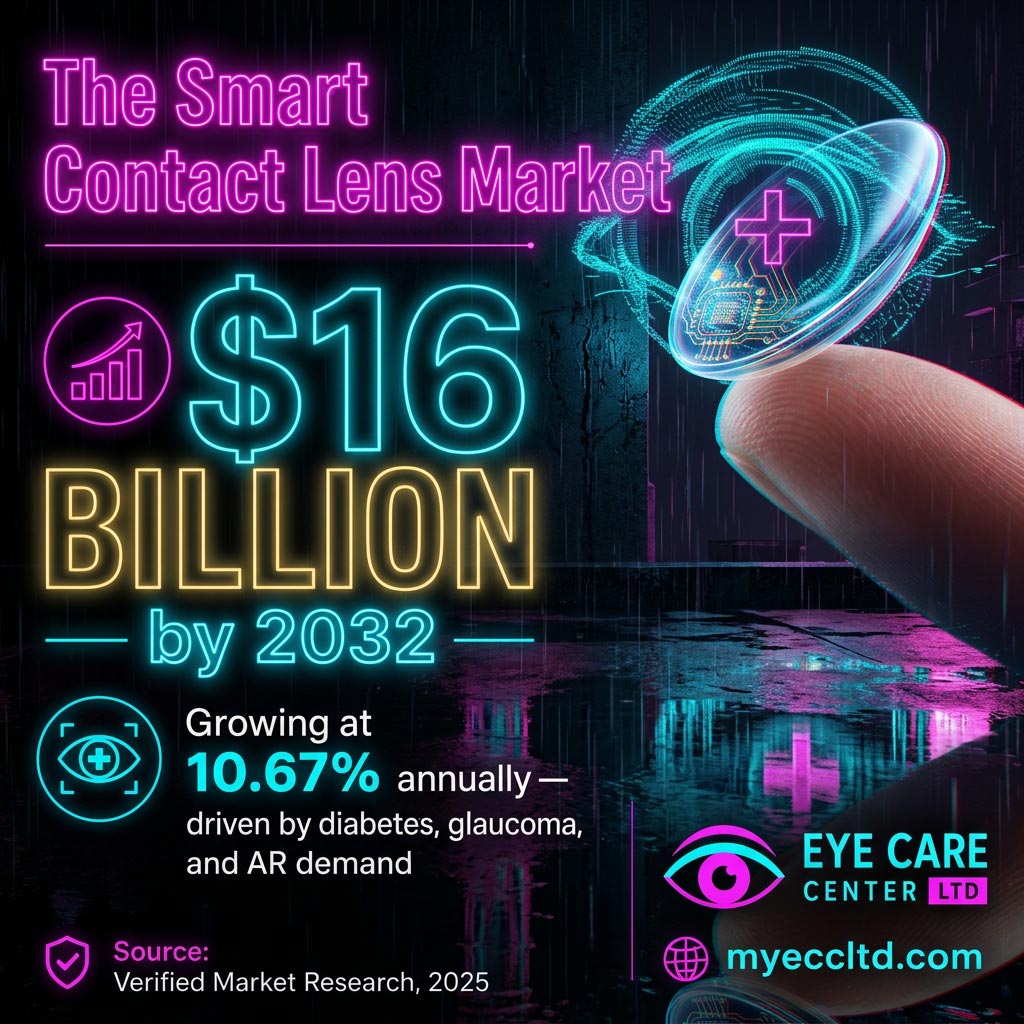
Mind-Boggling Fact: The global smart contact lens market was valued at $7.13 billion in 2024 and is projected to reach $16 billion by 2032 – fueled by demand for non-invasive diabetes monitoring, continuous glaucoma tracking, and augmented reality applications. The contact lens sitting on your eye is becoming one of the most consequential medical devices of the next decade.
What Is a Smart Contact Lens?
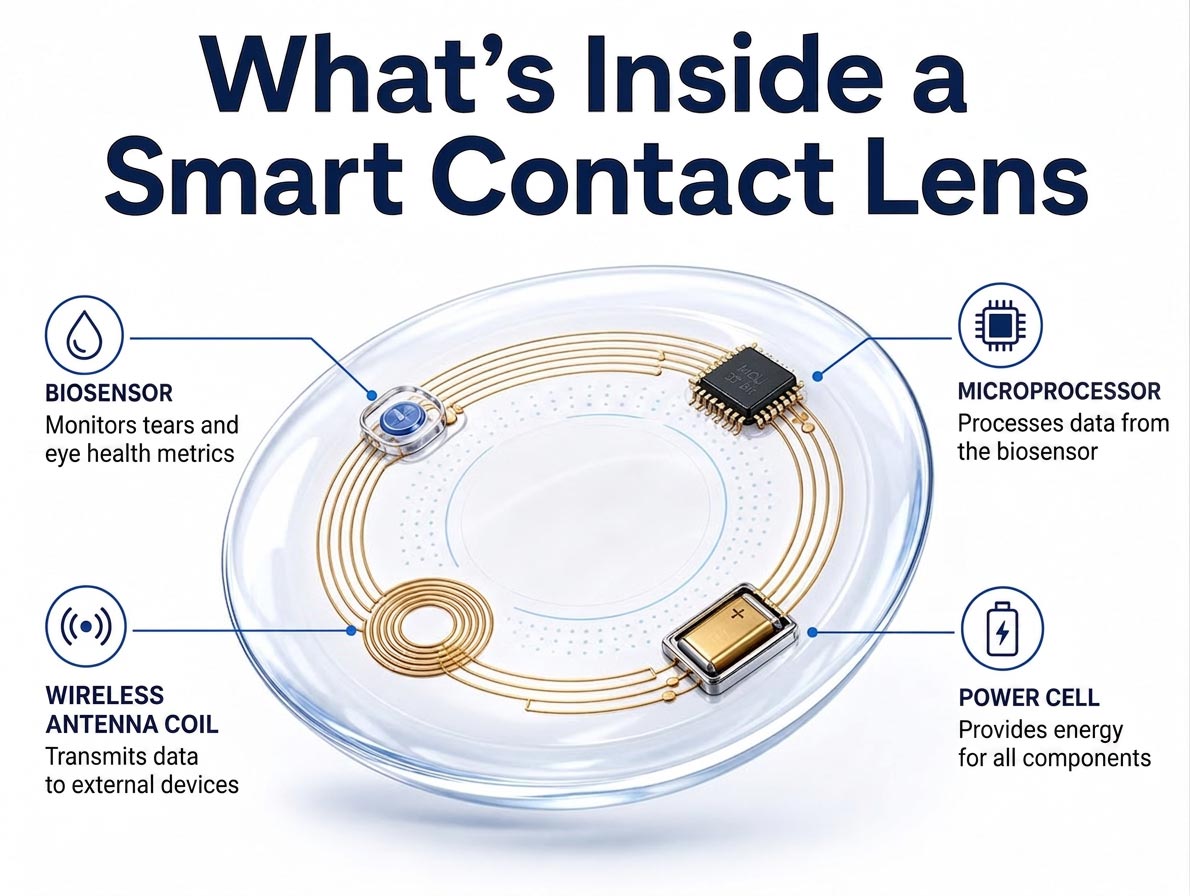
A smart contact lens is a standard soft contact lens that has been integrated with miniaturized electronic components – sensors, microprocessor chips, wireless communication units, and power sources – all embedded within a lens thin enough to rest comfortably on the surface of the eye. The electronics are typically built using materials like graphene and carbon nanotubes that can flex and curve with the lens without causing irritation.
These lenses do not simply correct vision. Depending on the application, a smart contact lens can:
- Measure biological signals from the eye and surrounding tear fluid
- Transmit data wirelessly to a smartphone or physician dashboard
- Deliver medication on demand directly to the ocular surface
- Project digital images or information into the wearer’s field of view
The tear fluid that bathes the surface of your eye turns out to be a surprisingly rich source of health information – it contains glucose, proteins, ions, and pressure-sensitive indicators that reflect conditions happening throughout the body, not just in the eye itself.
Power is one of the most fascinating engineering challenges these lenses face, and researchers have addressed it in several ways:
- Energy harvesting from blinking or ambient light
- Near-field communication (the same technology behind tap-to-pay) to receive wireless power from a nearby device
- Biofuel-based micro-cells that convert components of tear fluid into energy
The goal in every case is a lens a patient can wear through a normal day without any external hardware getting in the way.
Glucose Monitoring: The Diabetes Game-Changer
Of all the applications being developed for smart contact lenses, continuous glucose monitoring is the one that generates the most public interest – and for good reason. There are tens of millions of people in the United States managing diabetes, and the standard method of tracking blood sugar requires either a finger-prick blood draw or a sensor needle inserted under the skin. A contact lens that could monitor glucose non-invasively, around the clock, simply by reading the tear fluid on the surface of your eye, would be a genuinely transformative development.
The science behind it is real. Glucose levels in tear fluid correlate with blood glucose levels, which means a sensor embedded in a contact lens can detect meaningful fluctuations as they happen. Early prototypes demonstrated that when tear glucose exceeded a threshold, an LED embedded in the lens would activate as a warning – visible to anyone looking at the wearer, or detectable by a paired smartphone. More sophisticated versions transmit continuous data streams rather than simple alerts.
Google’s parent company Verily pursued this technology extensively before shelving its program in 2018, citing the difficulty of achieving consistent accuracy across the full range of glucose levels. That setback was significant, but research has not stopped. Multiple academic and commercial groups have continued refining the sensor chemistry and the wireless communication architecture. The challenge is not proving the concept – it is achieving the clinical-grade accuracy that the FDA requires before any such device can be prescribed to patients managing a condition as serious as diabetes. That bar is high, and appropriately so.
As of 2026, no glucose-monitoring smart contact lens has received FDA clearance for consumer use. But the pipeline is active, and for patients with diabetes who are also managing other eye health risks – diabetic retinopathy chief among them – the convergence of glucose monitoring and regular eye care is a conversation worth having with your optometrist now. If you want to understand what diabetic retinopathy is already doing silently to your eyes, our article on diabetic eye damage covers that in detail.
Glaucoma and IOP Monitoring: 24-Hour Eye Pressure Tracking
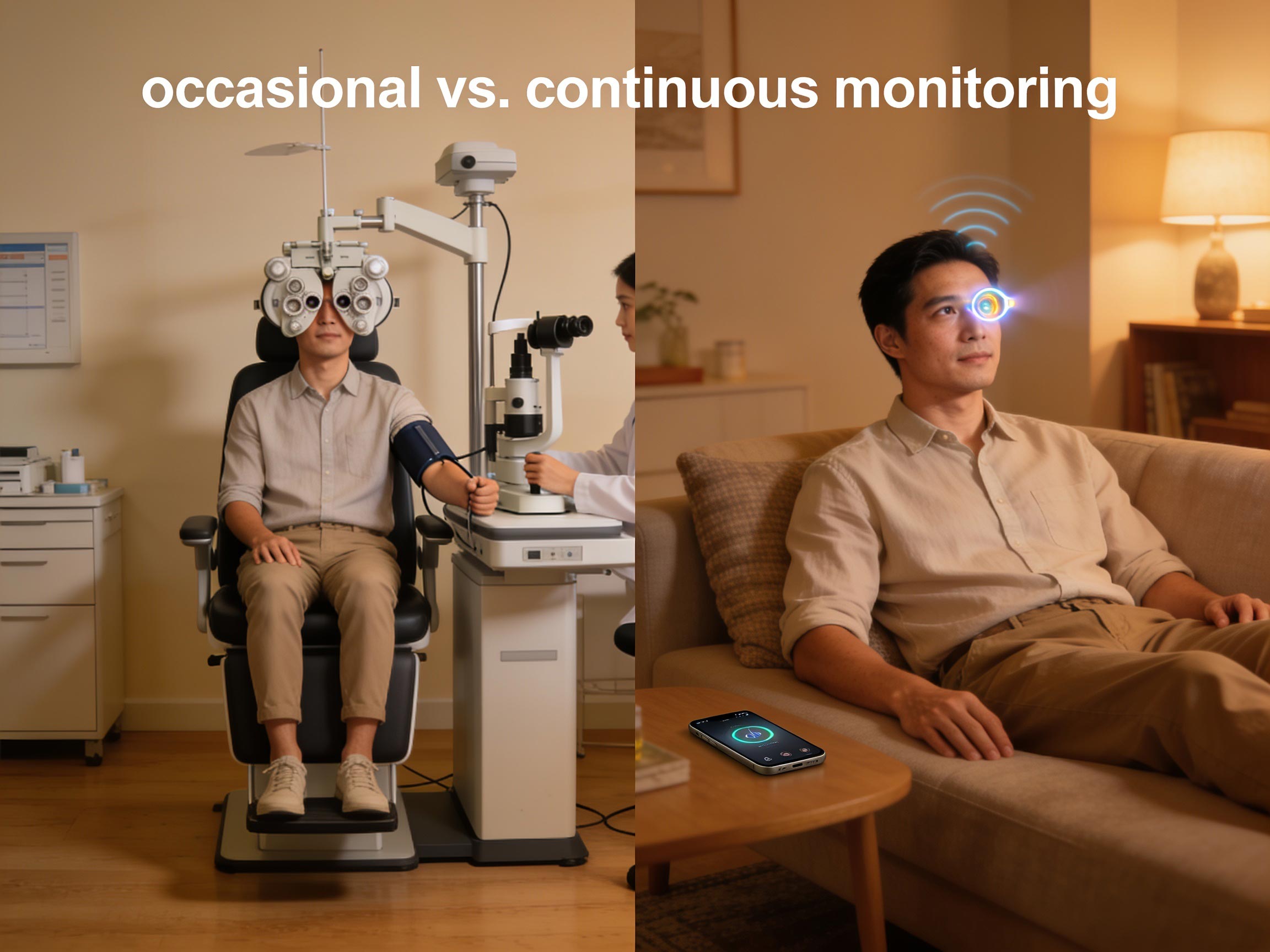
This is the application I find most clinically exciting from a practicing optometrist’s perspective, and it is also the one that is furthest along in terms of real-world use. Glaucoma is driven largely by elevated intraocular pressure – the pressure inside the eye – and the problem with how we currently monitor it is fundamental: we take a single measurement during a clinic visit, typically every three to six months, and we make treatment decisions based on that snapshot. But IOP fluctuates throughout the day. It can spike at night, during exercise, or in response to body position, and those fluctuations may not appear in a routine office measurement at all.
A device called the Sensimed Triggerfish already addresses this gap in a limited way. It is an FDA-cleared soft contact lens sensor worn for 24 hours that continuously records subtle changes in the curvature of the eye’s surface – a proxy for IOP changes – and transmits that data wirelessly to a recording device. It does not correct vision and is not designed for long-term wear, but it gives clinicians a continuous pressure profile that a single office measurement simply cannot provide. For patients with glaucoma that seems difficult to control, this kind of data can change treatment decisions significantly.
Research published in April 2026 in Science Translational Medicine described a next-generation approach – a “theranostic” smart lens that both monitors IOP and delivers anti-glaucoma medication on demand when pressure rises. The lens requires no battery, no electronics, and no external power because it uses the mechanical deformation of the lens itself – triggered by changes in eye pressure – to activate a microfluidic drug-release system. The medication releases precisely when and because pressure is elevated, without the patient needing to remember eye drops, and without the dosing imprecision that comes with instilling drops from a bottle. This is not yet available for patients, but it represents the direction this field is moving.
For anyone managing glaucoma at our Addison, Burbank, or Willowbrook locations, this is a technology I am watching closely. The connection between continuous IOP monitoring and better long-term vision outcomes in glaucoma patients is well established, and the prospect of combining that monitoring with automated drug delivery in a single comfortable lens is significant. You can read more about how we currently manage glaucoma and eye pressure at ECCLTD in our glaucoma awareness article.
Augmented Reality Lenses: Heads-Up Display on Your Eye
This is the category that captures the imagination most dramatically, and it is also the one with the longest road to everyday availability. Augmented reality smart contact lenses use microdisplays embedded in the lens to project digital information directly into the wearer’s field of vision – navigation prompts, notifications, real-time data, even interactive overlays tied to whatever the wearer is looking at. No phone screen, no glasses, no headset. Just the lens.
XPANCEO, a deep-tech company that made headlines at GITEX Global 2025 and again at MWC 2026, demonstrated working prototypes of several AR lens configurations, including an interactive AR lens that delivered context-aware visual information based on what the wearer was focusing on. Their most consumer-ready prototype combines a micro-OLED display with continuous glucose monitoring, attempting to address both health tracking and digital overlay in a single device. The company raised $250 million in a Series A that closed in mid-2025, the largest in AR/VR hardware history, and has a stated target of a consumer-ready prototype by 2027.
Mojo Vision, a California-based company, has been pursuing a similar path. Their lens incorporates the world’s smallest and densest micro-LED display, designed to sit precisely on the center of the cornea and render image data that the wearer perceives as floating in their field of view. Applications under development include:
- Navigation assistance for the visually impaired
- Sports performance overlays (speed, distance, heart rate)
- Real-time text and notification delivery without looking at a phone
- Context-aware information based on what the wearer is focused on
From a clinical standpoint, the questions I think about with AR lenses are less about the technology and more about the eye health implications of long-term wear of a device that is generating light and heat millimeters from the corneal surface. These are exactly the kinds of considerations that will be worked through in clinical trials, and they are exactly the reason why fitting and monitoring of any advanced lens technology will require an optometrist who understands not just the device but the eye it is sitting on.
Smart Lenses for Presbyopia: Autofocus Vision
Presbyopia is the age-related loss of the eye’s ability to shift focus between near and far distances – the reason most people over 45 eventually reach for reading glasses. It affects virtually everyone as they age, and it represents one of the largest unmet needs in vision correction. Current solutions – bifocal glasses, progressive lenses, multifocal contact lenses – all involve compromises. Smart contact lenses may eventually offer something those options cannot: genuine autofocus.
Researchers at the University of California San Diego and elsewhere have developed prototype lenses that use liquid crystal technology to change their focal power in response to an electrical signal. The signal is triggered by the eye’s own electrical activity – specifically the tiny electrooculographic signals generated when the eye attempts to shift its gaze from far to near. The lens detects that the eye is trying to focus close and adjusts its optics accordingly, within milliseconds, in a way that mimics what a young, healthy crystalline lens does naturally.
This technology is still in early research stages, but the concept is validated and the demand is enormous. Presbyopia affects an estimated 1.8 billion people globally, and a contact lens that genuinely restored dynamic focusing ability would represent one of the most significant quality-of-life improvements in the history of vision correction. For patients currently managing presbyopia with multifocal contacts or reading glasses at our Illinois locations, this is technology worth keeping an eye on.
Drug Delivery Lenses: Medication Without Eye Drops
Eye drops are notoriously inefficient. Studies estimate that less than 5% of a typical eye drop’s active medication actually reaches the intraocular target – the rest drains away through the tear ducts or absorbs into surrounding tissue. Adherence is a separate but equally significant problem:
- Patients frequently miss doses or instill drops incorrectly
- Many stop using medication when they feel better, regardless of whether the condition is controlled
- For chronic conditions like glaucoma, inconsistent adherence is one of the leading causes of disease progression
Drug-eluting contact lenses address both problems simultaneously. These lenses are infused with medication that releases slowly and continuously through the lens material directly onto the ocular surface, at a controlled rate, over hours or days. Because the drug is released from a surface that is already in contact with the eye rather than being dropped from a distance, bioavailability improves dramatically. Several groups have demonstrated drug-eluting lenses for glaucoma medications, antibiotics, and anti-inflammatory agents in research settings.
Latanoprost, one of the most commonly prescribed glaucoma medications, has been incorporated into contact lens materials in research models that demonstrated sustained release over a month of continuous wear. The combination of IOP monitoring and controlled latanoprost delivery in a single lens – the direction the theranostic research described above is heading – would represent a fundamentally different model of glaucoma management than anything currently available. For patients struggling with drop adherence, this direction in research is particularly meaningful.
What This Means for You Right Now
Most of what I have described above is not something you can walk into our office and receive a prescription for today. But here is what I want every patient to take away from this article: the foundation for smart lens technology is your relationship with a knowledgeable eye care provider, and that relationship starts now, not when these devices become commercially available.
Consider where you fall right now:
- Managing diabetes? Your eye doctor needs to be part of your care team already – not just for vision correction but because your eyes show signs of systemic disease before your other doctors may detect them.
- Elevated eye pressure or a family history of glaucoma? Continuous monitoring technology is developing specifically to address the gaps in your current care.
- In your mid-40s and noticing your near vision changing? The presbyopia correction landscape is about to become dramatically more sophisticated.
What we can do right now at The Eye Care Center LTD across our Addison, Burbank, and Willowbrook locations is make sure your baseline eye health is fully understood, your current prescriptions are optimized, and your risk factors are documented and monitored in a way that positions you to benefit from these technologies as they arrive. The patients who benefit most from medical advances are the ones whose doctors know them well before the advance becomes available.
If you are overdue for a comprehensive eye exam, or if you want to talk through how emerging technology intersects with a condition you are already managing, I would encourage you to schedule an appointment. This is a conversation I genuinely enjoy having, and it is one that has real implications for your long-term vision health.
Schedule Your Comprehensive Eye Exam
The future of eye care is moving fast. Make sure your eye health is in the best possible shape to benefit from it. Our doctors at The Eye Care Center LTD are accepting new patients at all three Illinois locations.
Book Online: Schedule Your Appointment
Call Us: 1-888-899-0816
Addison: 630-543-0607 | Burbank: 708-599-0050 | Willowbrook: 630-969-2807
Hours: Monday-Thursday 10am-6pm | Friday 10am-5pm | Saturday 9am-2pm
Frequently Asked Questions About Smart Contact Lenses
Are smart contact lenses available to buy right now?
Not for most consumers. The one device with FDA clearance for clinical use is the Sensimed Triggerfish, a 24-hour IOP monitoring lens for glaucoma management. AR, glucose monitoring, and autofocus lenses are still in research or prototype stages. Commercial availability for some applications is projected in the 2027-2029 timeframe, though regulatory timelines are difficult to predict precisely.
Will smart contact lenses require a prescription?
Yes. Any smart contact lens with medical applications – monitoring glucose, tracking eye pressure, delivering medication – will be classified as a medical device and require both FDA clearance and a prescription from a licensed eye care provider. Even AR lenses with vision correction built in will need professional fitting. Your relationship with your optometrist is central to accessing these technologies.
Are smart contact lenses safe to wear on the eye?
Current prototypes are designed with biocompatible materials and have been worn in clinical trials without significant adverse events. However, long-term safety data across large populations does not yet exist, which is a key part of what clinical trials are gathering. As with all contact lens wear, corneal oxygen transmission, fit, and hygiene will remain important considerations regardless of how sophisticated the embedded technology becomes.
Can smart lenses really monitor my blood sugar without a finger prick?
The science is valid – glucose in tear fluid does correlate with blood glucose levels, and sensors capable of detecting it have been demonstrated. The challenge is clinical accuracy. Blood glucose management requires precise readings, and achieving that level of accuracy consistently across the full physiological range has been the primary technical hurdle. No glucose-monitoring contact lens has received FDA clearance as of mid-2026.
How would smart lenses for glaucoma change my treatment?
Continuous IOP monitoring would give your eye doctor a far more complete picture of your pressure patterns than a periodic office measurement can provide. Pressure fluctuates throughout the day and night, and those fluctuations can be clinically significant even when your in-office reading looks normal. Research into lenses that also deliver glaucoma medication on demand when pressure rises could eventually reduce or eliminate the need for daily eye drops, improving adherence and outcomes.
What is the Sensimed Triggerfish, and can I get one?
The Sensimed Triggerfish is an FDA-cleared soft contact lens sensor that records continuous IOP fluctuations over a 24-hour period. It is not a vision-correcting lens and is worn only for that monitoring window, not as a regular contact lens. It is prescribed in clinical settings for patients with glaucoma that is difficult to characterize or manage with standard measurements. Ask your eye doctor whether a 24-hour pressure profile would be useful in your specific situation.
Could smart lenses fix my reading vision without glasses?
Autofocus smart lens technology, which uses liquid crystal elements triggered by the eye’s own electrical signals, has shown genuine promise in research settings. It is designed specifically to address presbyopia – age-related near vision loss – in a way that mimics the eye’s natural focusing mechanism. This is still in early research stages and not available commercially, but it is one of the applications many researchers and clinicians consider most likely to have a significant near-term consumer impact.
Will my eye doctor at The Eye Care Center LTD know how to fit smart lenses when they become available?
Yes. Smart lens fitting will build on existing contact lens expertise and add layers of technology management, data interpretation, and device integration. Our doctors stay current with emerging technologies in eye care, and as these devices move through clinical trials and toward regulatory approval, we will be positioned to offer them to appropriate patients. The foundation is a comprehensive understanding of your individual eye health, which starts with your exams today.
What eye conditions would benefit most from smart lens technology?
Based on current research trajectories, patients managing glaucoma, diabetes (particularly those with diabetic eye disease), and presbyopia stand to benefit the most from the earliest commercially available applications. People interested in AR applications represent a large consumer market separate from medical use cases. Dry eye patients may also benefit from drug-eluting lenses that deliver anti-inflammatory agents continuously rather than through the hit-or-miss delivery of eye drops.
Should I wait for smart lenses before scheduling an eye exam?
Absolutely not – and I would say this even if I were not an optometrist. Smart lens technology will benefit patients who already have a well-managed, well-documented eye health baseline. Conditions like glaucoma and diabetic retinopathy cause irreversible damage that accumulates while you are waiting. The best thing you can do for your long-term vision is get a comprehensive exam now, stay current with your care, and be positioned to take advantage of new technology as it becomes available. Waiting is the one thing that consistently makes outcomes worse.