
Every December, our phones get busy with the same question: “I still have money in my FSA. What can I use it for before it’s gone?” It is one of my favorite questions to answer, because the honest answer is that most people can put those dollars toward care they already need, like an updated prescription, a backup pair of glasses, or a full year of contact lenses.
The problem is timing. Flexible spending dollars and many vision insurance allowances are tied to the calendar, and the last few weeks of the year fill up fast. If you wait until the week before Christmas, you may find that appointments are booked and your glasses won’t be ready in time. This guide walks you through what each type of benefit covers, how the deadlines work, and how to make the most of what you have left.
FSA, HSA, and Vision Insurance: Which Ones Expire?
These three benefits often get lumped together, but they follow different rules. Knowing which one you have is the first step.
- FSA (Flexible Spending Account): Usually expires at the end of your plan year.
- HSA (Health Savings Account): Your balance rolls over year after year.
- Vision insurance: Exam and eyewear allowances typically reset with your plan year.
The FSA is the one with the real “use it or lose it” deadline. For 2026, the IRS allows employees to contribute up to $3,400 to a health FSA. Some employers let you carry over a limited amount of unused money into the next year, up to $680 for 2026 funds, while others offer a grace period of up to two and a half extra months to spend it instead. Some plans offer neither. Your plan can only offer one of these options, so a quick call to your benefits administrator or a look at your FSA portal will tell you exactly where you stand.
An HSA works differently. The money is yours, it stays in the account, and it can even be invested. There is no year-end rush to spend it, but it is still a smart, tax-advantaged way to pay for eye care you need now.
Vision insurance is the one people forget about most. Plans through VSP, EyeMed, Davis Vision, and others usually include an annual exam benefit plus an allowance for frames, lenses, or contact lenses. Many reset on January 1, while others run on a 12- or 24-month cycle. If you don’t use that allowance before it resets, it doesn’t carry forward. If you have questions about how your exam is billed, our guide to medical vs. vision insurance for eye exams explains the difference.
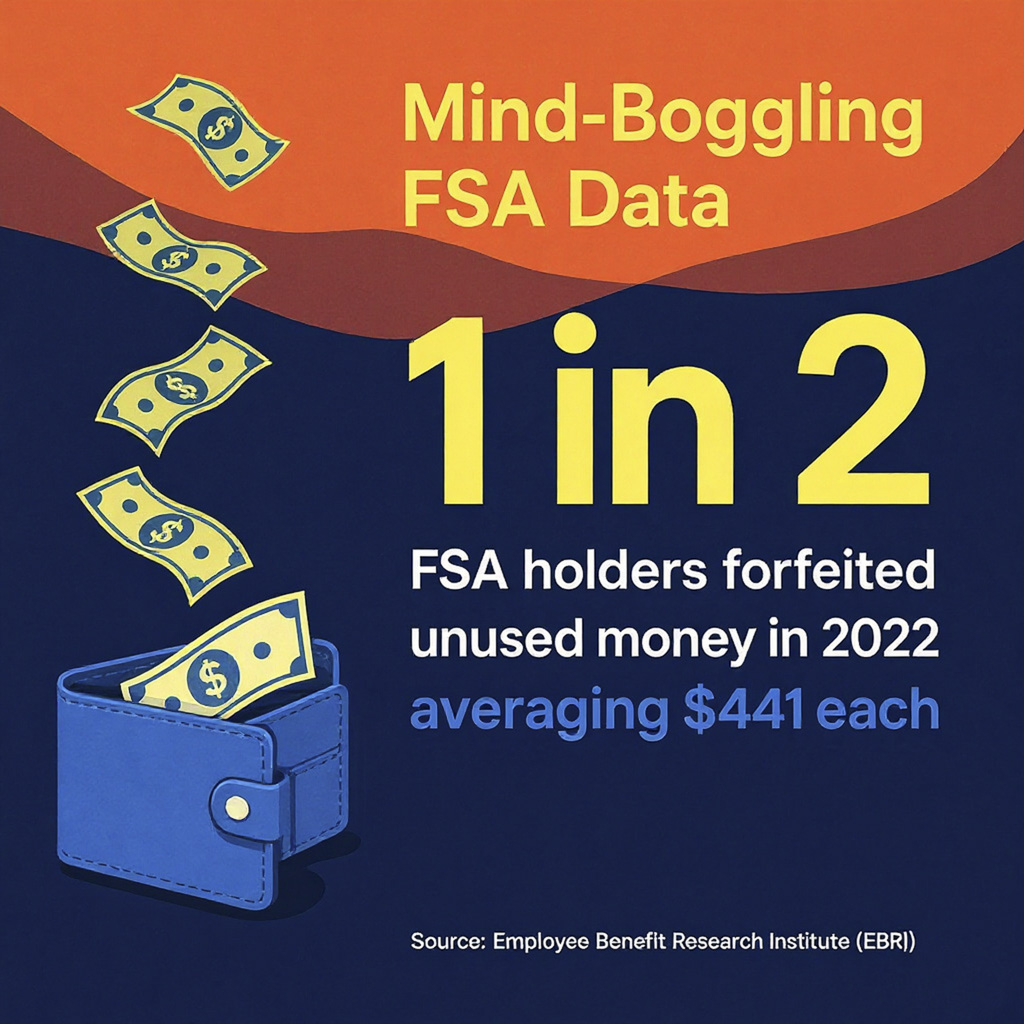
That number surprises a lot of my patients. According to research from the Employee Benefit Research Institute, about half of FSA account holders forfeited money in 2022, losing an average of $441 each. That is money people set aside from their own paychecks for health care and never got back. For most families, eye care is one of the easiest and most useful ways to make sure that doesn’t happen.
What Your FSA or HSA Can Pay For at Our Office
The IRS treats a wide range of eye care as an eligible medical expense. Under IRS Publication 502, the following are generally covered:
- Comprehensive eye exams: Including copays and any portion your insurance doesn’t cover.
- Prescription eyeglasses: Frames and lenses, including upgrades like anti-reflective coating.
- Prescription sunglasses: A practical second pair for driving and winter glare.
- Contact lenses: Including an annual supply and contact lens solution.
- Contact lens exams and fittings: Including refits for lenses that don’t feel right.
- Medical eye visits: Deductibles and copays for dry eye, infections, and other conditions.
- Laser vision correction: LASIK and related pre- and post-operative care.
Your FSA and HSA also cover your spouse and dependents, so a child’s eye exam or a teenager’s first pair of contacts counts, too. If you’re not sure whether a specific item qualifies, our front desk team can give you an itemized receipt for your FSA administrator, and we’re happy to help you sort it out.
A Simple Year-End Checklist
Here is the plan I recommend to patients who still have benefits to use. The earlier you start, the more options you have.
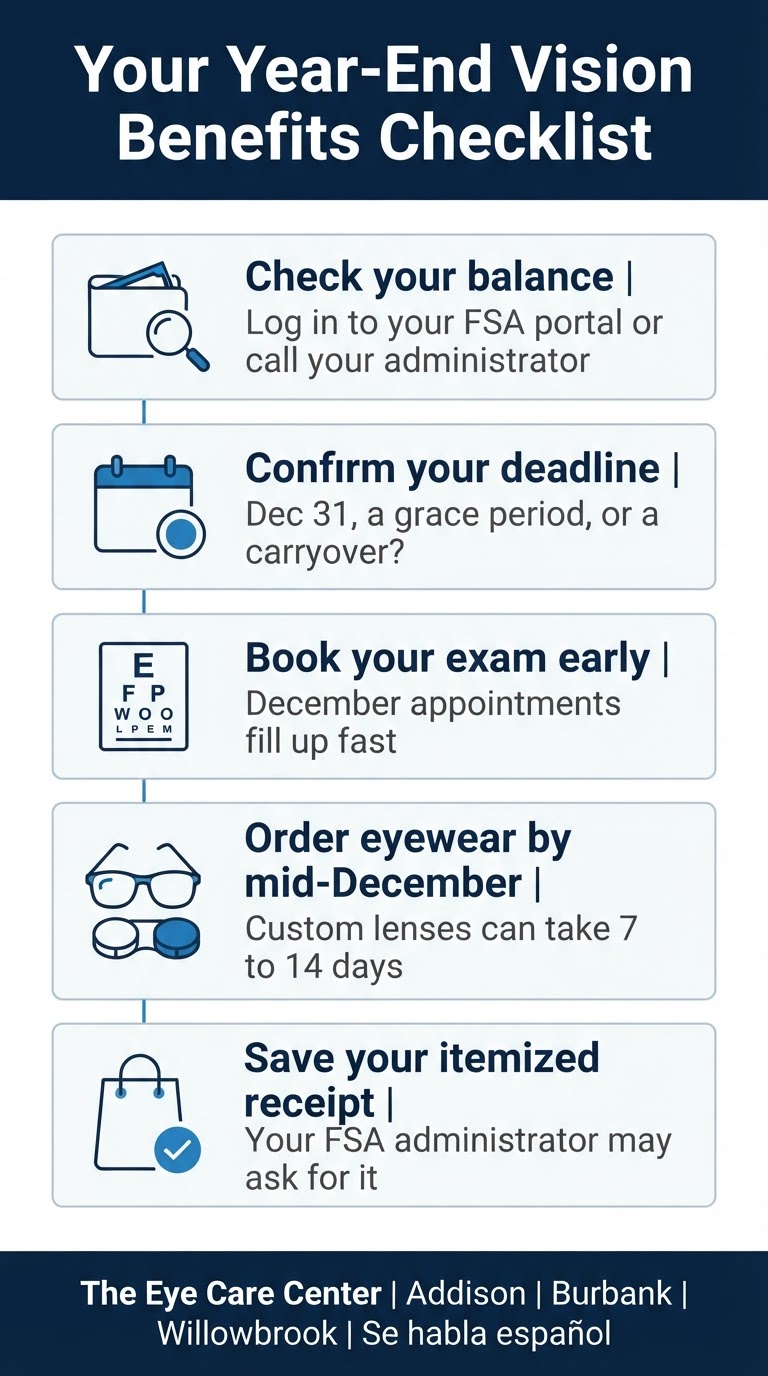
- Check your balance: Log in to your FSA portal or call your benefits administrator.
- Confirm your deadline: Find out whether your plan ends December 31 or offers a grace period or carryover.
- Book your exam early: November and early December give you the most appointment choices.
- Order eyewear by mid-December: Custom prescription lenses can take one to two weeks.
- Save your itemized receipt: Your FSA administrator may ask for it to approve the expense.
Timing matters more than most people realize. FSA rules are generally based on when you receive the care or the product, not when you book it, so an appointment scheduled for January won’t count toward this year’s balance. The same goes for eyewear: ordering early gives our lab time to finish your lenses and gives you time to come back for adjustments before the year closes out.
Smart Ways to Use What’s Left
If you’ve already had your annual exam this year and still have money left over, you have more options than you might think. These are the ones I see patients appreciate most:
- A backup pair of glasses: Peace of mind if your everyday pair breaks or goes missing.
- Prescription sunglasses: Real relief from low winter sun and snow glare on Chicago roads.
- Computer or office lenses: Designed for the distances you actually use at a desk.
- An annual contact lens supply: Stock up now and skip reordering all year.
- Your child’s eye exam: Catch vision changes before the second semester starts.
- A dry eye evaluation: Get ahead of the dry, heated indoor air of a Chicago winter.
A backup pair is the one I recommend most often, especially for patients who rely on their glasses all day. Losing or breaking your only pair usually happens at the worst possible time, and having a spare means you’re never stuck. Prescription sunglasses are a close second here in Chicagoland, where the low winter sun reflecting off snow and wet pavement can make driving uncomfortable. If you spend much of your day at a computer, a dedicated pair of computer lenses can make long workdays more comfortable.
For parents, a year-end visit is also a good time to check in on your child’s vision before the second half of the school year. Kids rarely complain about blurry vision because they don’t know anything different, and nearsightedness in particular can progress quickly during growth spurts. Our Little Eyes, Big Smiles program is built specifically for children’s eye care.
And if your contact lenses have felt dry or uncomfortable lately, this is a good time to address it. Our article on why contact lenses feel uncomfortable covers common causes, and a refit or a different lens material is often a simple fix.
Don’t Wait Until the Last Week of December
Every year, the final two weeks of December are our busiest. Patients who call on December 22 hoping to get an exam and new glasses before the 31st sometimes find that the timing simply doesn’t work, either because appointments are full or because their lenses can’t be finished in time. Booking in November or the first half of December takes the stress out of it.
We have three convenient locations in Addison, Burbank, and Willowbrook, with Saturday morning hours for patients who can’t get away during the week. When you call, let us know you’re using FSA, HSA, or vision insurance benefits, and our team will help you understand your coverage before your visit. Se habla español.
Use Your Benefits Before They Reset
Book your eye exam or eyewear visit at The Eye Care Center today. We accept most major vision plans and FSA and HSA cards, and our team will help you make the most of what you have left. Se habla español.
Addison: 1250 W Lake St #19c | (630) 543-0607
Burbank: 8525 S Harlem Ave | (708) 599-0050
Willowbrook: 6300 Kingery Hwy #116 | (630) 969-2807
Frequently Asked Questions
Can I use my FSA to buy prescription glasses?
Yes. Prescription eyeglasses, including frames, lenses, and lens upgrades like anti-reflective coating, are generally FSA- and HSA-eligible. Prescription sunglasses and contact lenses qualify as well. Keep your itemized receipt in case your administrator asks for it.
Does my HSA money expire at the end of the year?
No. Unlike an FSA, your HSA balance rolls over from year to year and stays with you even if you change jobs. There’s no deadline to spend it, but it’s still a tax-advantaged way to pay for the eye care you need.
What happens if my FSA has a grace period or carryover?
Some employers let you carry over a limited amount of unused FSA money into the next year (up to $680 for 2026 funds), while others give you a grace period of up to two and a half months to spend it. A plan can offer one or the other, or neither. Check with your benefits administrator to confirm your exact deadline.
Can I use this year’s FSA to buy a full year of contact lenses?
Generally, yes. An annual supply of contact lenses purchased before your deadline is an eligible expense. You’ll need a current contact lens prescription, so if your last contact lens exam was more than a year ago, plan to schedule one first.
Can I use my FSA or HSA for my children’s eye care?
Yes. FSA and HSA funds can typically be used for your spouse and dependents, including your children’s eye exams, glasses, and contact lenses.