
You sit down for your eye exam, read the letters, answer “one or two?” a dozen times, and then your optometrist says the word: astigmatism. For a lot of patients, that moment brings a small wave of worry. It sounds technical, maybe even serious, and most people leave the office without a clear picture of what it actually means for their eyes.
Here is the reassuring truth. Astigmatism is not an eye disease, and it is one of the most common findings we see at The Eye Care Center. It simply describes the shape of your eye and how it focuses light. In this guide, we will explain what astigmatism is in plain language, the signs to watch for, what causes it, and the many easy ways to correct it so you can see clearly and comfortably.
In this article:
What Is Astigmatism, in Plain Language?
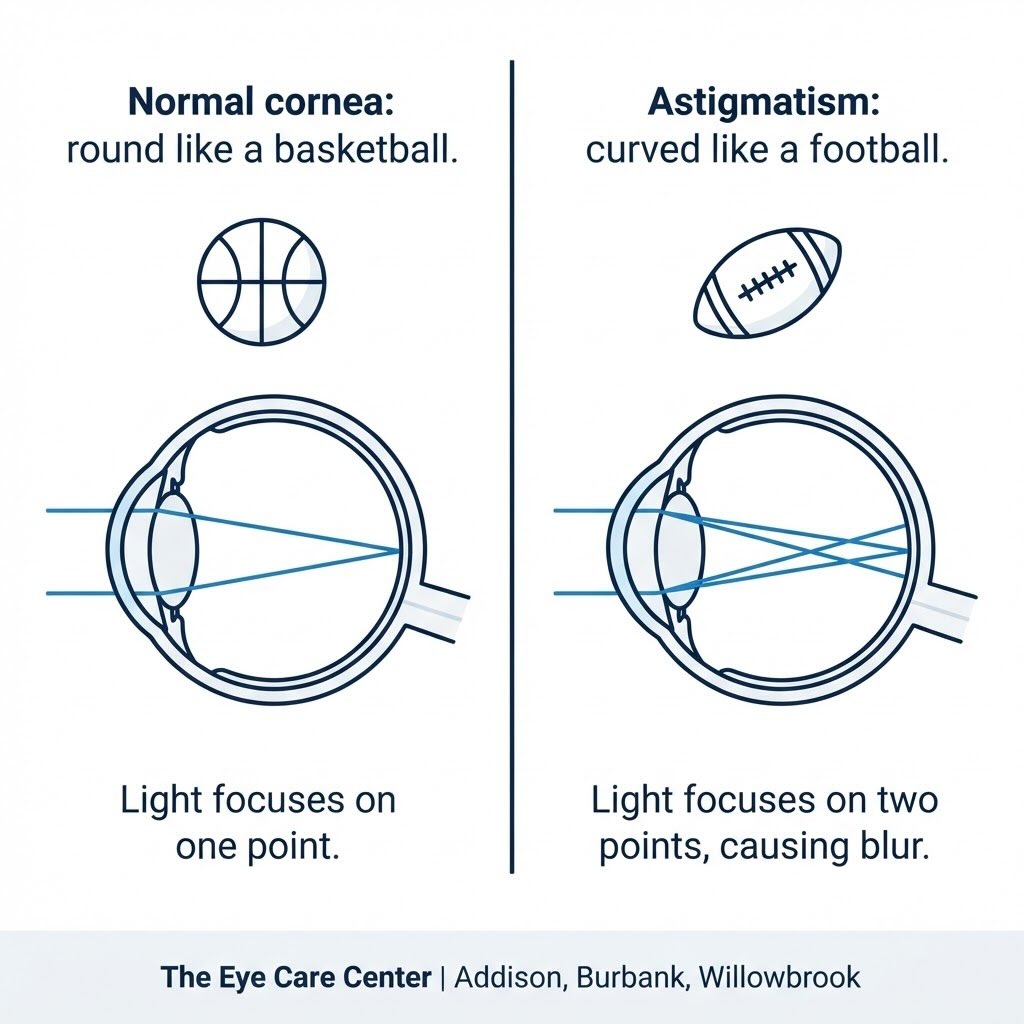
To see clearly, light entering your eye needs to come to a single, sharp focus on the retina at the back of the eye. Two structures do most of that focusing: the cornea (the clear front window of the eye) and the lens just behind it.
In an eye without astigmatism, the cornea is curved evenly in every direction, a bit like a basketball. With astigmatism, the cornea or lens is curved more steeply in one direction than the other, closer to the shape of a football or the back of a spoon. Because of that uneven curve, light focuses at two different points instead of one. The result is vision that can look blurry, stretched, or slightly doubled at any distance, both near and far.
Astigmatism often appears alongside nearsightedness or farsightedness. All three are called refractive errors, which simply means the eye bends light a little differently than ideal. None of them mean your eyes are unhealthy.
How Common Is Astigmatism?
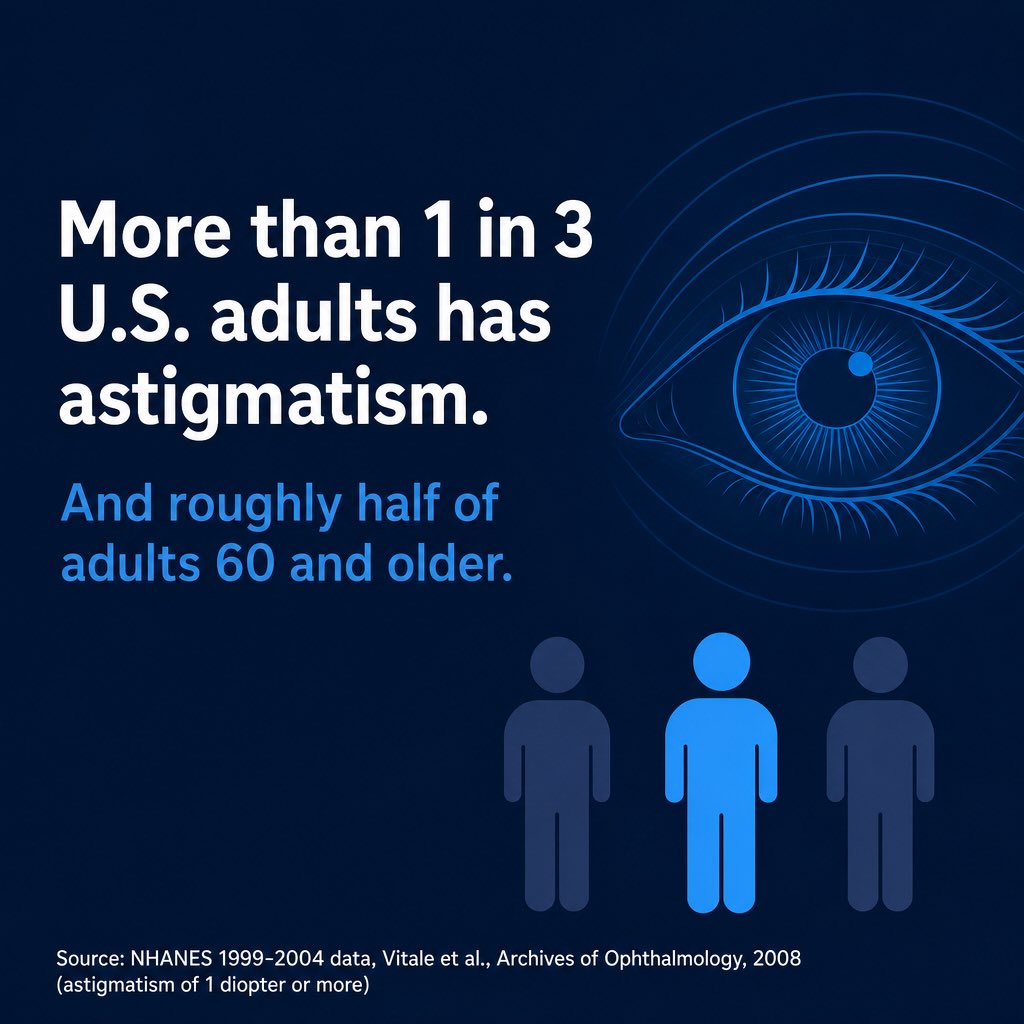
If you have just been diagnosed, you are in very good company. An analysis of national U.S. health survey data published in Archives of Ophthalmology found that about 36 percent of adults age 20 and older have astigmatism of at least one diopter, and the rate climbs to roughly half of adults age 60 and older. A large global review in the Journal of Current Ophthalmology went further, identifying astigmatism as the most common refractive error in both children and adults worldwide.
Many people have a small amount of astigmatism that never causes noticeable symptoms and needs no correction at all. Others have enough that glasses or contacts make a dramatic difference in sharpness and comfort.
Signs and Symptoms of Astigmatism
Mild astigmatism can go unnoticed for years, especially because the brain is very good at adapting. These are the signs we hear about most often:
- Blurry or distorted vision: at distance, up close, or both.
- Eye strain: tired, achy eyes after reading or screen time.
- Headaches: often around the brow or temples late in the day.
- Squinting: a habit of narrowing the eyes to sharpen focus.
- Trouble driving at night: glare, halos, or starbursts around lights.
Night driving complaints are especially common because your pupils open wider in the dark, letting in more light through the unevenly curved parts of the eye. Many patients tell us headlights and streetlights look “streaky,” which is a classic clue.
Children rarely complain, because they assume everyone sees the way they do. Instead, you might notice a child tilting their head, sitting very close to the TV, rubbing their eyes, or losing interest in reading. Uncorrected astigmatism in young children can interfere with normal visual development and, in some cases, contribute to amblyopia (lazy eye), which is why we recommend comprehensive exams for kids rather than relying on a school screening alone. Our back-to-school eye exam checklist covers more signs to watch for.
What Causes Astigmatism?
Most astigmatism is simply the way someone’s eyes are shaped, and it is often present from birth. It tends to run in families, so if a parent wears glasses for astigmatism, there is a good chance a child will too. Contrary to a common myth, reading in dim light or sitting close to a screen does not cause astigmatism.
Astigmatism can also develop or change later in life. The amount of astigmatism and its orientation naturally shift with age, which is part of why the condition becomes more common after 60. An eye injury, scarring on the cornea, or certain eye surgeries can also change the eye’s shape.
In a smaller number of people, astigmatism that keeps increasing quickly may signal keratoconus, a condition where the cornea gradually thins and bulges into a cone shape. Keratoconus usually shows up in the teens or twenties. It is one more reason regular comprehensive exams matter: catching unusual changes early opens up treatment options that can help protect vision.
How Astigmatism Is Diagnosed
Astigmatism is diagnosed during a comprehensive eye exam, not a basic vision screening. Reading an eye chart can tell us that something is blurry, but it cannot tell us why. During your visit, your optometrist may use several tools to measure exactly how your eye focuses light.
A refraction (the familiar “which is clearer, one or two?” test) fine-tunes your prescription. Keratometry and corneal topography map the curve of your cornea, sometimes creating a detailed color map of its surface. That map is especially helpful for fitting specialty contact lenses and for spotting early signs of keratoconus. On your prescription, astigmatism shows up in the “cylinder” (CYL) and “axis” columns, which describe how much astigmatism you have and in which direction.
Curious what else gets checked? Our guide to what a comprehensive eye exam actually checks walks through the full visit.
Your Options for Correcting Astigmatism
The good news: astigmatism is very treatable, and today’s options are better than ever. The right choice depends on how much astigmatism you have, your lifestyle, and your comfort preferences.
- Eyeglasses: the simplest, most reliable fix for most patients.
- Toric soft contacts: lenses designed to stay aligned on the eye.
- Rigid and scleral lenses: crisp vision for higher or irregular astigmatism.
- LASIK and SMILE: surgical options for qualified adult candidates.
- No correction: often fine when astigmatism is mild and symptom-free.
Glasses correct astigmatism with a lens ground to counteract the uneven curve of your eye. Some patients notice a short adjustment period with a new prescription, where floors seem slightly tilted or edges look curved. That usually settles within a week or two.
If you were told years ago that you “can’t wear contacts” because of astigmatism, that is rarely true today. Toric soft lenses are weighted or shaped so they stay in the correct orientation when you blink, and they come in daily disposable options. If your lenses feel blurry or uncomfortable, our article on why contact lenses feel uncomfortable can help. For higher amounts of astigmatism, or irregular astigmatism from keratoconus or corneal scarring, rigid gas permeable or scleral lenses create a smooth new optical surface over the cornea and can provide remarkably sharp vision.
For adults who want freedom from glasses and contacts, laser vision correction such as LASIK or SMILE can correct many types of astigmatism. The Eye Care Center co-manages these procedures, meaning we evaluate whether you are a good candidate, coordinate with a trusted surgeon, and provide your before and after care close to home. And if you are over 40 and also noticing trouble reading up close, astigmatism and presbyopia often go hand in hand. Our guide to presbyopia and your options explains how both can be addressed together.
Blurry vision, headaches, or glare at night? Let’s find out if astigmatism is the reason.
A comprehensive eye exam can pinpoint exactly how your eyes focus and which correction fits your life best. Visit any of our three Chicagoland locations in Addison, Burbank, or Willowbrook. Se habla espanol.
Book online: Request an appointment
Call us: 1-888-899-0816
Addison: 1250 W Lake St #19c, (630) 543-0607
Burbank: 8525 S Harlem Ave, (708) 599-0050
Willowbrook: 6300 Kingery Hwy #116, (630) 969-2807
Hours: Mon to Thu 10am to 6pm, Fri 10am to 5pm, Sat 9am to 2pm
Frequently Asked Questions
Is astigmatism a serious eye condition?
No. Astigmatism is a common refractive error, not an eye disease. It describes how your eye focuses light and is easily corrected with glasses, contact lenses, or in some cases refractive surgery. Rapidly increasing astigmatism should be evaluated, since it can occasionally signal keratoconus.
Can astigmatism get worse over time?
Astigmatism often stays fairly stable for years, but it can change gradually with age, and it becomes more common after 60. Injury, corneal scarring, or keratoconus can also change it. Regular comprehensive eye exams keep your prescription accurate and catch unusual changes early.
Can I wear contact lenses if I have astigmatism?
Yes, in most cases. Toric soft contact lenses are designed specifically for astigmatism and stay aligned on the eye. For higher or irregular astigmatism, rigid gas permeable or scleral lenses can provide very sharp vision. Your optometrist can recommend the best fit.
Does astigmatism go away on its own?
Astigmatism does not usually go away on its own, because it comes from the shape of the cornea or lens. Mild astigmatism may never need correction, while glasses, contacts, or laser vision correction can fully correct more noticeable cases.
Can LASIK fix astigmatism?
Many people with astigmatism are good candidates for LASIK or SMILE. The Eye Care Center co-manages these procedures, evaluating your candidacy, coordinating with a trusted surgeon, and providing your pre- and post-operative care at one of our Chicagoland locations.