It happens to a lot of families. Your child gets their first pair of glasses, the board at school looks sharp again, and everyone moves on. Then, at the next visit, the prescription has gone up. A year later, it goes up again. Before long you are wondering whether this is just how kids’ eyes work, or whether something should be done about it.
A nearsighted prescription that climbs year after year is common, but it is not something you simply have to wait out. Eye doctors call this myopia progression, and knowing why it happens, what it can mean for your child’s eye health later in life, and when to step in can make a real difference. Here is what Chicagoland parents should know.

In this article
What Myopia Progression Actually Means
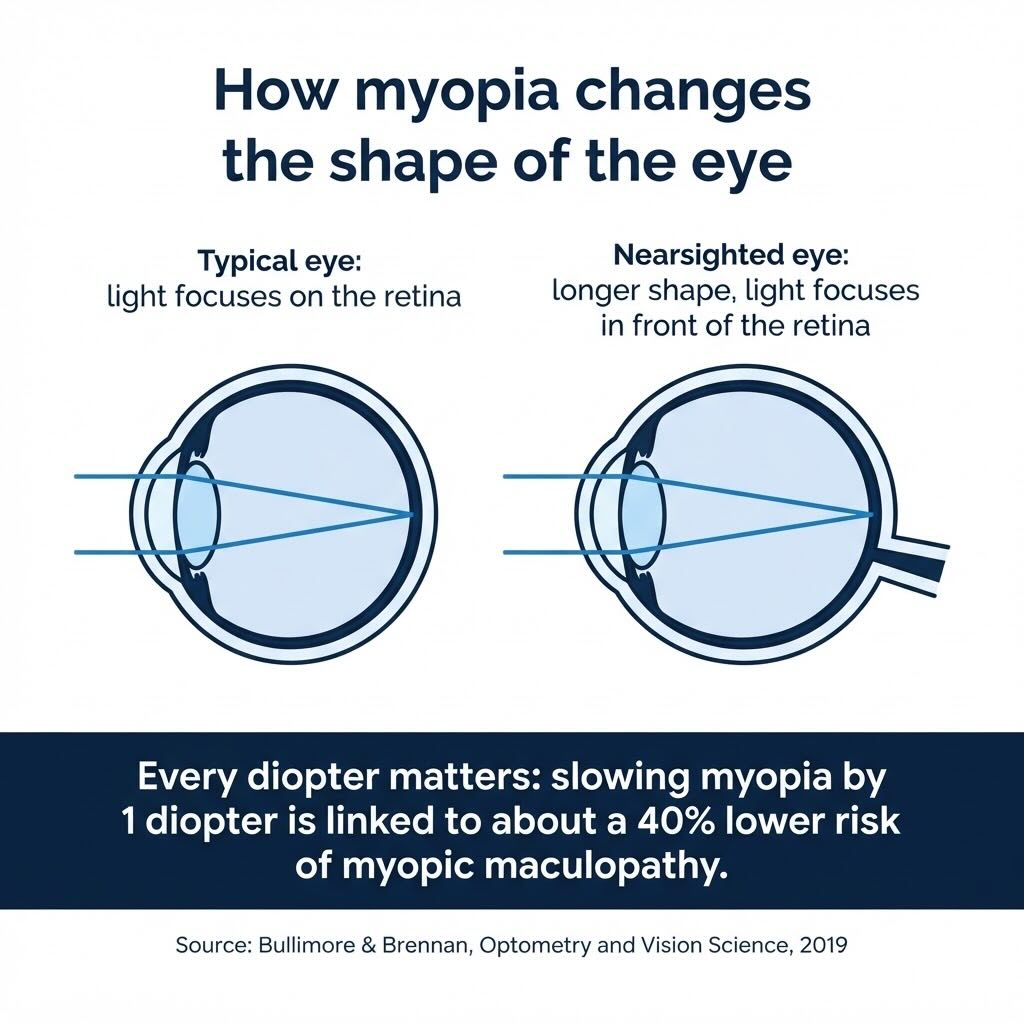
Myopia, or nearsightedness, means faraway things look blurry while things up close stay clear. In most children it happens because the eyeball grows a little too long from front to back. When that happens, light focuses just in front of the retina instead of directly on it, and distant objects lose their sharpness.
Progression simply means the eye keeps lengthening, so the prescription has to keep increasing to compensate. Prescriptions are measured in diopters and written as a minus number for nearsightedness, such as -1.00 or -2.50. The larger the minus number, the more nearsighted your child is. In childhood, myopia tends to increase fastest in younger kids and usually slows down in the mid to late teens, though for some people it continues into early adulthood. Those growing years are the window where paying attention matters most.
Why Your Child’s Prescription Keeps Climbing
There is rarely one single cause. Myopia progression is usually a mix of growth, genetics, and daily habits working together.
Growth is the starting point. Children’s eyes grow along with the rest of their bodies, and in a nearsighted child that growth tends to stretch the eye further in the wrong direction. Genetics play a role too. Kids with one or both nearsighted parents are more likely to become nearsighted themselves, which is worth mentioning at your child’s appointment.
Lifestyle matters as well. Researchers believe that time spent outdoors in natural daylight helps protect against myopia, while long stretches of close-up focus may add to the risk. In a large randomized trial in Guangzhou, China, published in JAMA in 2015, adding about 40 minutes of outdoor activity to the school day lowered the number of children who became nearsighted over three years. Today’s kids spend more time indoors and on screens than any generation before them, and the numbers reflect it. In the United States, the share of people with myopia rose from about 25 percent in the early 1970s to roughly 42 percent by the early 2000s, according to a National Eye Institute study published in Archives of Ophthalmology in 2009.
Finally, age of onset is one of the biggest clues. A child who becomes nearsighted at age 6 has many more years of eye growth ahead than a child who first needs glasses at 14. Research consistently links an earlier start with a higher prescription by adulthood.
Why It Matters for More Than Thicker Lenses
It is natural to think of a stronger prescription as an inconvenience: thicker lenses, more expensive glasses, and a child who cannot find anything without them. But the bigger concern is what happens inside the eye. As the eye lengthens, the retina and the tissues at the back of the eye are stretched thinner.
That is why high myopia, generally a prescription of about -5.00 to -6.00 or more depending on the definition used, is linked to a higher lifetime risk of serious eye conditions, including retinal detachment, glaucoma, early cataracts, and myopic maculopathy, a type of damage to the central retina that can cause permanent vision loss.
The encouraging part is that every bit of progression you prevent counts. A 2019 analysis by Bullimore and Brennan in Optometry and Vision Science pulled data from five large population studies covering about 21,000 people. It found that each additional diopter of myopia was associated with a 67 percent higher rate of myopic maculopathy. Put the other way, slowing a child’s myopia by just one diopter could lower that risk by about 40 percent. These are population-level estimates rather than a promise for any one child, but they show why waiting and watching is not the only option.
Signs Your Child’s Myopia May Be Progressing
Kids rarely announce that their vision has gotten worse. They tend to adapt, so it helps to know what to watch for.
- Squinting again: distance blur is creeping back.
- Sitting closer: to the TV, the board, or a screen.
- Headaches or tired eyes: often after school.
- Yearly prescription jumps: the eye is still lengthening.
- Glasses at a young age: more growing years ahead.
Squinting is a child’s way of sharpening blurry vision, so if you notice it while your child is already wearing glasses, the current prescription may no longer be strong enough. The same goes for scooting closer to the TV or asking to move to the front of the classroom. Headaches and eye fatigue at the end of the day can come from straining to see clearly for hours at a time.
The prescription history itself is one of the most useful signs. Many eye doctors view an increase of about half a diopter or more in a year as a sign of faster progression that deserves a closer look. And if your child needed glasses before about age 10, it is worth asking about a plan to monitor and manage their myopia, since they likely have many years of eye growth still ahead.
When to Act, and Why a Full Exam Matters
The best time to act is early, ideally as soon as you see the prescription changing from one year to the next. A school vision screening is a helpful first check, but it only tells you whether your child can read a chart across the room. It does not look at eye health, focusing, or how quickly the eye is changing over time.
A comprehensive eye exam goes further. Your child’s optometrist checks the prescription carefully, evaluates how the eyes focus and work together, examines the health of the eye, and compares results to past visits to see how fast things are moving. For children at higher risk, this is where a conversation about myopia management begins.
At The Eye Care Center, our in-house Little Eyes, Big Smiles myopia management program is built for exactly this situation. Rather than simply updating glasses each year, we look at ways to help slow the progression itself. Options can include specially designed glasses, contact lenses, and prescription eye drops, and the right choice depends on your child’s age, prescription, habits, and comfort. We will cover how those options compare in an upcoming article in this series.
Everyday Habits That Support Healthy Eyes
Habits at home will not replace an eye exam, but they can support your child’s eye health between visits. Encourage time outside in daylight whenever possible, and build regular breaks into homework and screen time. A simple version is the 20-20-20 rule: every 20 minutes, look at something about 20 feet away for 20 seconds. Good lighting and holding books and devices at a comfortable distance help too.
Chicago winters make outdoor time harder, so plan for it. A bundled-up walk after school before the sun sets, a weekend afternoon at the park, or sledding instead of a movie all count. Even short stretches of daylight add up over a season.
Is your child’s prescription going up every year? Let’s take a closer look.
Book a comprehensive pediatric eye exam at any of our three Chicagoland locations in Addison, Burbank, or Willowbrook, and ask us about our Little Eyes, Big Smiles myopia management program. Se habla espanol.
Book online: Request an appointment
Call us: 1-888-899-0816
Addison: 1250 W Lake St #19c, (630) 543-0607
Burbank: 8525 S Harlem Ave, (708) 599-0050
Willowbrook: 6300 Kingery Hwy #116, (630) 969-2807
Hours: Mon to Thu 10am to 6pm, Fri 10am to 5pm, Sat 9am to 2pm
Frequently Asked Questions
At what age does nearsightedness stop getting worse?
For most children, myopia progresses fastest at younger ages and slows down in the mid to late teens. It varies from child to child, though, and some people continue to see changes into their early twenties. Regular eye exams are the best way to know where your child stands.
Is it normal for my child’s glasses prescription to go up every year?
It is common, but a prescription that rises every year means the eye is still lengthening. That is a good reason to talk with your eye doctor about myopia management rather than simply updating glasses each year.
Can wearing glasses make my child’s myopia worse?
No. Regular glasses help your child see clearly, and there is no good evidence that wearing the correct prescription makes myopia worse. Deliberately using weaker glasses is not recommended, because research has not shown that it slows progression.
Can myopia progression be slowed?
Yes. Several approaches, including specially designed glasses, contact lenses, and prescription eye drops, have been studied for slowing myopia in children. The best option depends on your child’s age, prescription, and lifestyle, so it is worth discussing with an optometrist who offers myopia management.
How often should a nearsighted child have an eye exam?
At least once a year, or more often if your optometrist recommends it. Children with progressing myopia, or those in a myopia management program, may need more frequent visits to track changes.