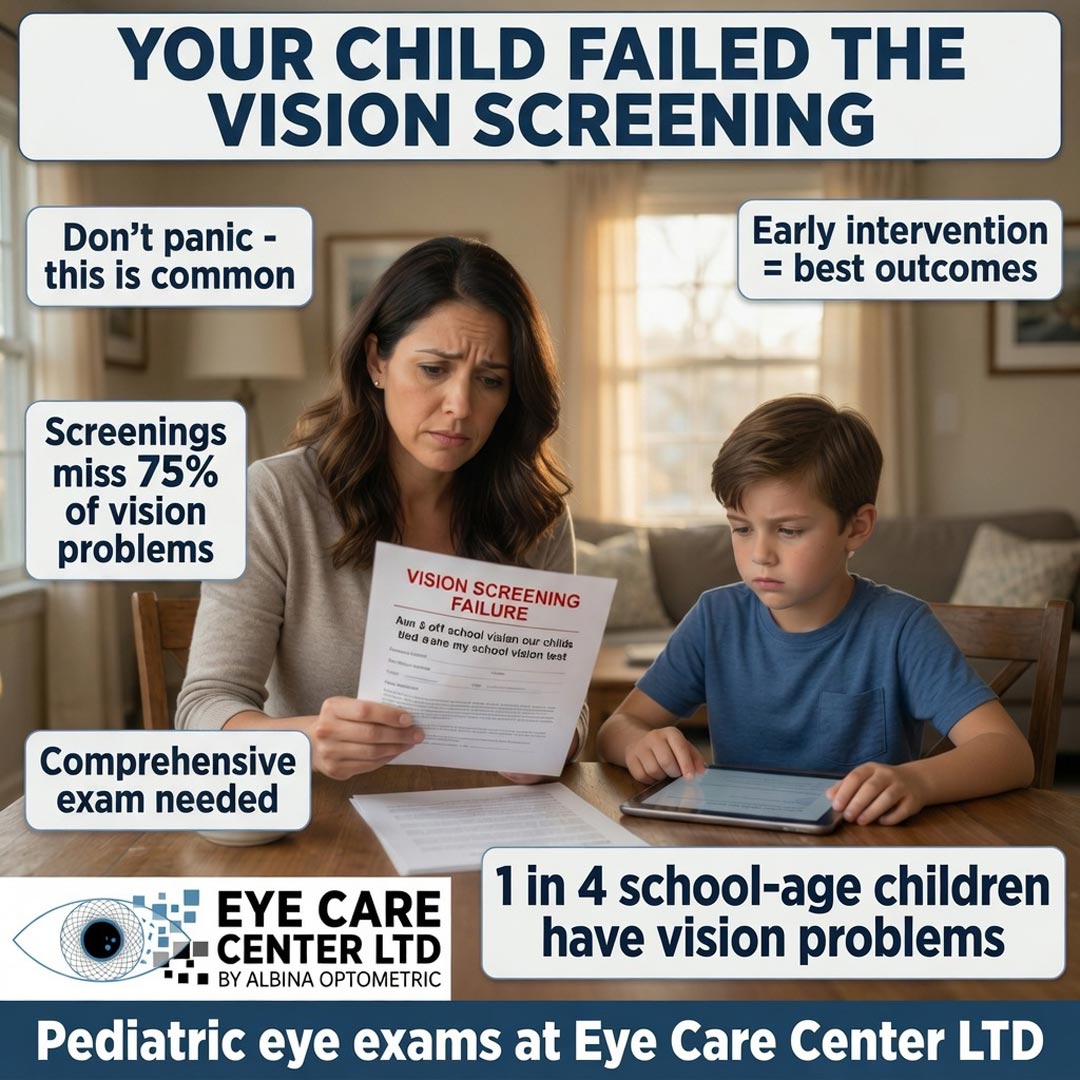
Your Child Failed the School Vision Screening. Now What? A Parent’s Complete Guide
The note came home in your child’s backpack: “Your child did not pass the vision screening. Please schedule a comprehensive eye exam with an eye care professional.”
Your stomach drops. Questions flood in: Is it serious? Do they need glasses? How could I not have noticed? Are they struggling in school because of this? What if it’s something worse than just needing glasses?
Take a breath. Here’s what I tell every parent who calls Eye Care Center after their child fails a school vision screening: this is extremely common, it’s almost always fixable, and you’re doing exactly the right thing by following up.
As an optometrist who has examined thousands of children referred after failed vision screenings at our Addison, Burbank, and Willowbrook offices, I can walk you through exactly what this means, what happens next, and why acting quickly matters for your child’s success in school and in life.
A child can read the 20/20 line on a school vision chart – and still have a vision problem severe enough to cause reading failure, chronic headaches, and years of academic frustration. That’s because school screenings test only one of the 17 distinct visual skills children need to learn effectively in a classroom.
First: Don’t Panic (But Do Act Quickly)
Why This Is Common
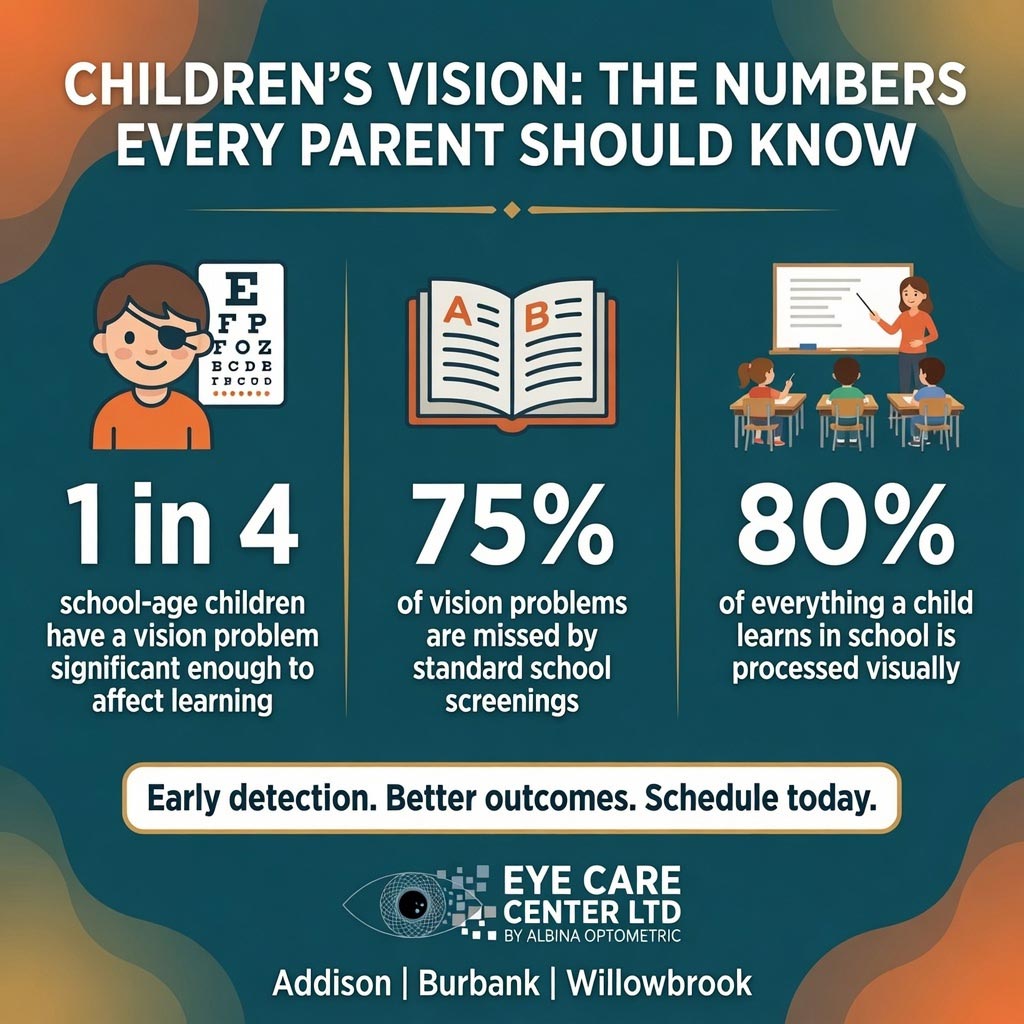
According to the American Optometric Association, approximately 1 in 4 school-age children have vision problems significant enough to impact learning. Of these, about 80% are correctable with glasses or contact lenses, many have gone undetected because children simply don’t know what “normal” vision looks like, and the vast majority turn out to be straightforward refractive errors – nearsightedness, farsightedness, or astigmatism. Serious eye diseases are rare in children, though we always check for them.
In my experience, the most common scenario is this: your child needs glasses, didn’t realize they were struggling to see, and will experience an immediate improvement in school performance once their vision is corrected.
Why You Shouldn’t Wait
While most findings aren’t urgent medical emergencies, undetected vision problems significantly impact learning from day one:
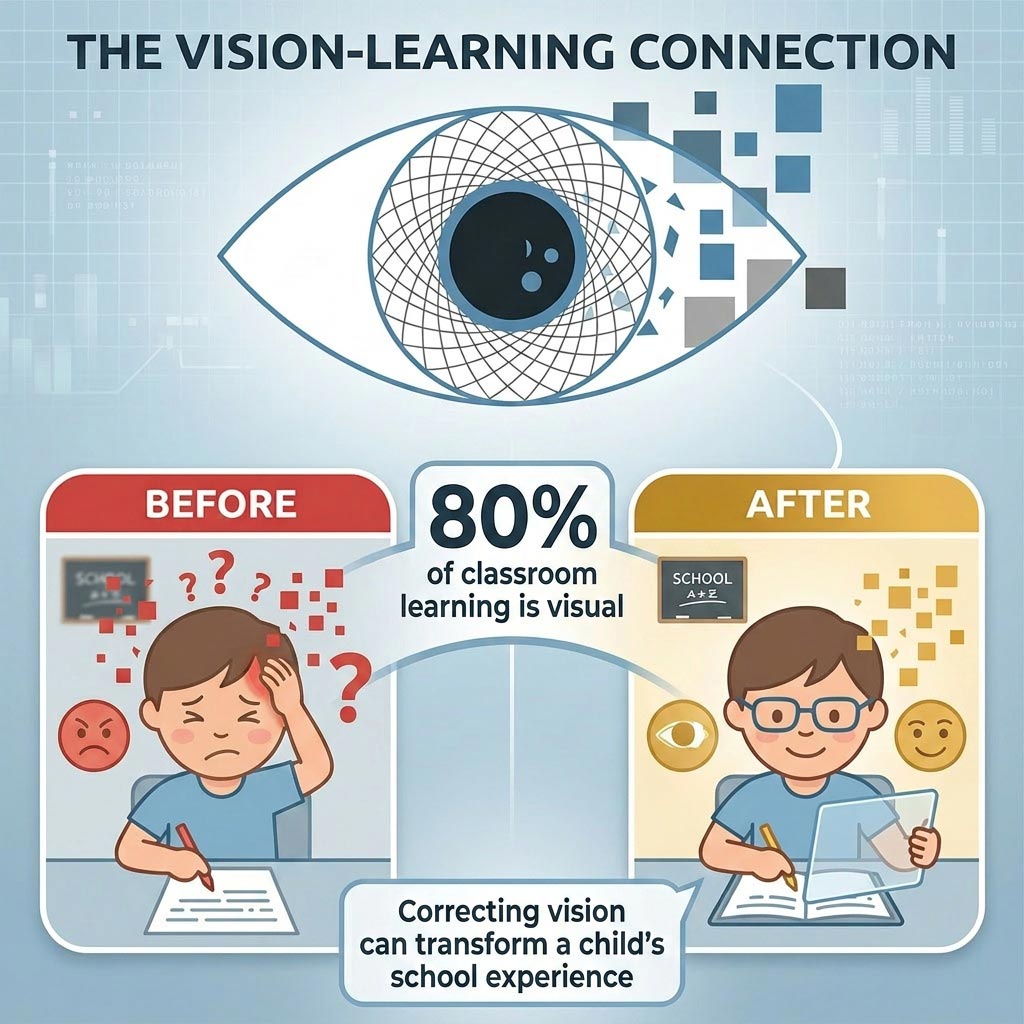
- 80% of learning is visual in elementary school
- Children struggling to see the board fall behind peers quickly
- Undetected vision problems affect reading development, comprehension, and academic confidence in ways that compound over time
- Some conditions – particularly amblyopia, commonly called “lazy eye” – have critical treatment windows. The earlier we intervene, the better and faster the outcome
You don’t need to rush to the emergency room, but you should schedule a comprehensive exam within 2-4 weeks of receiving the screening notice.
What You Might Have Missed – And Why That’s Normal
Parents often feel guilty: “How did I not notice?” Don’t beat yourself up. Children are remarkably adaptive and rarely complain about vision problems for a simple reason: they don’t know what they’re missing. If they’ve always seen blur, they assume everyone does. They compensate by sitting closer to the TV, squinting, asking classmates what the board says, or assuming they’re just “bad at reading.” Vision problems often develop gradually, making changes too subtle for parents to catch. You’re not a bad parent for not noticing. You’re doing the right thing by following up now.
What the School Vision Screening Actually Tested
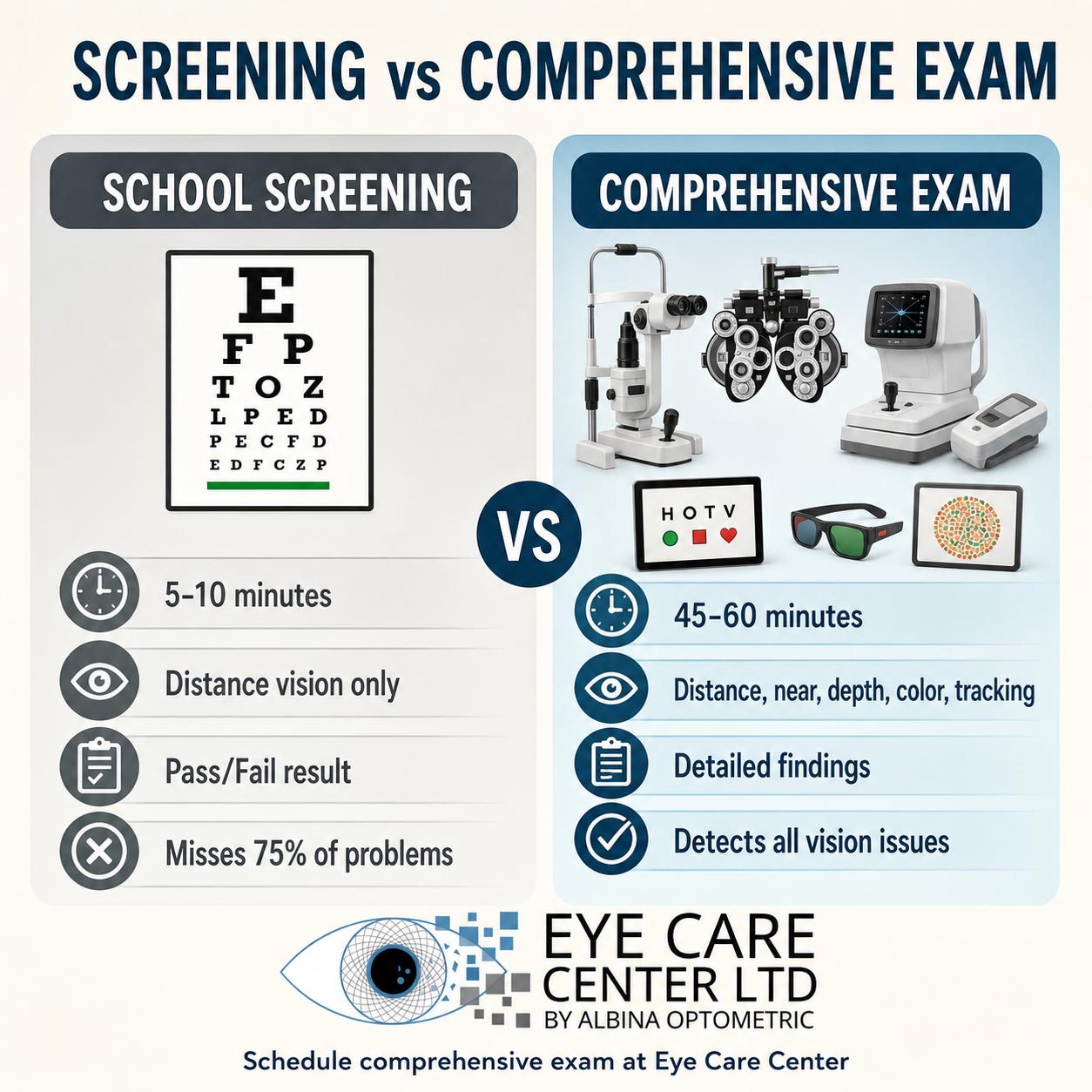
Understanding what the screening actually tested – and what it didn’t – helps put the “failure” notice in its proper context.
Typical School Vision Screening Components
The classic component is distance visual acuity – the Snellen chart where your child reads the smallest line they can see from 20 feet away. This tests each eye separately and both together, with a typical pass/fail cutoff at 20/40 or worse. Some screenings also include a basic cover test for eye alignment and color vision testing with Ishihara color plates.
What’s typically not included:
- Near vision testing (critical for reading and homework)
- Eye health evaluation of any kind
- Depth perception assessment
- Eye movement and tracking tests
- Focusing ability measurement
- Binocular vision assessment (how well both eyes work together)
Why Screenings Miss So Much
Research shows school vision screenings miss approximately 75% of vision problems in children. A child with moderate nearsightedness will fail. A child with mild nearsightedness, significant farsightedness, convergence insufficiency, or eye tracking problems will very often pass. Add in the realities of the school environment – noisy hallways, untrained volunteer screeners, children memorizing the chart or peeking around the eye cover, and time pressure to screen hundreds of kids quickly – and the limitations become clear.
The pass/fail system also strips out nuance. A child seeing 20/40 in both eyes technically passes, even though that’s nowhere near optimal for classroom learning. There’s no context for how that child is actually performing visually day to day. This is precisely why comprehensive exams are essential even for children who pass school screenings.
Most Common Reasons Children Fail Vision Screenings
Here are the actual findings we most commonly see in children referred after failed screenings:
1. Myopia (Nearsightedness) – Most Common
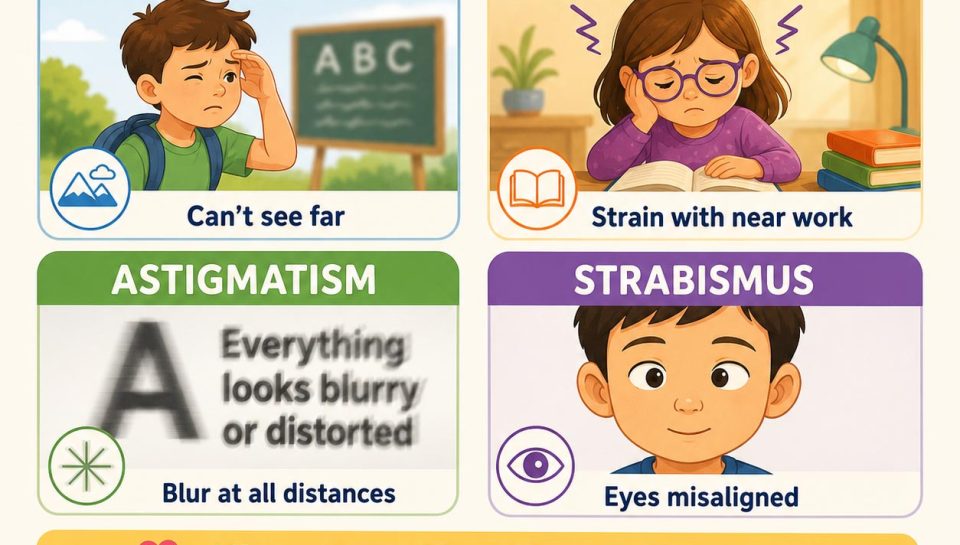
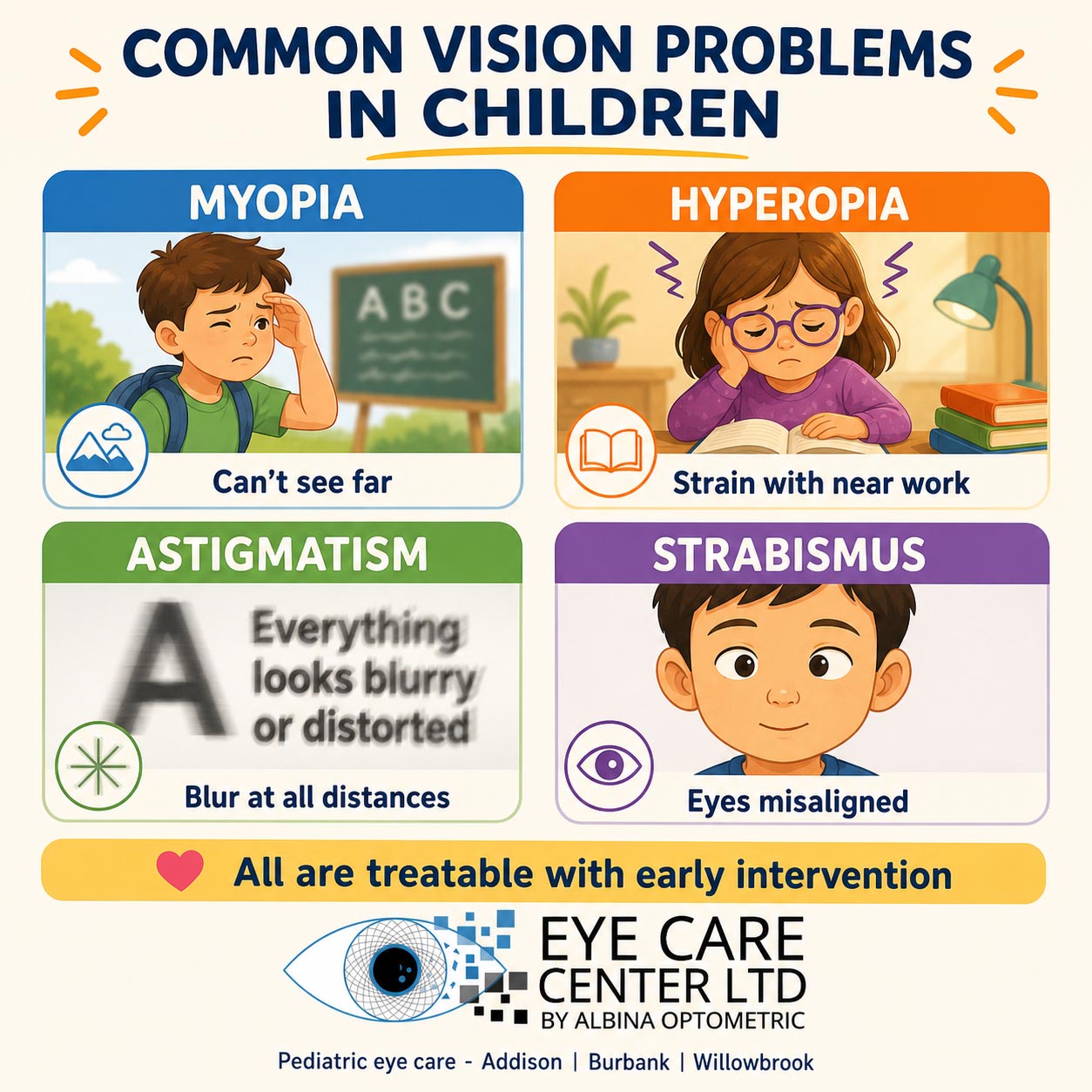
What it is: The eye is slightly too long or the cornea too curved, causing distant objects to blur while near vision stays clear. This is by far the most common finding after a failed screening.
Signs to watch for: squinting to see the board, sitting very close to the TV, holding books or tablets unusually close, complaints of headaches, and no trouble with reading or close work at all.
Treatment: Glasses or contact lenses for distance. If progression is a concern, we also evaluate whether myopia management options – such as Ortho-K lenses, low-dose atropine drops, or specialty soft lenses – are appropriate to slow the prescription from increasing over time.
2. Hyperopia (Farsightedness)
What it is: The eye is slightly too short, requiring extra focusing effort especially for near tasks. Mildly farsighted children often pass distance screenings because they can force their eyes to compensate – but this comes at a cost.
Signs to watch for: eye strain, fatigue, and headaches especially after reading or extended near work, avoidance of books and homework, and difficulty maintaining attention on close tasks.
Treatment: Glasses, particularly for reading and schoolwork. Not all farsightedness requires correction – it depends on the amount and the symptoms present.
3. Astigmatism
What it is: Irregular corneal curvature that causes blur at all distances, not just far away.
Signs to watch for: blur at both near and far distances, difficulty with detail work, eye strain and headaches, and occasionally seeing ghost images or halos around lights.
Treatment: Glasses or contact lenses with astigmatism correction (called toric lenses for contacts).
4. Anisometropia (Unequal Prescriptions)
What it is: A significant prescription difference between the two eyes. The brain may suppress (ignore) the blurrier eye to avoid double vision, which can lead to amblyopia if left untreated. Early detection and correction are critical here.
Treatment: Glasses to equalize the input from both eyes. May require patching therapy if amblyopia has already begun to develop.
5. Amblyopia (“Lazy Eye”)
What it is: Reduced vision in one eye due to abnormal visual development during early childhood. The brain essentially learned to favor one eye and the weaker eye’s vision never fully developed.
The critical fact every parent needs to know: amblyopia is most treatable before ages 7-9. After that window, the brain’s visual pathways are less responsive to retraining. This is the single most important reason not to delay a comprehensive exam after a failed screening.
Treatment: Glasses to correct the underlying refractive error, plus patching therapy – covering the good eye for several hours daily to force the brain to use and develop the weaker eye.
6. Strabismus (Eye Misalignment)
What it is: The eyes don’t point in the same direction simultaneously. The turn may be constant or intermittent, and it can go inward (esotropia), outward (exotropia), or vertically (hypertropia/hypotropia).
Treatment: Glasses, vision therapy, or surgery depending on the type and severity. Many cases of childhood strabismus respond well to non-surgical treatment when caught early.
What Happens at a Comprehensive Pediatric Eye Exam
The comprehensive exam your child needs is a fundamentally different experience from the school screening. Here’s what to expect:
Before the Appointment
Bring the vision screening failure notice from school, your insurance card, a list of any medications your child takes, and any information about family eye history (do parents or siblings wear glasses, has anyone been treated for lazy eye or strabismus, any known eye diseases?). If your child’s teacher has shared specific observations about their behavior in class – squinting, losing place when reading, avoiding the board – bring those notes too. That context is genuinely useful during the exam.
Prepare your child by explaining that they’re getting their eyes checked, similar to a checkup at the pediatrician. Reassure them it won’t hurt. Tell them they’ll look at pictures and letters, and if they’re old enough to understand, let them know that drops may make their eyes feel temporarily blurry and sensitive to light – but that it goes away.
During the Exam (45-60 Minutes)
Patient History (5-10 minutes): I ask about vision complaints, school performance, reading ability, headaches, eye rubbing, squinting, medical history, and family eye history. The more detail parents can provide here, the better.
Visual Acuity Testing (5-10 minutes): Distance and near vision, each eye tested separately and together, using age-appropriate charts (pictures for young children, letters for school-age kids).
Refraction (10-15 minutes): Determining the exact prescription needed. This is the “which is better, one or two?” portion of the exam, along with objective measurement using retinoscopy. For children, cycloplegic refraction (with dilation drops) is often necessary because children can artificially focus to compensate for farsightedness, masking the true prescription.
Binocular Vision Assessment (5-10 minutes): Eye alignment, eye teaming, convergence (the ability to turn eyes inward for near work), tracking patterns, and depth perception. This is the part that screenings skip entirely – and where we often find issues that explain school struggles.
Eye Health Evaluation (10-15 minutes): External exam of eyelids and lashes, pupil responses to check for neurological issues, slit lamp exam of eye structures, and dilated fundus exam to evaluate the retina, optic nerve, and blood vessels.
Additional Testing if Needed: Color vision, visual field testing, and retinal imaging can be added based on initial findings.
About Dilation
Dilation is often necessary for children because it relaxes the focusing muscles, allowing us to measure the true prescription without the child’s natural ability to compensate interfering with the result. It also gives us a thorough view of the retina and optic nerve. The drops sting slightly for a few seconds, then take 20-30 minutes to fully work. Vision will be blurry for reading and eyes will be light-sensitive for 3-6 hours afterward, so bring sunglasses and plan for a quiet afternoon at home. The temporary blur is worth the accuracy it provides.
Possible Findings and What They Mean
After the comprehensive exam, here are the most likely scenarios and what we do about each:
Scenario 1: Needs Glasses (Most Common)
I’ll tell you: “Your child has [myopia/hyperopia/astigmatism] and needs glasses for [distance/reading/all the time].” From there, we provide a prescription, help you select frames and lenses appropriate for an active child, and schedule a follow-up to confirm the prescription is working well. Most children notice an immediate improvement once wearing glasses – and many are genuinely amazed the first time they put them on and see the world clearly for the first time.
Scenario 2: Borderline – Monitor Without Correction
I’ll tell you: “Your child has a small prescription, but they’re seeing well enough that glasses aren’t the right step yet. We’ll monitor for changes.” This usually means a return visit in 6-12 months and watching for symptoms at home (squinting, headaches, sitting very close to screens). We don’t prescribe glasses as a precaution – we prescribe them when they provide meaningful, measurable benefit.
Scenario 3: Amblyopia Requiring Treatment
I’ll tell you: “Your child has reduced vision in one eye – what’s commonly called lazy eye – and we need to start treatment.” This means glasses to correct the underlying refractive error plus patching therapy: covering the good eye for 2-6 hours daily to force the brain to strengthen its connection to the weaker eye. Follow-ups happen every 6-12 weeks to track improvement. Treatment takes months and sometimes longer, but when started early, the prognosis is excellent.
Scenario 4: Binocular Vision Dysfunction
I’ll tell you: “Your child’s eyes aren’t working together efficiently. They have [convergence insufficiency/accommodative dysfunction/eye tracking problems].” This is often accompanied by a glasses prescription if there’s a refractive component, plus a referral for vision therapy – specialized exercises designed to train the visual system to function more efficiently. Home exercises will be part of the treatment plan as well. These problems significantly affect reading and sustained near work even when distance vision is technically perfect.
Scenario 5: Everything Looks Normal
I’ll tell you: “Your child’s vision and eye health look excellent. The screening may have been a false positive.” This is more common than parents expect – school screenings have high false-positive rates. We’ll provide documentation to share with your child’s school, and we’ll still recommend annual exams going forward because vision can change, often quickly in growing children.
Beyond Glasses: Vision Problems That Screenings Always Miss
Some of the most academically disruptive vision problems have nothing to do with whether a child can see clearly. Children with perfect 20/20 distance vision can still have significant visual processing deficits that make reading, focusing, and classroom learning genuinely difficult. These are the problems comprehensive exams catch and screenings never will.
Convergence Insufficiency
Convergence insufficiency is the inability to sustain inward eye movement for near tasks like reading. When a child tries to read, the eyes should converge (turn slightly inward) and hold that position for as long as reading continues. When convergence is insufficient, the visual system can’t maintain that posture, and the child experiences words that appear to move, swim, or blur on the page – often accompanied by headaches and double vision. The child eventually avoids reading altogether, not out of laziness, but because reading is genuinely exhausting and uncomfortable for their visual system. Distance vision can be a perfect 20/20. Standard screenings detect none of this.
Accommodative Dysfunction
Accommodation is the eye’s ability to shift focus between distances – from the board to the desk to the book and back. Accommodative dysfunction means the eye can’t make those shifts quickly or accurately, or can’t sustain focus on near objects for long periods. The result: blur when looking from board to desk, fatigue during reading, slow reading speed, and difficulty copying notes. These children are often labeled as inattentive or poor students when their visual system is the actual obstacle.
Eye Tracking Problems
Efficient reading depends on smooth, coordinated eye movements that track across a line of text and return to the beginning of the next line accurately. When eye tracking is inefficient, children lose their place constantly, skip or reread lines, rely on a finger to hold their position, and develop slow, labored reading fluency. They may also struggle with sports involving moving objects. These are classic signs – and they’re frequently mistaken for dyslexia or attention problems when the underlying cause is a correctable visual tracking issue.
Why This Matters for Learning Diagnoses
Research shows that up to 80% of children diagnosed with learning difficulties have an undiagnosed vision problem contributing to their struggles. This doesn’t mean vision causes all learning disabilities – but it does mean that fixing a vision problem often dramatically improves performance and that misattributing a vision problem to a behavioral or learning issue wastes years of a child’s development. Before any learning disability evaluation, a thorough vision exam should be completed. Every time.
Vision Correction Options Beyond Glasses
Glasses are the most common outcome after a failed screening – and for many children, they’re the right and complete solution. But depending on your child’s age, prescription, lifestyle, and how quickly their vision is progressing, there are other options worth discussing at the comprehensive exam. These aren’t last resorts. For the right child, they can be first-line recommendations.
Orthokeratology (Ortho-K): Clear Vision All Day Without Wearing Glasses
Orthokeratology – Ortho-K for short – is one of the most underutilized tools in pediatric eye care, and one of the most compelling options I can offer a child with myopia. Ortho-K lenses are specially designed rigid contact lenses worn only at night, while sleeping. They gently and temporarily reshape the front surface of the cornea so that when your child wakes up and removes them, they can see clearly throughout the entire school day – no glasses, no daytime contacts.
For an active school-age child, that means participating in gym class, sports, and recess without worrying about glasses, with correction that becomes part of a bedtime routine rather than something to remember, lose, or break during the day.
What makes Ortho-K particularly valuable in children is what it does beyond convenience. Clinical research consistently shows that children wearing Ortho-K lenses experience meaningfully slower myopia progression compared to children in standard glasses or soft contact lenses. For a child whose prescription is climbing year over year, slowing that trajectory has real long-term health implications – high myopia in adulthood significantly increases lifetime risk of retinal detachment, glaucoma, and other serious complications. Ortho-K doesn’t just correct vision today. It works to reduce how severe the prescription becomes over time.
Candidacy for Ortho-K depends on the prescription, corneal shape, and the child’s maturity level, and we evaluate it carefully before recommending it. But if your child has a myopia diagnosis and you’re wondering whether there’s something more proactive than updating their glasses prescription every year, this is a conversation worth having at the exam. Learn more about Ortho-K at Eye Care Center.
Myopia Management: Slowing the Prescription, Protecting Long-Term Eye Health
When a child is diagnosed with myopia – especially at a young age – the most important question isn’t just how we correct it today. It’s how we slow how fast it progresses. That’s the focus of myopia management, and it’s an area where optometry has advanced significantly in the past decade.
Beyond Ortho-K, the myopia management options we use at Eye Care Center include:
- Low-dose atropine drops: A small nightly dose of atropine – far lower than the concentration used for dilation – has been shown in multiple large clinical trials to significantly reduce myopia progression. Side effects at these concentrations are minimal, and the daily routine is straightforward.
- Multifocal and specialty soft contact lenses: Lens designs that reduce the peripheral defocus thought to drive myopia progression. These are worn during the day and are appropriate for children who are mature enough for daytime lens wear. FDA-cleared options like MiSight 1 day have demonstrated effectiveness in clinical trials specifically for myopia control.
The goal of myopia management is not to eliminate glasses entirely. It’s to give your child’s eyes the best chance at a lower final prescription, reduced lifetime risk of serious eye disease, and better long-term visual health – starting now, when intervention has the most impact. Explore myopia management at Eye Care Center.
Contact Lenses for Children: The Right Age Is Often Younger Than You Think
Parents are frequently surprised to hear that contact lenses can be appropriate for children well before the teenage years. The determining factor isn’t a specific age – it’s maturity, motivation, and the ability to follow a consistent care routine. A responsible, motivated 10-year-old is a better candidate than a disengaged 16-year-old.
For children who are good candidates, daytime soft lenses offer real advantages beyond just vision correction. Peripheral vision is better without a frame in the way. There’s no fogging, no breaking, and no sliding off during recess. Active kids in sports often find contacts dramatically more practical. And for children who feel self-conscious about wearing glasses, contacts remove that friction entirely – which matters, because a child who feels good about their correction is a child who actually wears it consistently.
If your child is asking about contacts, or if you have a sense they might be ready, bring it up at the exam. We can walk through candidacy together and help you make a decision that works for your child’s life. Learn about contact lens options for children at Eye Care Center.
How Vision Affects Learning: The Connection Parents Miss
Reading – the foundation of all academic learning – requires the simultaneous coordination of at least five distinct visual skills: clear vision at near distance, both eyes working together as a team, smooth tracking across lines of text, the ability to shift focus quickly between distances, and sustained convergence while the eyes move across a page. If any single skill is deficient, reading becomes far more effortful than it should be.
What School Demands Visually
Consider what a typical school day asks of a child’s visual system. Reading the board requires clear distance vision. Reading books and worksheets requires sustained near focus. Copying notes requires rapid focus shifting between board and paper, dozens of times an hour. Writing requires hand-eye coordination. And all of it requires the ability to sustain visual attention for hours without significant fatigue.
A child with an undiagnosed vision problem is doing all of this with a system that’s working against them. The result is predictable: fatigue, frustration, avoidance behaviors, reduced confidence, falling behind academically, and – most heartbreakingly – being labeled as lazy, unmotivated, or learning disabled when the real issue is correctable with a pair of glasses or a course of vision therapy.
The Transformation After Correction
I see this regularly, and it never gets old. Children who transform after getting glasses or completing vision therapy: reading speed that increases dramatically within weeks. Homework that took two exhausting hours now takes forty-five minutes. Behavior problems that decrease because the frustration driving them is gone. Confidence that returns visibly. Teachers who report dramatic improvements in attention, participation, and willingness to try. Parents who call our office to say they wish they’d come sooner.
You’re here now. That’s what matters.
Your Action Plan: What to Do Right Now
Step 1: Schedule the Comprehensive Exam (Do This First)
Don’t wait. Call Eye Care Center today and tell us your child failed a school vision screening. We’ll prioritize the appointment and schedule adequate time for a thorough pediatric evaluation. Our three locations serve the Chicago area:
- Addison: 1250 W Lake St #19c – (630) 543-0607
- Burbank: 8525 S Harlem Ave – (708) 599-0050
- Willowbrook: 6300 Kingery Hwy #116 – (630) 969-2807
Step 2: Talk to Your Child’s Teacher Now
While waiting for the appointment, let the teacher know about the failed screening and the upcoming exam. Ask whether they’ve noticed anything – squinting, sitting close to the board, losing place when reading, reluctance to do close work. Request temporary accommodations if it makes sense: front-row seating, permission to move closer to the board, or larger print worksheets. Teachers are partners in this process and most are eager to help once they understand what’s happening.
Step 3: Observe Your Child Before the Appointment
Between now and the exam, pay attention to how close your child sits to the TV or holds their tablet. Notice whether they squint, rub their eyes frequently, or complain of headaches after school. Watch how they approach homework – do they fatigue quickly, lose their place, use their finger to track text, or seem to avoid reading? Does one eye ever seem to drift inward or outward? Share everything you observe at the exam – that real-world context is clinically valuable and helps us make the right recommendations.
Step 4: After the Exam
If glasses are prescribed, involve your child in choosing frames they feel good about wearing – a child who likes how they look in their glasses actually wears them. Choose durable, flexible frames for active kids, and consider a backup pair if budget allows. Establish a routine for wearing and storing glasses, and let the school know so the teacher can reinforce wearing them throughout the day.
If vision therapy is recommended, follow through consistently. Attend all scheduled appointments and be consistent with any home exercises we prescribe. Improvement takes weeks to months, and consistency is what drives results.
If the exam is completely normal, provide the documentation to your child’s school and continue annual exams. A normal result today doesn’t mean vision won’t change – especially in growing children, where prescriptions can shift significantly in a single year.
Step 5: Commit to Annual Exams Going Forward
Children’s vision changes rapidly and unpredictably. A prescription that was perfect last year may be meaningfully different this year. New problems can develop at any grade level. The recommended schedule is a first exam at 6 months of age, a second at age 3, one before kindergarten around age 5, and then annually throughout the school years – or more frequently if a vision problem is being actively managed.
Don’t wait for a failed screening to bring your child in. By the time a screening catches it, it may have been affecting your child’s learning for months or years.
Your child’s vision is the foundation of their education. A comprehensive exam at Eye Care Center takes about an hour and can change the trajectory of their school experience – immediately.
Schedule Your Child’s Comprehensive Eye Exam Today
Or call us directly at 1-888-899-0816. We have appointments available Monday through Saturday at all three locations. Tell us your child failed a school vision screening when you call – we’ll make sure we have the right time blocked for a full pediatric evaluation.
The Bottom Line
Your child failed a school vision screening. That sounds scarier than it is. The vast majority of the time, it means they need glasses – a simple, effective solution that will immediately improve their ability to learn and succeed in school. Sometimes it reveals a binocular vision issue or the early stages of amblyopia, both of which respond well to treatment when caught early. And occasionally, the screening was simply wrong, and your child’s eyes are fine.
What’s true in every scenario is this: you won’t know until you get the comprehensive exam. And the sooner you get it, the sooner your child gets whatever they need – whether that’s a new pair of glasses, a clear bill of eye health, or the beginning of treatment that could protect their vision and their academic future for years to come.
We’ve helped thousands of families navigate exactly this moment. We know how to work with kids of all ages, and we know how to make what feels like a scary appointment feel like a straightforward, manageable step. We’d be honored to help your family too.
Frequently Asked Questions
My child passed the screening last year but failed this year. How does vision change that fast?
Extremely easily, especially in school-age children. Myopia (nearsightedness) in particular can progress significantly in a single year during childhood, sometimes shifting by a full diopter or more between annual screenings. This is one of the most important reasons for annual comprehensive exams rather than relying on periodic screenings. A child who passed last year can genuinely need glasses today, and that change happened gradually over months in a way that neither the child nor parents would notice until the difference becomes significant enough to show up on a chart.
How is a comprehensive eye exam different from the vision screening at school?
The school screening takes 5-10 minutes and tests primarily distance visual acuity – essentially just whether your child can read an eye chart from 20 feet away. A comprehensive exam takes 45-60 minutes and evaluates distance vision, near vision, eye health, binocular vision (how well both eyes work together), eye tracking, focusing ability, depth perception, color vision, and the internal health of the eye including the retina and optic nerve. Research shows screenings miss approximately 75% of vision problems because the problems they’re designed to detect represent only a fraction of what actually affects children’s vision and learning.
What age should children have their first eye exam?
The American Optometric Association recommends a first comprehensive eye exam at 6 months of age, a second at age 3, and another before starting kindergarten at around age 5. After that, annual exams are recommended throughout the school years. Many parents wait until their child has a problem or fails a screening, but proactive exams catch conditions like amblyopia and strabismus before they’ve had time to affect visual development. The earlier those conditions are found, the better and faster they respond to treatment.
My child says their vision is fine and they don’t have any trouble seeing. Can they still have a vision problem?
Yes – very commonly. Children have no frame of reference for what “normal” vision feels like, so they genuinely don’t know they’re seeing the world differently than their classmates. A child with mild-to-moderate nearsightedness may have never seen the board clearly and simply assumes everyone sees that way. A child with convergence insufficiency doesn’t know that reading shouldn’t feel exhausting. Children adapt and compensate in remarkable ways, which is why they rarely report symptoms until a vision problem has become quite significant. Never rely on a child’s self-report as evidence that their vision is fine.
Will my child have to get their eyes dilated?
Possibly, and we’ll discuss it at the appointment. Dilation is often recommended for children because it relaxes the eye’s focusing muscles, allowing us to measure the true prescription without the child compensating. Kids are remarkably good at forcing their eyes to focus harder to pass a vision test, which can mask significant farsightedness. Dilation also gives us a complete view of the retina and optic nerve. The drops sting briefly, vision will be blurry for reading and light-sensitive for 3-6 hours, and then it passes completely. Bring sunglasses and plan for a calm afternoon. The temporary inconvenience consistently produces more accurate results.
Does insurance cover a comprehensive eye exam for a child who failed a vision screening?
Most vision insurance plans cover annual comprehensive eye exams for children, and many medical insurance plans also cover exams when there’s a medical indication – which a failed school screening often qualifies as. Coverage varies significantly by plan, so we verify your specific benefits before your appointment so there are no surprises. Call us at 1-888-899-0816 before scheduling if you’d like us to check your coverage first.
What if my child refuses to wear glasses?
This is one of the most common questions I get from parents of newly diagnosed kids, and the answer almost always takes care of itself once the glasses are on. When a child puts on their first pair of correctly fitted glasses and realizes they can suddenly see the board from across the room, or that reading doesn’t give them a headache anymore, they usually become enthusiastic about wearing them. Involving your child in frame selection helps enormously – a child who feels good about how they look in glasses wears them. For children who are genuinely resistant, we can have a conversation about pediatric contact lenses depending on age and maturity.
Could my child’s vision problem be causing their attention or behavior issues at school?
It’s a real possibility worth investigating before drawing other conclusions. A child whose visual system is working against them throughout the school day is a child who is exhausted, frustrated, and struggling in ways they can’t articulate. That experience can absolutely manifest as inattention, acting out, avoidance, or what looks like disengagement or a learning disability. I’ve seen children whose behavior transformed after getting glasses or completing vision therapy, with teachers and parents reporting dramatic improvements within weeks. I always recommend a comprehensive eye exam be completed before or during any evaluation for ADHD or learning disabilities – it’s a simple, non-invasive step that rules out a very treatable contributing factor.
How do I schedule a pediatric eye exam at Eye Care Center?
You can schedule online anytime using our online booking tool, or call us at 1-888-899-0816. When you call or book, let us know your child failed a school vision screening – we’ll make sure we schedule a full pediatric evaluation with enough time to be thorough. We have three locations in the Chicago area: Addison (1250 W Lake St #19c), Burbank (8525 S Harlem Ave), and Willowbrook (6300 Kingery Hwy #116). Hours are Monday-Thursday 10am-6pm, Friday 10am-5pm, and Saturday 9am-2pm. Same-week appointments are typically available.