This One Drop a Night Can Slow Your Child’s Worsening Eyesight — Here’s the Science Behind Low-Dose Atropine
By Dr. Najib Albina, O.D. | The Eye Care Center LTD
If your child’s glasses prescription keeps getting stronger every year, you are not alone, and it is not something you have to accept as inevitable. Myopia in children is progressing at rates we’ve never seen before, and the long-term consequences go well beyond needing thicker glasses. High myopia dramatically increases a child’s lifetime risk of retinal detachment, glaucoma, cataracts, and macular degeneration. The question for parents and their eye doctors is no longer just how do we correct myopia, but how do we slow it down.
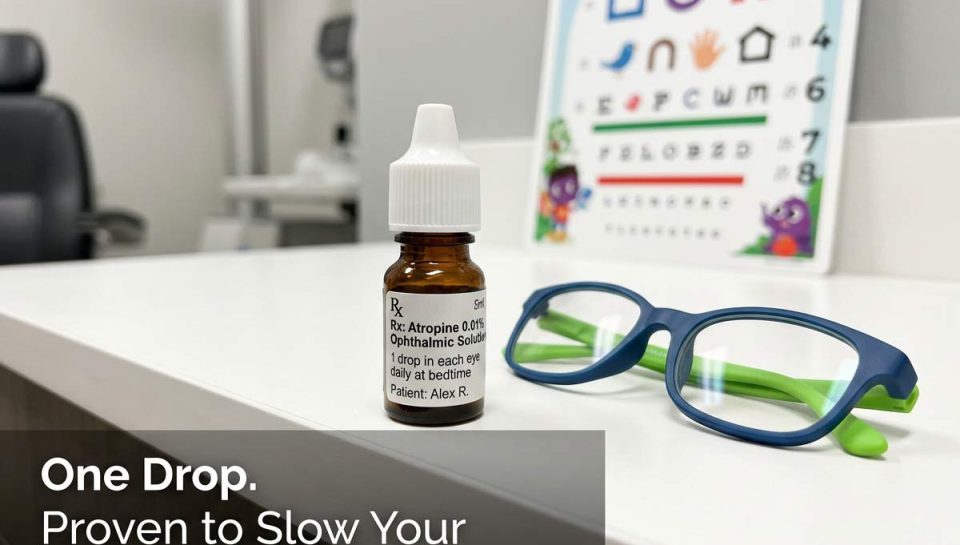
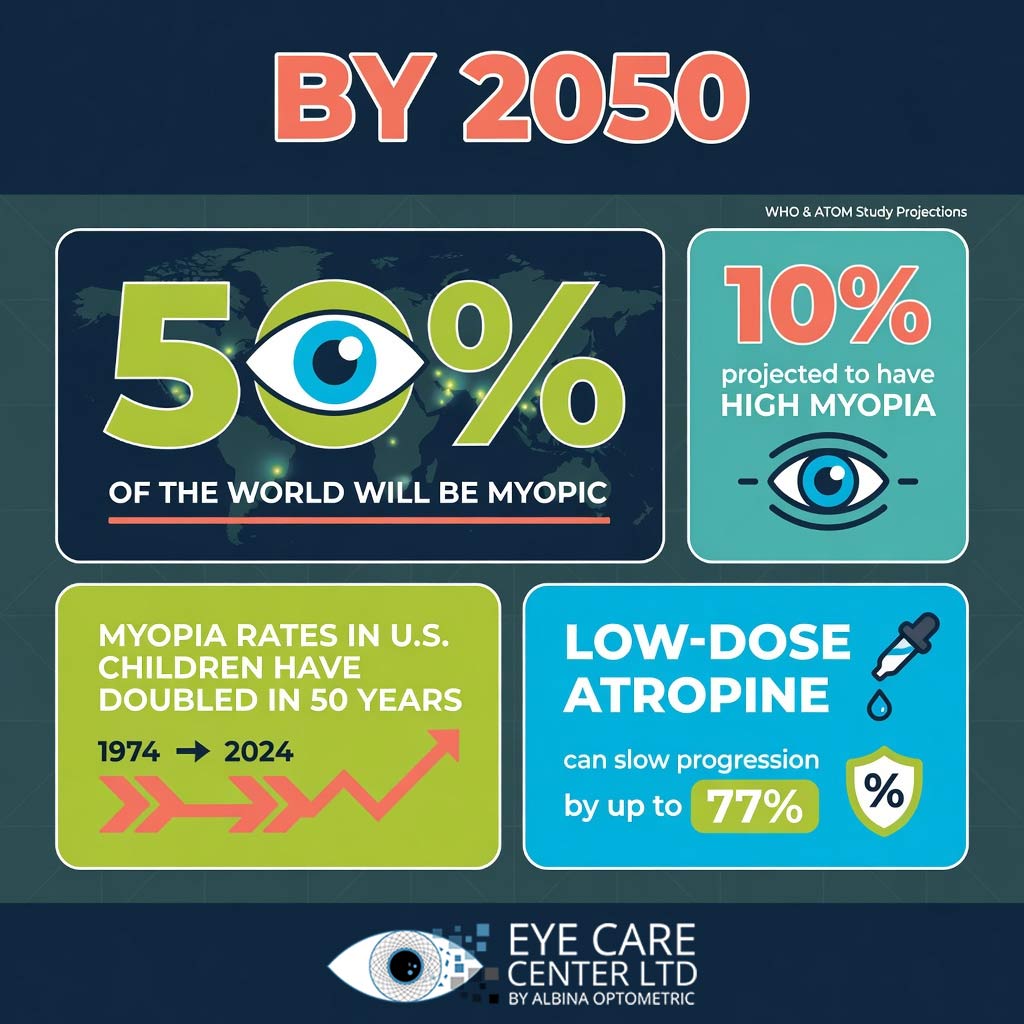
Low-dose atropine is one of the most well-researched, consistently effective tools we have for doing exactly that. At concentrations as low as 0.01% to 0.05%, atropine eye drops have been shown in multiple large-scale clinical trials to slow myopia progression by 50% to 77% compared to no treatment, with a side effect profile that is remarkably well tolerated in children. This is not experimental or cutting-edge in the sense of being unproven. It is backed by decades of research across multiple countries and is a standard of care recommendation from optometric and ophthalmologic organizations worldwide.
I want to walk you through what atropine is, how it works, what the research actually shows, what the side effects look like in practice, who is a good candidate, and what myopia management at our practice looks like from start to finish. If your child’s myopia is progressing, this information is for you.
Mind-boggling fact: At the current rate of progression, researchers estimate that half of the world’s population will be myopic by 2050, up from about 28% today. More alarmingly, 10% of the global population is projected to have high myopia, a level that carries significant risk of blinding eye diseases later in life.
Is Your Child’s Myopia Progressing? Warning Signs to Watch For
Many parents bring their child in for an annual exam and assume that a new prescription is just “normal growing up.” In some cases it is. In many cases, particularly when the changes are rapid or start young, it is a clinical signal worth taking seriously. Here are the signs that should prompt a conversation with your eye doctor about myopia management.
- Prescription increases of -0.50D or more per year. A single refraction is a snapshot. Two or more measurements showing a consistent pattern of increase is the most reliable indicator of progressing myopia.
- Myopia onset before age eight. Children who develop nearsightedness early have the most years of progression ahead of them and are at significantly higher lifetime risk of reaching high myopia (-6.00D or beyond).
- Squinting at the board at school or complaints about distance vision getting worse between appointments. These are subjective signs that progression is outpacing the current correction.
- Both parents are myopic. Myopia is highly heritable. A child with two myopic parents has a significantly elevated risk of developing and progressing in myopia compared to a child with no family history.
- Minimal outdoor time and high amounts of near work. Research consistently shows that less than one to two hours of outdoor time daily is associated with faster myopia progression. Extended near work (reading, screens, devices) compounds this risk.
- Myopia that developed or worsened noticeably after a period of increased close-up activity. A common pattern seen in children after extended periods of heavy device use or sustained near work.
If two or more of these apply to your child, a myopia management consultation is worth scheduling sooner rather than later. The window where intervention has the greatest impact is finite.
Why timing matters: The earlier myopia management begins, the more progression can be prevented over a child’s lifetime. A child who starts treatment at age eight versus age twelve will protect several more years of critical growth — and those are the years that determine whether they end up with moderate or high myopia as an adult.
What is atropine and how does it work for myopia?
Atropine is an anticholinergic medication derived from the belladonna plant. At high doses, it has been used for over a century to dilate pupils and paralyze the focusing mechanism of the eye during eye exams. At the low doses used for myopia control (0.01% to 0.05%), something different and more interesting happens.
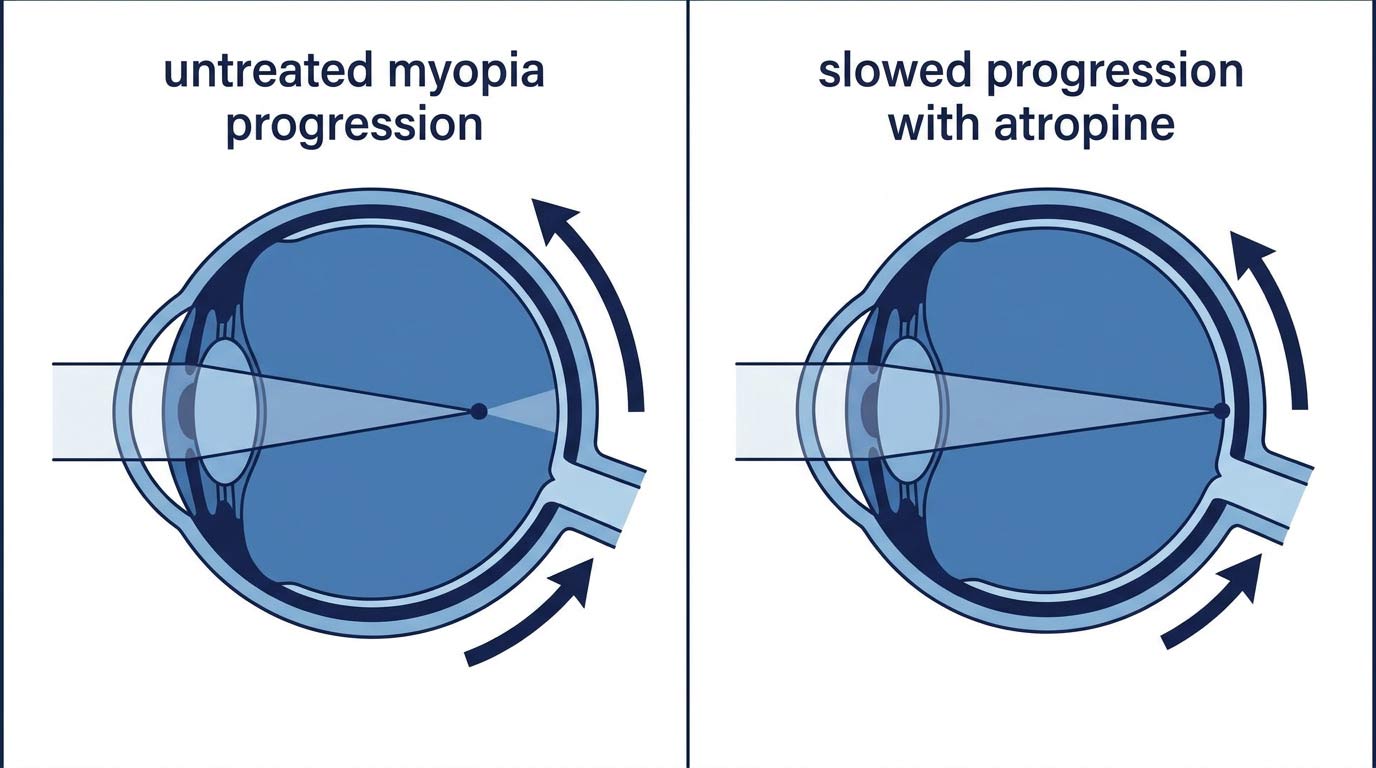
The honest answer is that we don’t fully understand the mechanism. The original hypothesis was that atropine slowed myopia by relaxing the ciliary muscle, reducing accommodative strain (the effort the eye exerts to focus up close), which was thought to be a driver of axial elongation. But research using low doses has largely disproved this. At 0.01%, atropine causes virtually no clinically significant pupil dilation and no measurable effect on accommodation, yet it still effectively slows myopia progression.
The current leading hypothesis focuses on atropine’s effect on muscarinic receptors in the retina and sclera (the white outer coat of the eye). Researchers believe atropine may slow the biochemical signaling cascade that causes the eye to grow longer in response to optical defocus signals. In myopia, the eye grows too long from front to back, causing distant objects to focus in front of the retina rather than on it. Slowing this axial elongation is precisely what we are trying to achieve, and atropine appears to interfere with the growth signals responsible for it.
What matters clinically is that the intervention works, it is safe, and it is practical. A single drop placed in each eye at bedtime is the standard dosing regimen. It takes seconds, causes minimal disruption to the child’s daily life, and based on the research, it works.
What the clinical research actually shows
The ATOM (Atropine for the Treatment of Myopia) studies conducted in Singapore are among the most influential in this field and are worth understanding in some detail.
ATOM1 compared 1% atropine against placebo and found dramatic reductions in myopia progression over two years. However, when the drops were stopped, a significant rebound effect occurred, with eyes progressing rapidly to partially “catch up” to where they might have been without treatment.
ATOM2 compared three lower concentrations: 0.5%, 0.1%, and 0.01% atropine. Over two years, all three groups showed reduced progression compared to historical controls. When treatment was stopped at the two-year mark and patients were followed for another year, the 0.01% group showed the least rebound effect while maintaining meaningful slowing of progression during treatment. The overall net effect over the full three-year study period was best in the 0.01% group for exactly this reason.
The LAMP (Low-Concentration Atropine for Myopia Progression) study in Hong Kong directly compared 0.05%, 0.025%, and 0.01% atropine in children aged four to 12. After two years, the 0.05% concentration produced the greatest slowing of both refractive error progression and axial elongation. The results suggested that 0.05% may be the optimal balance between efficacy and side effects for many patients.
Multiple studies from Taiwan, the United States, and Europe have produced broadly consistent findings: low-dose atropine meaningfully slows myopia progression in children, with lower concentrations producing fewer side effects and less rebound, while slightly higher concentrations (still far below the traditional 1% clinical dilating dose) appear to offer greater efficacy. The evidence supports individualized treatment decisions based on rate of progression, age, baseline refractive error, and tolerance.
The different concentrations and why they matter
You may encounter various concentrations mentioned in discussions of atropine for myopia: 0.01%, 0.025%, 0.05%, 0.1%, and 0.5%. Here is a practical guide to how these differ in clinical use.
The 0.01% concentration has the best side effect profile of any studied concentration. Pupil dilation is minimal to none, accommodation is not significantly affected, and light sensitivity is rarely a concern. The tradeoff is that it appears to be the least potent option, though it still provides meaningful slowing of progression and the lowest rebound risk.
The 0.05% concentration has emerged from the LAMP study as the preferred concentration for many practitioners. It produces greater slowing of axial elongation than 0.01%, with acceptable side effects. Some children notice mild light sensitivity or slight difficulty with close focus in bright environments, but most adapt well.
The 0.025% concentration sits between the two and is used when parents or patients want more efficacy than 0.01% with fewer side effects than 0.05%. All three of these low-dose concentrations are custom-compounded by pharmacies because they are not available commercially in the United States in these strengths.
Higher concentrations (0.1%, 0.5%, 1%) are generally not recommended for routine myopia management due to more significant side effects including substantial pupil dilation, loss of near accommodation, the need for photochromic or UV-blocking lenses during treatment, and the greater rebound effect when treatment is discontinued. These concentrations may be appropriate in specific clinical scenarios but are not the standard of care for childhood myopia management.
At-a-Glance: Low-Dose Atropine Concentrations Compared
| Concentration | Efficacy (progression slowing) | Light sensitivity | Rebound risk on stopping | Best suited for |
|---|---|---|---|---|
| 0.01% | Moderate (~50–59%) | Minimal to none | Lowest | Mild progression; side-effect-sensitive patients; younger children just starting treatment |
| 0.025% | Moderate-high | Mild | Low to moderate | Patients who need more efficacy than 0.01% but want fewer side effects than 0.05% |
| 0.05% | High (~67–77%) | Mild to moderate in bright light | Moderate | Rapid progressors; children with early onset myopia; preferred concentration per LAMP study |
| 0.1% – 1% | High, but rebound significant | Significant; photochromic lenses often needed | High | Not recommended for routine myopia management; specific clinical cases only |
All low-dose concentrations (0.01%–0.05%) are custom-compounded and not commercially available in the United States. Concentration selection is made at your child’s myopia management consultation based on their individual progression rate, age, and tolerance.
Side effects: what to realistically expect
When I discuss atropine with parents, side effects are naturally a central concern. Here is an honest, clinically grounded picture of what most families actually experience at the low doses used for myopia management.
At 0.01%, the most common report from both parents and children is essentially nothing noticeable. Some children may experience very mild light sensitivity in bright outdoor environments, and a small percentage notice slight difficulty reading small print in strong light. Because the drops are applied at bedtime, even these minor effects are present only during the nighttime hours when the child is asleep, and any residual morning effects are typically minimal.
At 0.05%, light sensitivity is somewhat more common, and some children may find very bright environments, particularly direct sunlight, temporarily uncomfortable. Transitional (photochromic) lenses or UV-protective sunglasses worn outdoors largely address this. A small subset of patients at this concentration may notice mild near blur in very brightly lit conditions. These effects are dose-dependent and reversible.
Systemic absorption from eye drops is generally low, but atropine at higher doses can cause flushing, dry mouth, and elevated heart rate. At the concentrations used for myopia management, systemic side effects are extraordinarily rare and have not been a significant clinical issue in any of the major trials. Closing the eyelids for two minutes after drop instillation and pressing gently at the inner corner of the eye further reduces systemic absorption.
Allergic reactions to atropine are possible but uncommon. Signs include redness, itching, and swelling around the eye beyond what is expected from the drug’s mechanism. If your child develops these symptoms, discontinue use and contact us promptly.
Who is a good candidate?
Low-dose atropine is appropriate for most children with progressing myopia, but the decision requires a clinical evaluation and individualized discussion. Here are the key factors I consider when recommending it.
Age is a primary consideration. Myopia tends to progress most rapidly between ages six and fourteen, making this the window where intervention has the greatest impact. Children as young as five or six have been enrolled in research studies, and atropine has been used safely in this age range. Older teenagers approaching their late teens and early twenties may not need treatment if their prescription has stabilized, though this requires monitoring to confirm.
Rate of progression matters more than current prescription level. A child with -1.50D of myopia that has progressed -0.75D per year is a stronger candidate for treatment than a child with -4.00D that has been stable for two years. We assess progression by comparing prescriptions over time, ideally with at least two refraction measurements six months to a year apart.
Baseline prescription and age at onset of myopia are also relevant. Children who develop myopia very young (before age eight) are at particularly high risk of ending up with high myopia because they have more years of potential progression ahead of them. These patients are strong candidates for early, proactive myopia management.
We also discuss family history, since myopia is highly heritable, and lifestyle factors including screen time, reading habits, and outdoor time, which research consistently shows is protective against myopia onset and progression. Low-dose atropine works best as part of a comprehensive myopia management strategy rather than as a standalone intervention.
The Long-Term Stakes: What High Myopia Means for Your Child’s Eye Health
The conversation about atropine is ultimately not about glasses prescriptions. It is about protecting your child’s eyes from conditions that can cause permanent, irreversible vision loss decades from now. The link between myopia level and serious eye disease is well-established, and the numbers are sobering enough that every parent of a myopic child deserves to understand them.
The critical threshold is -6.00D, which defines “high myopia.” Research consistently shows that the risk of major sight-threatening conditions increases substantially as myopia reaches and exceeds this level. The goal of myopia management is not simply to keep your child from needing strong glasses — it is to keep them below this threshold, or as far below it as possible.
Myopia Level and Associated Lifetime Disease Risk
| Myopia Level | Retinal Detachment Risk | Myopic Maculopathy Risk | Glaucoma Risk | Cataract Risk |
|---|---|---|---|---|
| Low myopia (up to -3.00D) | ~4× greater than no myopia | Low | Mildly elevated | Mildly elevated |
| Moderate myopia (-3.00D to -6.00D) | ~10× greater than no myopia | Moderate | Moderately elevated | Moderately elevated |
| High myopia (-6.00D and above) | ~22× greater than no myopia | Significantly elevated; leading cause of irreversible vision loss in myopic individuals | Up to 3× higher than moderate myopia | Significantly elevated; earlier onset |
Risk estimates are based on published epidemiological data and are intended to illustrate the relationship between myopia severity and disease risk, not to predict outcomes for any individual patient.
The practical implication: a child who ends up at -4.00D instead of -7.00D as an adult because of early myopia management has not just a slightly better prescription. They have meaningfully lower lifetime risk of the conditions listed above. Even one diopter of prevention matters. This is why we treat myopia progression as a health issue, not a vision correction issue.
The math that motivates us: Research suggests that each diopter of myopia prevented corresponds to a roughly 20% reduction in the risk of myopic maculopathy. Slowing progression by even 1.00D to 2.00D over a child’s formative years is not a cosmetic outcome — it is a meaningful reduction in long-term disease risk.
Combining atropine with other myopia control strategies
The evidence increasingly supports combination approaches to myopia management. Low-dose atropine combined with other proven interventions appears to produce better outcomes than any single treatment alone.
Orthokeratology (ortho-k) involves specially designed rigid contact lenses worn overnight that gently reshape the cornea to provide clear daytime vision without glasses or contacts, while simultaneously sending defocus signals to the peripheral retina that slow eye growth. Several studies have found that combining ortho-k with low-dose atropine produces greater slowing of axial elongation than either treatment alone. We offer ortho-k at our practice and frequently discuss it alongside atropine as a combined management option for motivated patients and families.
Soft multifocal contact lenses designed specifically for myopia management (such as MiSight and similar designs) create both central correction and peripheral defocus simultaneously. These lenses have their own strong evidence base and can be combined with atropine in cases where progression is rapid or where the child is highly motivated to wear contact lenses.
Increasing outdoor time remains one of the most consistently supported environmental interventions. Research shows that children who spend two or more hours per day outdoors have significantly lower rates of myopia onset, independent of near work or screen time. The mechanism is believed to involve dopamine release stimulated by bright light exposure, which inhibits eye elongation. Encouraging outdoor time alongside any optical or pharmaceutical intervention is always part of our recommendations.
What myopia management looks like at Eye Care Center
If you bring your child in for a myopia management consultation, here is what to expect. We begin with a comprehensive eye exam that includes cycloplegic refraction (a precise measurement taken after drops are used to temporarily relax the focusing muscles, ensuring we capture the true refractive error and not just an accommodative component). We measure axial length when indicated, review previous prescriptions to assess progression rate, and evaluate overall eye health.
Based on those findings, we discuss the full spectrum of myopia management options appropriate for your child’s situation, including low-dose atropine, orthokeratology, soft multifocal lenses, and lifestyle modifications. We present the evidence for each option honestly, discuss the practical realities of compliance and cost, and make a recommendation based on your child’s specific risk profile and your family’s preferences.
If atropine is chosen, we write the prescription for a compounding pharmacy (since these low concentrations are not commercially available) and establish a monitoring schedule that typically includes follow-up exams every six months to assess efficacy and adjust concentration if needed.
Myopia management consultations are available at our Addison (630-543-0607), Burbank (708-599-0050), and Willowbrook (630-969-2807) locations. Schedule a consultation today to discuss your child’s options.
Learn more about our approach to childhood myopia in our related article on why outdoor time matters for your child’s vision.
Don’t Wait for Your Child’s Prescription to Keep Getting Worse
Myopia that progresses unchecked in childhood can lead to serious eye disease in adulthood. Low-dose atropine is safe, proven, and practical. Schedule a myopia management consultation at Eye Care Center LTD and let us build a plan to protect your child’s vision.
Schedule a Myopia Management Consultation
Addison: (630) 543-0607 | Burbank: (708) 599-0050 | Willowbrook: (630) 969-2807
Monday – Thursday 10am-6pm | Friday 10am-5pm | Saturday 9am-2pm
Frequently asked questions about low-dose atropine for myopia
At what age can children start low-dose atropine?
Children as young as five to six years old have been included in clinical research studies evaluating low-dose atropine, and the treatment has been used safely across this age range. The decision depends more on the rate of myopia progression and overall eye health than on age alone. Early intervention is often advantageous because younger children have more years of potential progression ahead of them.
How long does my child need to stay on atropine?
Most myopia management protocols continue treatment through the most rapid years of progression, typically until the mid-to-late teenage years when the prescription often stabilizes. The decision to discontinue is made collaboratively based on monitored progression data. Abruptly stopping treatment can result in a rebound effect, particularly at higher concentrations, so transitions are planned carefully.
Will atropine give my child blurry vision or make them sensitive to light?
At the low concentrations used for myopia management (0.01% to 0.05%), most children experience little to no noticeable effect on their daytime vision. Some mild light sensitivity may occur, particularly at the 0.05% concentration, and UV-protective sunglasses or transitions lenses can address this effectively. The drops are applied at bedtime, so most effects are present only during sleep hours when they are irrelevant.
Is low-dose atropine FDA-approved for myopia control?
Not specifically, and this is one of the most common questions parents ask. In the United States, atropine eye drops do not have a specific FDA approval for myopia control — the compounded low-dose concentrations (0.01%, 0.025%, 0.05%) used for this purpose are considered off-label use. This is important context, but it does not mean the treatment is experimental or untested. Off-label prescribing is a routine part of medical and optometric practice when a treatment has strong clinical evidence but lacks a formal commercial approval pathway. Low-dose atropine for myopia is supported by decades of published research including large randomized controlled trials, and is a recognized standard of care by major optometric and ophthalmologic organizations worldwide. The reason a commercial FDA-approved product does not yet exist in these concentrations is primarily economic — the market for compounded drops has reduced the incentive for pharmaceutical companies to pursue the formal approval process, not because the evidence is lacking.
Can atropine be combined with glasses or contact lenses?
Yes. Atropine does not replace corrective lenses; it slows the progression of myopia. Children on atropine still wear their glasses or contact lenses for clear vision, and the atropine drops are used separately each night. Combining atropine with orthokeratology or myopia-controlling soft contact lenses has been shown to produce greater slowing of progression than either treatment alone.
Does insurance cover low-dose atropine for myopia control?
Coverage varies. Many insurance plans do not currently cover myopia management treatments including compounded atropine drops, as this is considered an off-label use in the United States. We provide thorough documentation and can help you submit to your insurer. Out-of-pocket costs for compounded atropine are typically moderate, and many families find the investment justified given the long-term health implications of unchecked myopia progression.
What happens if we stop the atropine?
When atropine is discontinued, some degree of rebound progression is possible, meaning the eye may grow faster for a period as it adjusts to the absence of treatment. This effect is most pronounced with higher concentrations and less significant with 0.01% atropine. We manage discontinuation carefully, often tapering the treatment or transitioning patients to monitoring rather than abrupt cessation, to minimize rebound effects.
Are there alternatives to atropine for myopia control?
Yes. Orthokeratology (overnight rigid lenses that reshape the cornea), soft multifocal contact lenses designed for myopia management (such as MiSight), and increased outdoor time all have strong evidence for slowing myopia progression. Some families choose combination approaches. We discuss all options at the myopia management consultation and recommend based on your child’s individual risk profile, lifestyle, and preferences.
Where can I get low-dose atropine drops for my child?
Low-dose atropine in the concentrations used for myopia management (0.01% to 0.05%) is not commercially available in the United States. It must be prescribed by a licensed eye care provider and prepared by a compounding pharmacy. At Eye Care Center LTD, we prescribe and coordinate these drops for our patients. Schedule a myopia management consultation at any of our three Illinois locations to get started.