What Does LASIK Cost in Illinois? An Honest Price Breakdown From an Eye Doctor Who Doesn’t Sell It
By Dr. Quentin Park, O.D. | The Eye Care Center LTD
Ask what LASIK costs and you will get advertising instead of an answer. Billboards promise $299 per eye. Premium centers quote five figures for both eyes. Somewhere in that enormous gap is the number you would actually pay, and finding it usually requires sitting through a sales consultation. As an optometrist who evaluates LASIK candidates and manages their care before and after surgery, but does not perform or sell the surgery itself, I can give you the answer without the pitch.
Here is the short version for Illinois in 2026: realistic, all-in pricing at reputable Chicago-area providers generally runs about $2,000 to $2,900 per eye, with most patients landing near $2,400 to $2,600 per eye for modern bladeless, custom-guided treatment. Both eyes, expect roughly $4,000 to $5,800 total. Anything dramatically below that range deserves scrutiny of what is excluded, and anything dramatically above it deserves a clear explanation of what you are getting for the premium.
This article breaks down what drives that price, the teaser-pricing traps to avoid, how financing and HSA/FSA dollars work, how LASIK compares financially to a lifetime of glasses and contacts, and how our co-management model at Eye Care Center works: honest candidacy evaluation first, referral to a trusted surgeon second, and your aftercare close to home at our Addison, Burbank, or Willowbrook office.
In this article:
- The real numbers for Illinois
- What drives the price up or down
- The $299 trap: how teaser pricing works
- What a legitimate quote should include
- Insurance, HSA/FSA, and financing
- Is LASIK worth it? The 10-year math
- Not everyone is a candidate, and that matters
- Why treating dry eye before LASIK matters
- LASIK vs. SMILE: which one fits you
- How LASIK co-management works at Eye Care Center
- Frequently asked questions
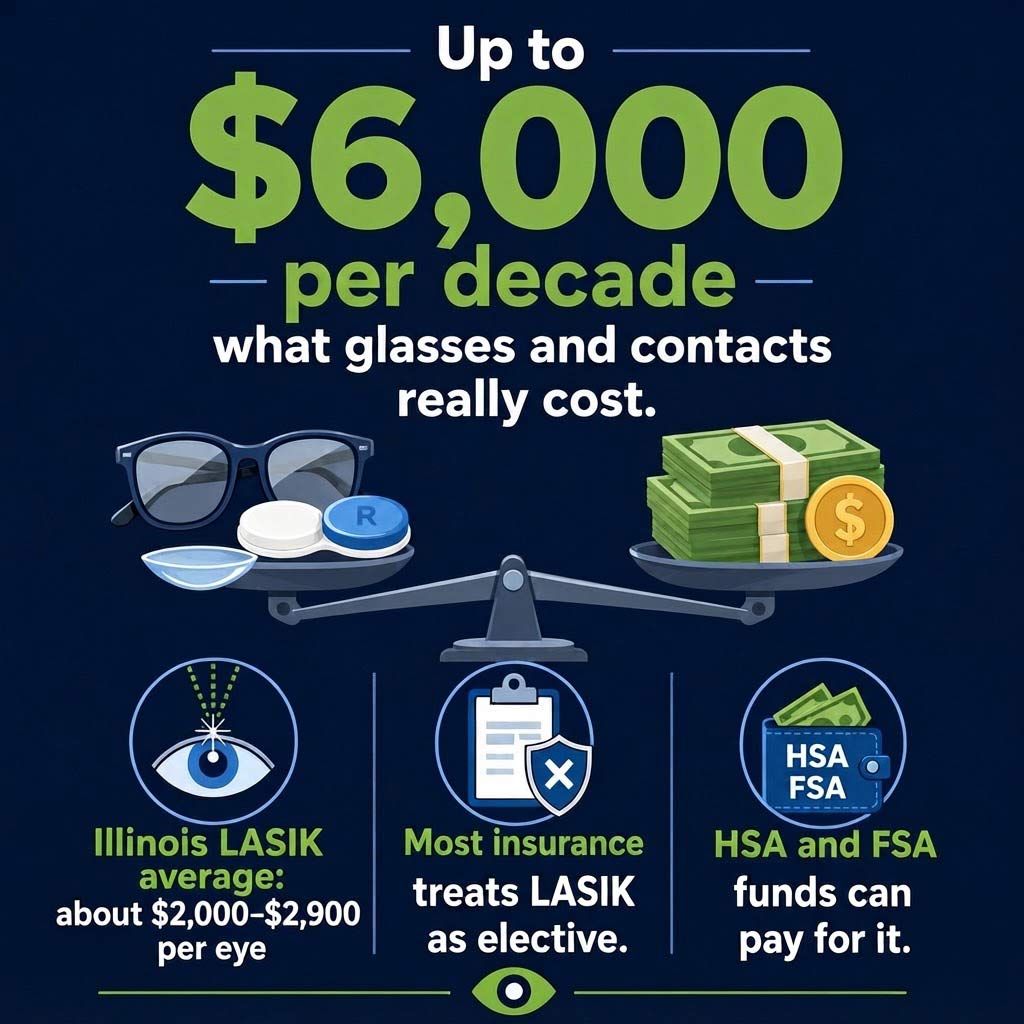
Mind-boggling fact: The average glasses and contact lens wearer spends up to $6,000 per decade on corrective eyewear, and that figure excludes prescription sunglasses, replacement pairs, and solution. Over a 40-year adult lifetime of wear, many people quietly spend more on temporary vision correction than LASIK would have cost them two or three times over.
The real numbers for Illinois
Based on current published pricing across the Chicago metro area, here is the honest landscape:
- Typical Chicago-area range – about $2,000 to $2,900 per eye at established providers
- Common all-inclusive pricing – roughly $2,400 to $2,600 per eye for modern custom bladeless LASIK
- Budget end – some reputable practices advertise around $2,000 per eye all-in
- Both eyes total – plan on roughly $4,000 to $5,800 for quality care
- National context – Illinois pricing sits near the national average, neither a bargain state nor a premium one
These figures reflect elective self-pay pricing, since health insurance almost never covers LASIK. They are planning ranges, not quotes; your exact price depends on your prescription, corneal anatomy, the technology used, and the provider you choose. The point of knowing the range is simple: it lets you recognize both a suspicious lowball and an unjustified premium when you see one.
What drives the price up or down
- Flap technology – bladeless femtosecond laser flaps cost more than older microkeratome blade flaps, and most modern practices have moved to bladeless
- Custom wavefront guidance – treatments mapped to your eye’s unique optical fingerprint price higher than standard ablation profiles
- Your prescription – higher corrections and significant astigmatism can affect pricing at some centers
- Surgeon experience and volume – high-volume, fellowship-trained corneal surgeons command more than discount chains
- What is bundled – enhancement guarantees, follow-up visits, and medications may be included or billed separately
- Alternative procedures – PRK, SMILE, EVO ICL, and refractive lens exchange each carry their own pricing, sometimes meaningfully higher than LASIK
A worthwhile rule: the technology and the surgeon matter more to your outcome than a few hundred dollars of price difference. Your corneas do not have a clearance rack.
The $299 trap: how teaser pricing works
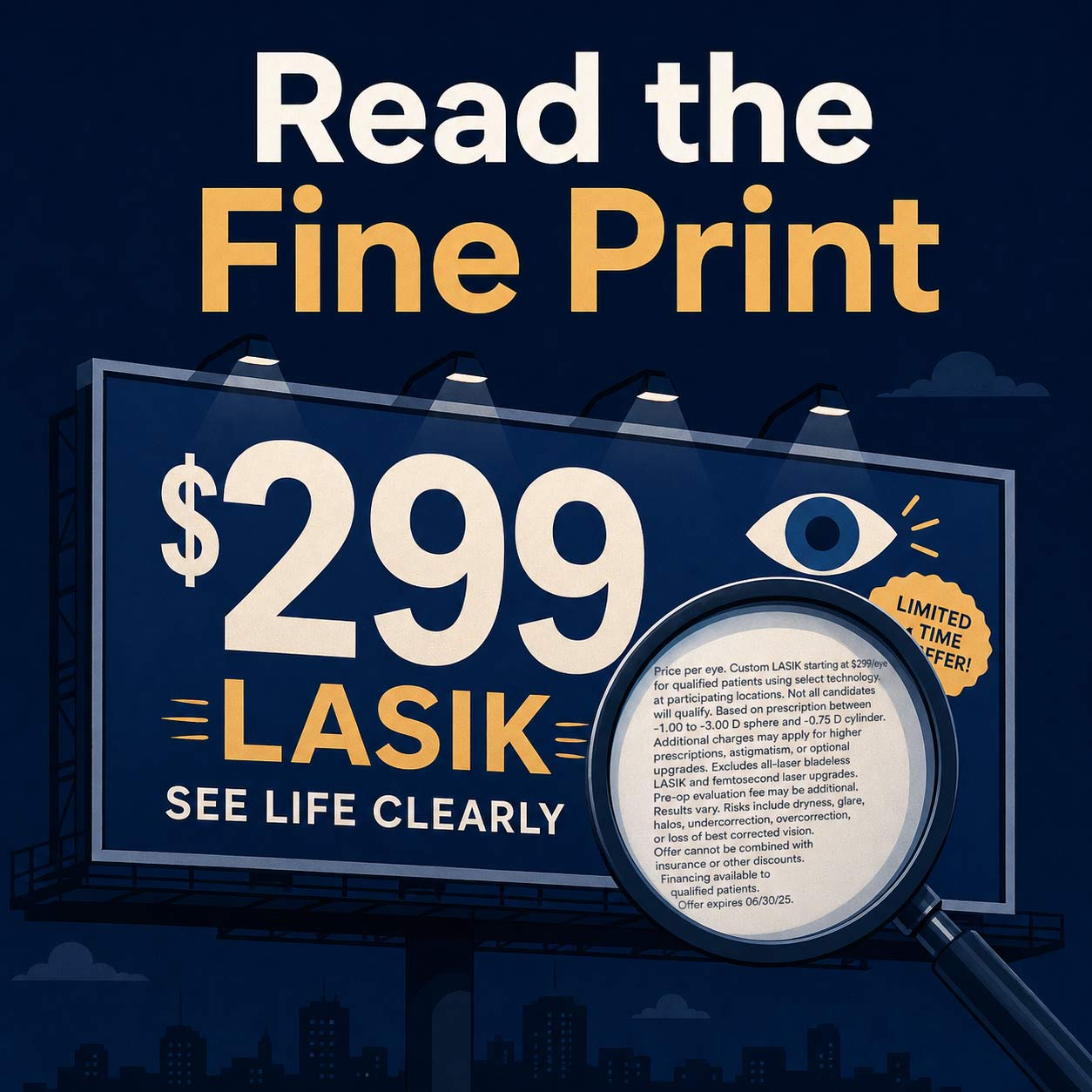
Those $299-per-eye advertisements are technically real and practically fictional. The advertised price typically applies only to the mildest prescriptions, using the oldest technology, with everything meaningful sold separately. The pattern works like this:
- Prescription qualifiers – the teaser tier covers corrections so mild that few people who want LASIK qualify for it
- Technology upsells – bladeless flaps, custom guidance, and modern lasers are added at consultation, each for hundreds more per eye
- Unbundled essentials – follow-up visits, medications, and enhancement procedures billed on top
- Consultation pressure – same-day booking discounts designed to short-circuit comparison shopping
By the time a typical patient walks out with a real quote, the $299 has usually become $2,000 to $2,500 per eye, which is to say: the normal market price, reached through an abnormal process. You did not find a bargain; you found a funnel. Choose providers who publish transparent all-inclusive pricing from the start.
What a legitimate quote should include
Before comparing two quotes, confirm both cover the same things. A complete, honest LASIK price includes:
- The full pre-operative workup – corneal topography, thickness mapping, dry eye assessment, and dilated exam
- The procedure itself – with the specific technology named in writing
- All routine post-operative visits – typically day one, one week, one month, and beyond
- Post-operative medications – or a clear statement that drops are prescribed separately
- Enhancement policy – whether touch-up procedures within one to two years are included, and under what conditions
If any of those five items is vague, ask directly and get the answer in writing. The enhancement policy matters more than most patients realize: a small percentage of eyes need a touch-up, and discovering that it costs extra after the fact is an expensive surprise.
Insurance, HSA/FSA, and financing
- Health insurance – LASIK is elective, so standard plans do not cover it except in rare medical-necessity situations
- Vision plan discounts – some vision plans negotiate 10 to 20% discounts with partner surgical networks, worth one phone call to check
- HSA and FSA – LASIK is a qualified medical expense, so pre-tax dollars can fund it, effectively discounting the procedure by your tax rate
- Financing plans – CareCredit and similar programs are nearly universal, with promotional zero-interest periods commonly 12 to 24 months
- Realistic monthly math – a $4,800 both-eye procedure over 24 months runs about $200 per month before fees and terms
One caution on financing: promotional zero-interest offers typically charge deferred interest retroactively if the balance is not cleared within the promotional window. Read the terms, set the payoff date in your calendar, and treat the promotional period as a deadline, not a suggestion.
Is LASIK worth it? The 10-year math
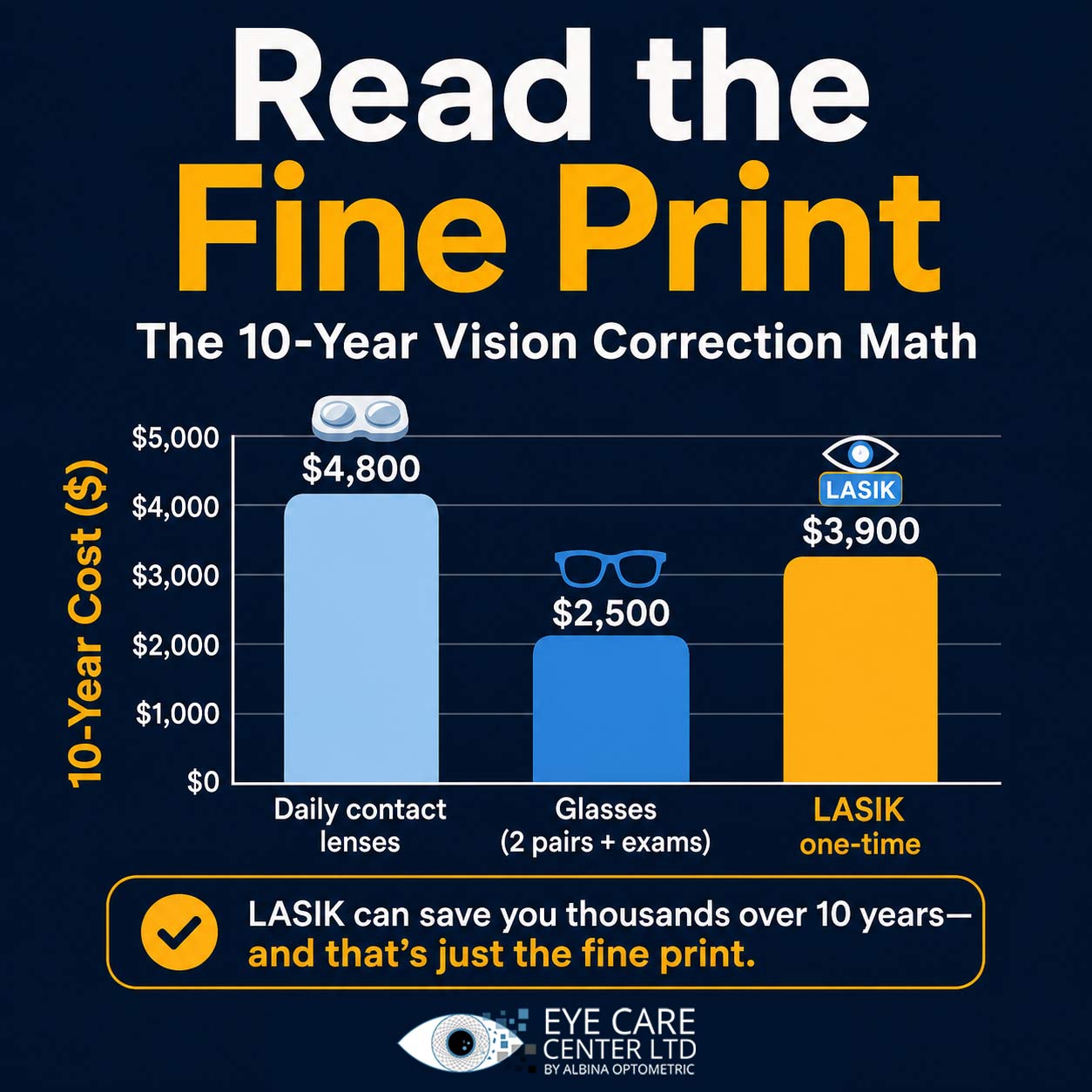
Purely financially, the comparison is closer than either side admits, and it depends heavily on what you currently wear:
- Daily disposable contact wearers – often spending $500 to $800 per year on lenses and solution, LASIK can reach break-even in roughly 6 to 10 years
- Glasses-only wearers – buying modest frames every two years, the pure dollar case is weaker and the decision is really about lifestyle
- Both-wearers – people maintaining glasses, prescription sunglasses, and contacts simultaneously usually have the fastest payback
The honest answer is that most people do not choose LASIK on spreadsheet math alone. They choose it for mornings without fumbling for glasses, sports and swimming without contacts, travel without solution bottles, and freedom from dry, end-of-day lens fatigue. The math simply determines whether that lifestyle upgrade costs you money over a decade or roughly pays for itself. For contact lens wearers especially, it often does the latter.
One age-related caveat I give every patient over 40: LASIK corrects distance vision but does not stop presbyopia, the age-related loss of near focus. If you are 45, LASIK will not spare you reading glasses, and for patients in their 50s and beyond, other procedures sometimes make more sense. This is exactly the kind of guidance an independent evaluation gives you before you sit in front of anyone selling a specific surgery. Our article on modern cataract surgery and premium lens implants covers the main alternative for that age group.
Not everyone is a candidate, and that matters
Roughly 15 to 20% of people who want LASIK are not good candidates for it, and a proper evaluation screens for the reasons why:
- Thin or irregular corneas – insufficient tissue for safe flap creation and ablation
- Unstable prescriptions – your correction should be stable for at least a year before surgery
- Significant dry eye – LASIK temporarily worsens dry eye, so untreated disease needs management first
- Keratoconus or corneal disease – absolute contraindications that topography screening exists to catch
- Certain health conditions – uncontrolled autoimmune disease and some medications complicate healing
Being told no by an independent doctor is cheap. Being told yes by a sales-driven consultation when the honest answer was no can be very expensive in every sense. This is the strongest argument for starting your LASIK journey with an eye doctor who has no financial stake in whether you have surgery. Patients screened out of LASIK often remain excellent candidates for PRK, EVO ICL, or other procedures, and we discuss those paths openly.
Why treating dry eye before LASIK matters
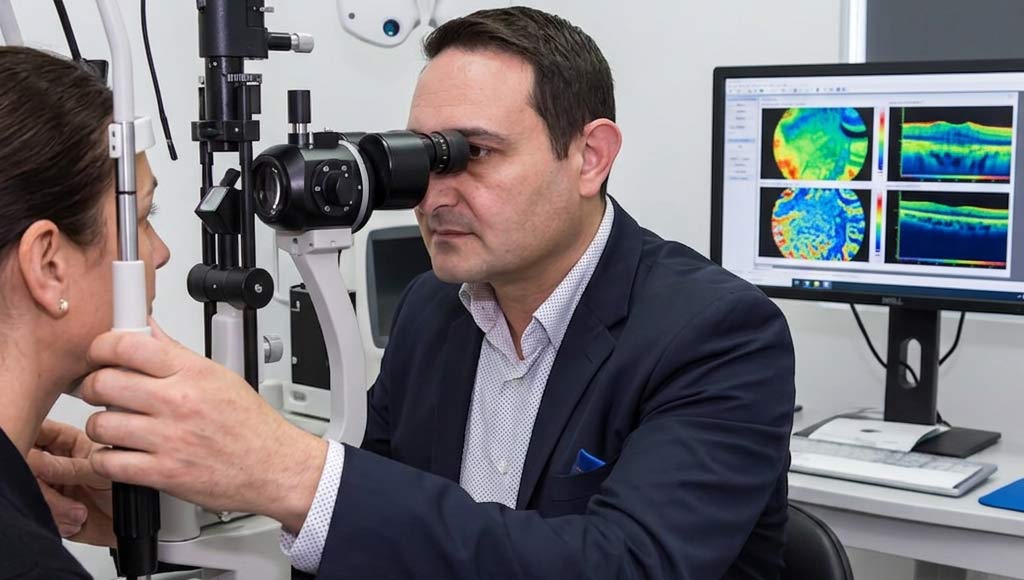
Dry eye disease is the single most common reason a LASIK candidacy evaluation gets delayed, and it is also the most commonly overlooked factor in patient satisfaction after surgery. Here is why it matters so much.
- LASIK temporarily worsens dry eye in nearly everyone. Creating the corneal flap severs surface nerves that regulate tear production and blink reflex, so some degree of post-operative dryness is expected even in patients with healthy eyes going in.
- Undiagnosed dry eye compounds that effect. A patient with untreated meibomian gland dysfunction or aqueous deficiency going into surgery is starting from a deficit, and the post-operative dryness lands on top of a problem that was never addressed.
- Dry eye distorts your pre-operative measurements. An unstable tear film affects the accuracy of corneal topography and wavefront measurements taken before surgery, which can affect how precisely the treatment is calculated.
- Poor healing and comfort follow poor tear film. Patients with treated, stable ocular surfaces heal more comfortably and report higher satisfaction than those who go into surgery with an unmanaged tear film.
This is exactly why our LASIK candidacy evaluation always includes a dry eye assessment, not just a prescription check. If we find meibomian gland dysfunction or another form of dry eye, we treat it first, confirm the ocular surface has stabilized, and only then move you forward to a surgical consultation. It typically adds a few weeks to the process and meaningfully improves both your measurements and your comfort afterward. Read more about how we diagnose and treat the most common cause of dry eye in our article on meibomian gland dysfunction and the true cost of untreated dry eye.
LASIK vs. SMILE: which one fits you
SMILE (Small Incision Lenticule Extraction) is a newer refractive procedure that we also co-manage, and patients frequently ask how it compares to LASIK on both outcome and price. The core difference is technique: LASIK creates a corneal flap and reshapes the tissue underneath with an excimer laser, while SMILE uses a femtosecond laser alone to carve a small lens-shaped piece of tissue (a lenticule) inside the cornea and remove it through a small incision, with no flap created at all. Because there is no flap, SMILE preserves more corneal nerve fibers and is associated with somewhat less post-operative dry eye than LASIK in several published studies, which matters for patients who already run dry or who are more dry-eye prone. SMILE also currently treats a narrower range of prescriptions, primarily nearsightedness with or without astigmatism, while LASIK remains more versatile for farsightedness and a broader range of corrections. Pricing for SMILE typically runs modestly higher than standard LASIK in the Chicago market, often by a few hundred dollars per eye, reflecting the newer technology and licensing costs. Neither procedure is universally “better.” The right choice depends on your prescription, your corneal thickness, and your individual dry eye risk profile, which is precisely what your candidacy evaluation is designed to sort out before you commit to either one.
How LASIK co-management works at Eye Care Center
- Independent candidacy evaluation – corneal topography, pachymetry, dry eye assessment, and a straight answer about whether LASIK fits your eyes
- Procedure guidance – honest comparison of LASIK, SMILE, PRK, and lens-based alternatives for your prescription and age
- Surgeon referral – we refer to experienced Chicago-area refractive surgeons whose outcomes we see in our own chairs, and we help you interpret their quotes
- Post-operative care close to home – your follow-up visits happen at our Addison, Burbank, or Willowbrook office with doctors who know your history
- Lifelong eye care – LASIK changes your prescription, not your need for eye health exams, and we remain your home base afterward
If you are weighing LASIK, start with the evaluation, not the sales consultation. A comprehensive exam tells you whether your eyes are even in the conversation before you spend an afternoon being marketed to. Learn what that exam involves in our guide to what really happens during a comprehensive eye exam.
Find Out If LASIK Fits Your Eyes Before Anyone Quotes You a Price
A LASIK candidacy evaluation at Eye Care Center LTD gives you an independent answer about your corneas, your prescription stability, and your realistic options, with no surgery to sell you. If LASIK makes sense, we connect you with trusted Chicago-area surgeons and manage your care before and after. Schedule at any of our three Illinois offices.
Schedule Your LASIK Evaluation
Addison: (630) 543-0607 | Burbank: (708) 599-0050 | Willowbrook: (630) 969-2807
Monday – Thursday 10am-6pm | Friday 10am-5pm | Saturday 9am-2pm
Se habla espanol.
Related reading on myeccltd.com:
- Cataracts at 50? Why Modern Surgery Is Nothing Like Your Grandparents’ Experience
- What Really Happens During a Comprehensive Eye Exam
- Why Your Eyes Feel Like Sandpaper by 3 PM
Frequently asked questions about LASIK cost in Illinois
How much does LASIK cost in Illinois in 2026?
Reputable Chicago-area providers generally charge about $2,000 to $2,900 per eye, with modern bladeless custom LASIK most commonly landing around $2,400 to $2,600 per eye. Expect roughly $4,000 to $5,800 total for both eyes at quality practices. Exact pricing depends on your prescription, the technology used, and what the quote includes.
Why is some LASIK advertised at $299 per eye?
Teaser pricing applies only to the mildest prescriptions using older technology, with modern lasers, custom guidance, follow-up care, and enhancements sold separately at consultation. Most patients who respond to teaser ads end up quoted standard market prices. Providers who publish transparent all-inclusive pricing are generally the safer starting point.
Does insurance cover LASIK?
Standard health insurance treats LASIK as elective and does not cover it except in rare medical-necessity cases. However, some vision plans offer negotiated discounts of 10 to 20% through partner networks, and LASIK is a qualified expense for HSA and FSA accounts, letting you pay with pre-tax dollars.
Can I finance LASIK?
Yes. CareCredit and similar healthcare financing programs are accepted nearly everywhere, with promotional zero-interest periods commonly running 12 to 24 months. A both-eye procedure around $4,800 works out to roughly $200 per month on a 24-month plan. Pay close attention to deferred-interest terms: balances not cleared within the promotional window are typically charged interest retroactively.
Is cheaper LASIK worse LASIK?
Not automatically, but the questions to ask are the same at every price: what flap technology is used, is the treatment custom-guided, what is the surgeon’s volume and experience, and what does the price include. A moderate price from a transparent, high-volume provider with modern technology is generally a better value than either extreme of the market.
Is LASIK cheaper than wearing contacts long term?
For many contact lens wearers, yes. Daily disposable wearers commonly spend $500 to $800 per year on lenses and solution, which puts LASIK break-even at roughly 6 to 10 years. Glasses-only wearers have a weaker pure-dollar case, and for them the decision rests more on lifestyle preference than savings.
Am I too old for LASIK?
There is no strict upper age limit, but the calculus changes with age. LASIK does not prevent presbyopia, so patients over 40 to 45 will still need reading correction afterward. For patients in their 50s and 60s, especially with any early lens changes, refractive lens exchange or eventual cataract surgery with premium lens implants often makes more sense than LASIK. An independent evaluation sorts this out before you spend money.
What if I am not a LASIK candidate?
Roughly 15 to 20% of interested patients are screened out due to corneal thickness, prescription instability, dry eye, or corneal conditions. Most remain candidates for alternatives such as PRK, EVO ICL implantable lenses, or lens-based procedures. A candidacy evaluation at Eye Care Center covers the full option set, not just LASIK.
Does Eye Care Center perform LASIK?
No, and that is precisely why our evaluation is valuable. As optometrists, we assess your candidacy independently, refer you to experienced Chicago-area refractive surgeons when surgery makes sense, and provide your pre-operative and post-operative care at our Addison, Burbank, and Willowbrook offices. You get an honest answer first and a trusted surgical referral second.
Why does dry eye need to be treated before LASIK?
LASIK temporarily worsens dry eye in nearly every patient because creating the corneal flap severs surface nerves that regulate tear production. Starting surgery with untreated dry eye compounds that effect, can distort pre-operative measurements, and is associated with slower healing and lower satisfaction. Our candidacy evaluation always screens for dry eye, and we treat and stabilize it before referring you for surgery.
What is the difference between LASIK and SMILE?
LASIK creates a corneal flap and reshapes tissue underneath with an excimer laser. SMILE uses a femtosecond laser to remove a small lens-shaped piece of tissue through a tiny incision, with no flap created. SMILE is associated with somewhat less post-operative dry eye in several studies and currently treats a narrower range of prescriptions than LASIK, mainly nearsightedness. SMILE typically costs modestly more than LASIK in the Chicago market. Both are procedures we co-manage, and the right choice depends on your prescription and dry eye risk profile.