Several of my patients have asked me about a video making the rounds on social media. It calls a new treatment named ER-100 “the first age-reversal trial in humans,” and it’s being tested in the eye. If you have glaucoma, or someone you love does, a headline like that is hard to scroll past.
The quick answer: ER-100 is a real, experimental gene therapy that entered its first human trial in 2026. It targets glaucoma and NAION, two diseases that damage the optic nerve. It is being tested mainly for safety, it is not available at any clinic, and approval is likely years away. The best way to protect your vision today is still early detection with a comprehensive eye exam.
So let me give you the straight version: what ER-100 is, why researchers chose the eye, what we still don’t know, and what actually protects your vision right now.
What Is ER-100?
ER-100 is an experimental gene therapy from Life Biosciences, a Boston company co-founded by Harvard longevity researcher David Sinclair. In January 2026, the company announced FDA clearance to begin testing it in people. In June 2026, it announced that the first patient had been treated.
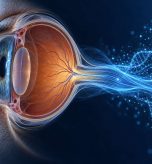
The therapy delivers three genes, OCT4, SOX2, and KLF4 (often shortened to “OSK”), into the eye. The goal is not to replace damaged cells, but to help aging nerve cells in the eye behave more like younger ones again.
- Who makes it: Life Biosciences, based in Boston.
- What it is: A gene therapy given by injection into the eye.
- What it targets: Glaucoma and NAION, two diseases that damage the optic nerve.
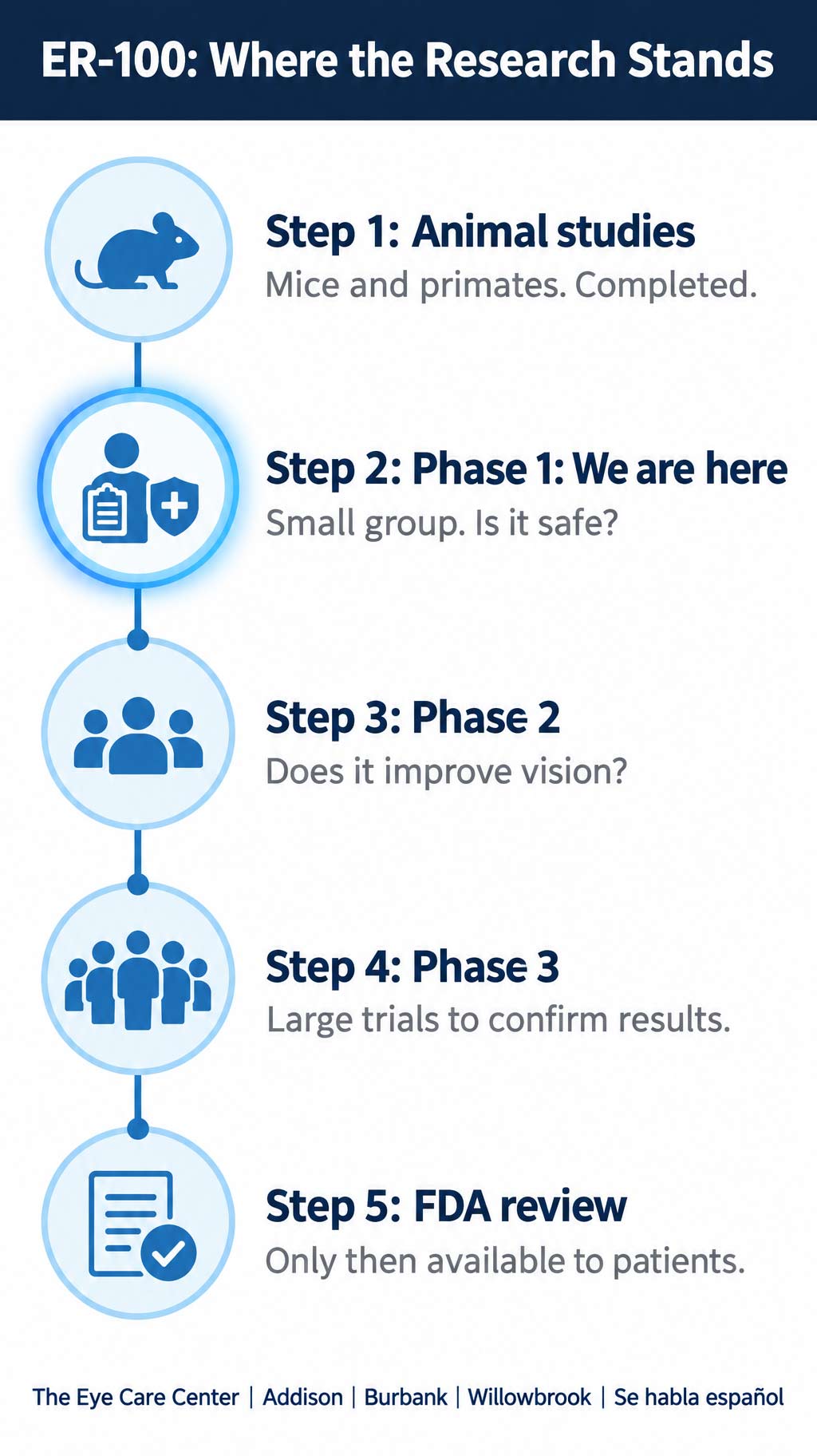
- Where it stands: A Phase 1 trial focused on safety.
- Is it available? No. It is only being given to trial participants.
The trial is registered on ClinicalTrials.gov as NCT07290244. According to the company, it will look at safety, tolerability, and the body’s immune response, along with several measures of visual function.
How Is It Supposed to Work?
Every cell in your body carries the same DNA. What makes a nerve cell act like a nerve cell is a layer of chemical markers on top of that DNA, called the epigenome. Think of it as a set of instructions telling each cell which genes to use and which to ignore.
One leading theory of aging is that these instructions get scrambled over time, a bit like a scratched CD that starts to skip. The music is still on the disc, but the player can’t read it cleanly anymore. Cells keep their DNA, but they gradually lose the ability to work the way they did when they were young.
The three genes in ER-100 come from Nobel Prize-winning research. In 2012, Shinya Yamanaka shared the Nobel Prize for showing that a set of four genes could turn adult cells all the way back into stem cells. Fully resetting a cell that way would erase its identity, which is the last thing you want for a nerve cell in your eye. So ER-100 uses three of those genes, switched on in a controlled, partial way. The idea is to restore the cell’s youthful instructions without changing what kind of cell it is.
The approach builds on a 2020 study published in Nature, in which the same three genes restored vision in mice with optic nerve damage and in older mice. Life Biosciences reports that later studies in nonhuman primates also showed improved visual function.
Why Start With the Eye?
Researchers chose the eye for a few practical reasons, and they tell you a lot about why glaucoma is such a serious disease.
- The optic nerve doesn’t regenerate: Once its cells die, today’s treatments can’t bring them back.
- The eye is easy to reach: A small dose can go exactly where it’s needed.
- The eye is contained: The therapy stays largely in one place instead of circulating through the body.
- Vision is measurable: Doctors can track changes precisely with standard eye tests.
The optic nerve is the cable that carries everything your eye sees to your brain. It’s made of about a million nerve fibers from cells called retinal ganglion cells. Glaucoma slowly damages those cells, usually starting with your side vision. NAION, short for non-arteritic anterior ischemic optic neuropathy, is a sudden loss of blood flow to the optic nerve, often described as a “stroke” of the eye. You may have seen NAION in the news because of its studied link to GLP-1 drugs, which I covered in my article on Ozempic, Wegovy, and your eyes.
In both diseases, the damage has been permanent. Our current glaucoma treatments, including eye drops, laser procedures, and surgery, work by lowering eye pressure to slow or stop further damage. They protect the vision you still have. They can’t restore what’s already gone. That’s exactly why a therapy aimed at restoring nerve cell function would be such a big deal if it works.
The Reality Check: What We Don’t Know Yet
I’m genuinely excited about this research. I’m also cautious, and you should be too. Here’s what the viral posts tend to skip:
- Phase 1 is about safety: It answers “is this safe?” before “does this work?”
- Animal results don’t always carry over: Many treatments that work in mice fail in people.
- It’s not whole-body age reversal: It targets nerve cells in one eye.
- Approval is years away: Successful drugs typically go through Phase 2 and Phase 3 trials first.
- No clinic can offer it today: Be wary of anyone selling “cellular reprogramming.”
A Phase 1 trial involves a small number of patients and is designed to find out whether a treatment is safe and tolerable, and at what dose. Even when early results look promising, larger trials are needed to prove a treatment actually improves vision in people. That process usually takes years.
The phrase “age reversal” is also doing a lot of heavy lifting in those videos. ER-100 is designed to reset aging cells in the optic nerve. That’s a remarkable goal, but it’s a long way from turning back the clock on your whole body.
What Protects Your Vision Today
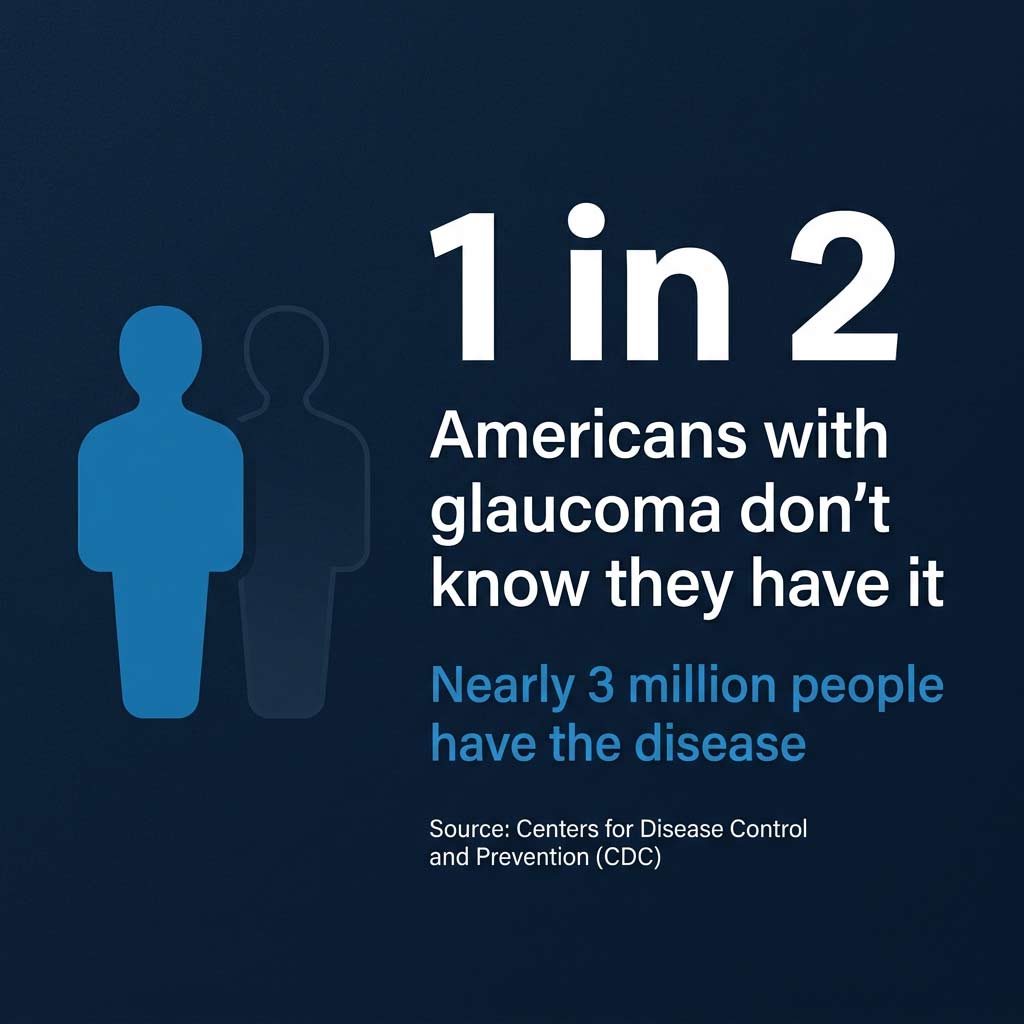
Here’s the part that matters most right now. According to the CDC, nearly 3 million Americans have glaucoma, and about half of them don’t know they have it. Glaucoma usually causes no pain and no early symptoms. By the time someone notices a change in their vision, a significant amount of the optic nerve may already be damaged.
Even if ER-100 eventually succeeds, the best outcome will always come from catching glaucoma early, while there’s still healthy nerve tissue to protect. Today, that’s what a comprehensive eye exam does.
- Eye pressure check: High pressure is the biggest treatable risk factor.
- Optic nerve imaging (OCT): Measures the nerve fiber layer for early thinning.
- Visual field test: Maps your side vision for blind spots you haven’t noticed.
- Dilated exam: Lets us look directly at the optic nerve.
No single test tells the whole story. Some people develop glaucoma with normal eye pressure, which is why we look at the optic nerve itself, not just the pressure number. You can read more in my guide to what eye pressure is considered normal, and in how we detect glaucoma in our clinics.
Who Should Be Checked for Glaucoma?
Anyone can develop glaucoma, but some people carry a higher risk and should be especially consistent about exams:
- Age 60 or older: Risk rises steadily with age.
- Family history: Having a parent or sibling with glaucoma raises your risk.
- Black or Hispanic heritage: Glaucoma is more common and often starts earlier.
- Diabetes or high blood pressure: Both affect blood flow to the optic nerve.
- High nearsightedness: A longer eye can make the optic nerve more vulnerable.
- Long-term steroid use: Including steroid eye drops, pills, or inhalers.
- A past eye injury: Trauma can damage the eye’s drainage system.
If any of these apply to you, don’t wait for symptoms. A yearly comprehensive exam is the most reliable way to catch glaucoma while your vision can still be protected. And if you’ve already been diagnosed, keep taking your drops and keep your follow-up visits. Today’s treatments work well when they’re used consistently.
The Bottom Line
ER-100 is one of the most interesting developments in eye research in years. For the first time, scientists are testing in people whether aging optic nerve cells can be coaxed into working like younger ones again. If it succeeds, it could change how we think about glaucoma and other diseases once considered permanent.
But that’s a future possibility, not a present-day option. The vision you protect today is the vision you’ll have when new treatments arrive. That starts with knowing whether you have glaucoma at all. Our glaucoma care includes the full set of tests that catch it early.
Frequently Asked Questions: ER-100 and Glaucoma
Is ER-100 available to patients?
No. ER-100 is only being given to participants in a Phase 1 clinical trial. It is not approved by the FDA, and no eye doctor or clinic can offer it outside the trial. Be cautious of any business claiming to sell “cellular reprogramming” or similar age-reversal treatments.
Can ER-100 reverse glaucoma?
We don’t know yet. In animal studies, the approach restored aspects of vision after optic nerve damage. The current human trial is focused mainly on safety, and larger trials will be needed to find out whether it improves vision in people.
Is vision loss from glaucoma permanent?
With today’s treatments, yes. Eye drops, laser procedures, and surgery lower eye pressure to slow or stop further damage, but they can’t restore vision that’s already been lost. That’s why early detection through regular eye exams is so important.
Can I join the ER-100 trial?
The trial is listed on ClinicalTrials.gov as NCT07290244, where you can find its eligibility requirements and contact information. Our office is not a trial site. If you have glaucoma or NAION and are curious about clinical trials, we’re happy to talk through your options at your next visit.
Does ER-100 reverse aging in the whole body?
No. Despite the “age reversal” headlines, ER-100 is designed to reset aging nerve cells in the eye. It is injected into one eye and targets the optic nerve. It is not a whole-body anti-aging treatment.
Glaucoma rarely causes symptoms until vision is already lost. The best protection is a comprehensive eye exam with optic nerve imaging, available at all three of our locations:
Addison: 1250 W Lake St #19c | (630) 543-0607
Burbank: 8525 S Harlem Ave | (708) 599-0050
Willowbrook: 6300 Kingery Hwy #116 | (630) 969-2807
Book online or call 1-888-899-0816. Se habla español.