If you have diabetes, you already keep track of a lot: blood sugar, A1C, medications, meals, and a calendar full of appointments. When your vision seems fine, it is easy to let the eye exam slide to the bottom of the list. You can read the menu, you can drive to work, so what could be wrong?
The trouble is that diabetic eye disease usually starts without any warning. Damage can build at the back of the eye long before you notice a change, and by the time your vision blurs, the disease may already be advanced. November is National Diabetes Month, which makes this a good time to book the one test that can catch it early: a comprehensive dilated eye exam.
In this article
How Diabetes Damages the Eyes
Over time, high blood sugar damages the tiny blood vessels that feed the retina, the light-sensing tissue at the back of your eye. Those vessels can weaken and leak. This is diabetic retinopathy, the most common diabetic eye disease and a leading cause of blindness among working-age adults in the United States.
As retinopathy progresses, parts of the retina can lose their blood supply, and the eye may respond by growing new, fragile vessels that bleed easily. Fluid can also leak into the center of the retina at any stage, a problem called diabetic macular edema. Diabetes affects other parts of the eye as well: the American Diabetes Association notes that glaucoma and cataracts occur earlier and more often in people with diabetes.
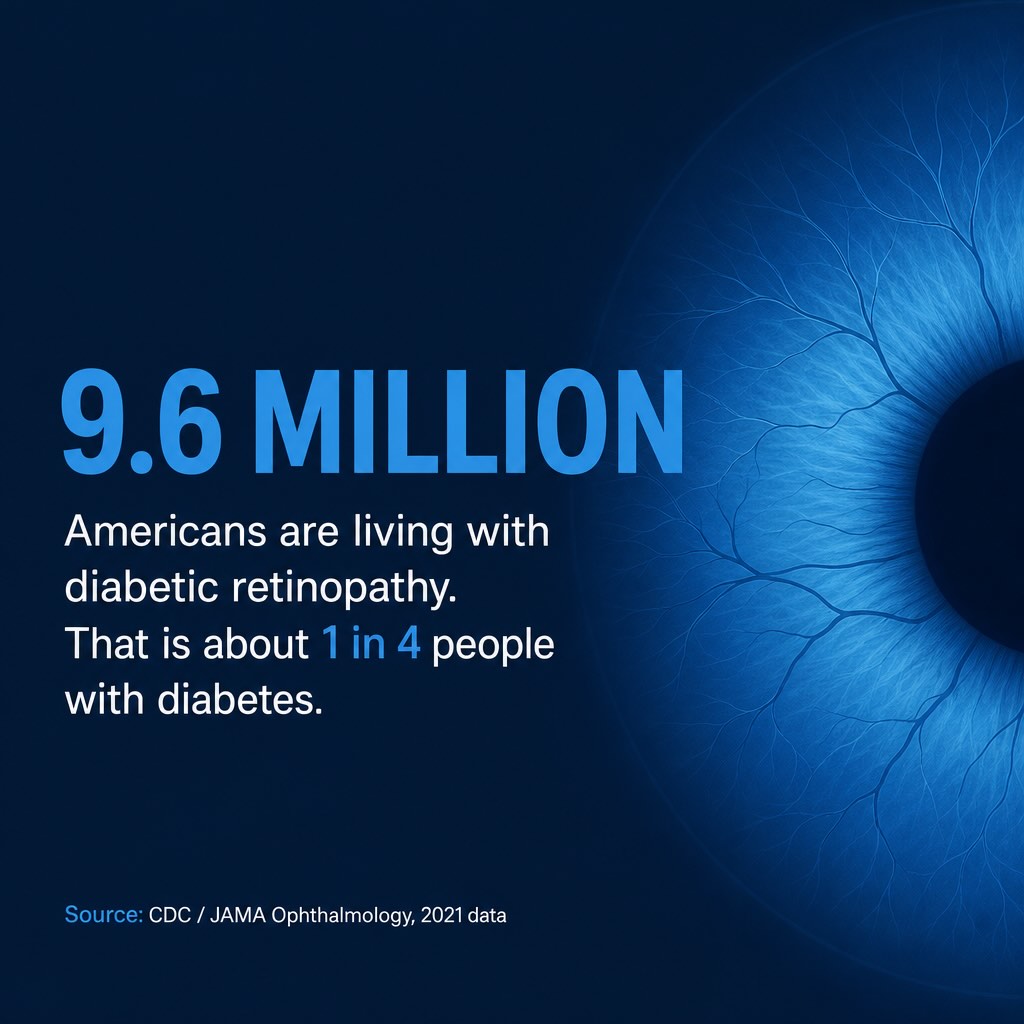
This is not a rare problem. A CDC-led study in JAMA Ophthalmology estimated that 9.6 million Americans were living with diabetic retinopathy in 2021, including 1.84 million with a form that threatens their sight.
Why You Can See Fine and Still Have Eye Disease
Early damage often does not touch the small central area of the retina you use for sharp vision, so you can read the bottom of the chart while disease is developing. Even serious retinopathy can cause no symptoms at all.
Researchers at Joslin Diabetes Center saw how wide that gap can be. In a study of nearly 27,000 people with diabetes who had their retinas imaged, 89 percent of those with mild retinopathy and 55 percent of those with vision-threatening retinopathy said they were unaware of any eye disease.
Meanwhile, many people are missing the visit that would tell them. National survey data from 2023 shows only about two-thirds of adults with diagnosed diabetes reported an eye exam in the past year.
When symptoms do appear, they can include spots or floaters, blurry vision, a dark or empty area in the center of your vision, and poor night vision. These symptoms can come and go, and the damage can continue even when they fade. If you have a sudden change in vision, a burst of new floaters, or flashes of light, call an eye doctor the same day.
What a Dilated Exam Shows That a Vision Check Cannot
A basic vision screening answers one question: how well can you read the letters? It says very little about the health of the eye. That is the difference between a screening and a comprehensive exam.
During a dilated exam, your doctor uses drops to widen your pupils, which opens a much clearer view of the retina, blood vessels, macula, and optic nerve. Your doctor looks for leaking vessels, swelling, bleeding, and abnormal new vessels, and also checks your eye pressure and your lenses for signs of glaucoma and cataracts. Your visit may also include retinal photos or other imaging, which create a useful record for comparing year to year. Photos have value, but the American Diabetes Association is clear that they do not replace a dilated comprehensive exam.
Plan for your vision to stay blurry and light sensitive for a few hours afterward. Bring sunglasses, and ask someone to drive you if you can.
How Often You Need a Diabetic Eye Exam
The American Diabetes Association’s 2026 Standards of Care set out when dilated exams should begin. With type 2 diabetes, your first exam should happen at diagnosis, because blood sugar may have been high for years before anyone caught it. With type 1 diabetes, the first exam should happen five years after diagnosis. Children and teens with diabetes need screening too, so ask your child’s care team when to start.
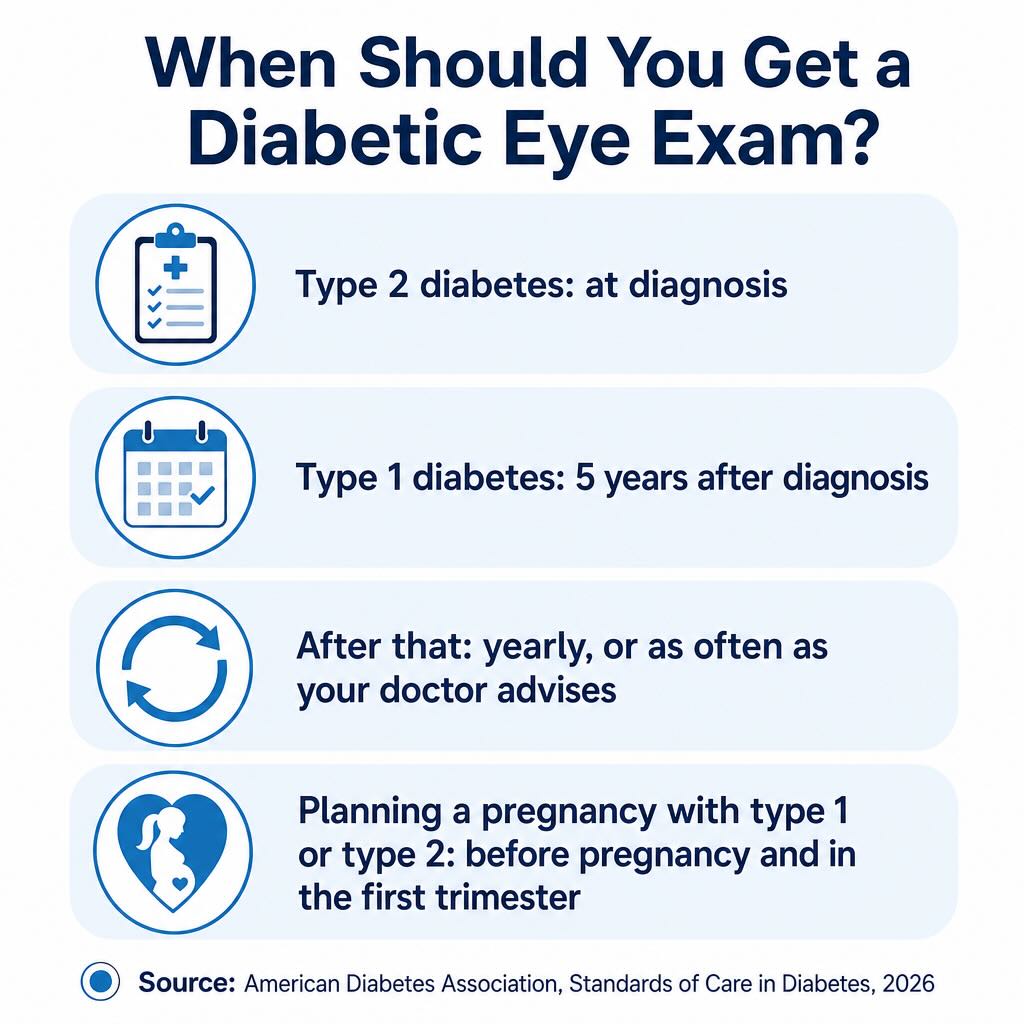
After that first visit, plan on once a year. If you have had one or more clear exams and your blood sugar is at goal, your doctor may decide you can stretch to every one to two years, but that is a decision to make together. If any retinopathy is present, exams should happen at least yearly, and more often if it is progressing.
Pregnancy calls for extra attention. If you have type 1 or type 2 diabetes, get an exam before pregnancy and in the first trimester, since you may need monitoring through each trimester and for a year after delivery. Gestational diabetes does not typically call for an eye exam during pregnancy.
Who Faces a Higher Risk
Anyone with type 1 or type 2 diabetes can develop diabetic eye disease, but these factors raise the odds:
- Years with diabetes: risk grows over time.
- Blood sugar above goal: ongoing high levels drive the damage.
- High blood pressure or cholesterol: both add to retinal risk.
- Kidney disease: it is linked to retinopathy.
- Pregnancy with existing diabetes: retinopathy can start or worsen.
- Black or Hispanic background: vision-threatening disease is more common.
The difference across communities is striking. The JAMA Ophthalmology study estimated that vision-threatening retinopathy affects about 8.7 percent of Black and 7.1 percent of Hispanic people with diabetes, compared with about 3.6 percent of White people with diabetes. For Spanish-speaking patients and families, we are glad to walk through your results in Spanish. Se habla espanol.
Medication changes matter too. If you have started or increased a GLP-1 medication such as Ozempic, tell your eye doctor. The American Diabetes Association advises checking retinopathy status when glucose-lowering treatment is stepped up, since a rapid drop in A1C can cause a temporary early worsening. Do not stop any medication on your own. Your eye doctor and diabetes care team can coordinate the plan.
What Happens If We Find Something
Finding retinopathy early is good news, even if it does not feel that way. Early stages may need only closer monitoring and steady work on blood sugar, blood pressure, and cholesterol. If your exam shows more advanced disease or macular edema, your doctor will refer you promptly to an ophthalmologist experienced in diabetic retinopathy for treatment, which may include medication injections in the eye or laser therapy.
The payoff for catching it in time is large. According to the National Eye Institute, early detection, timely treatment, and appropriate follow-up can reduce the risk of severe vision loss from diabetic retinopathy by 95 percent. Waiting carries a real cost, because vision that is lost often cannot be restored.
Between visits, your daily habits help protect your sight. Keep your blood sugar, blood pressure, and cholesterol in your target ranges, take your medications as prescribed, stay active, and quit smoking if you smoke.
How Diabetic Eye Exams Are Usually Billed
Many patients assume an eye exam always falls under a vision plan. Because diabetes is a medical condition, a diabetic eye exam is often billed to your medical insurance instead. Medicare Part B, for example, covers an eye exam for diabetic retinopathy once a year, and you pay 20 percent of the Medicare-approved amount after your deductible. Coverage varies by plan, so bring your medical and vision insurance cards, and our team can help you sort out what applies.
Bring your medication list and your most recent A1C if you have it. You can also ask us to share your results with your primary care doctor or endocrinologist, so your whole care team is working from the same picture.
Seeing fine does not always mean your eyes are healthy. Book your yearly diabetic eye exam today.
Our doctors provide comprehensive dilated eye exams for patients with diabetes at our three Chicagoland locations in Addison, Burbank, and Willowbrook. Se habla espanol.
Book online: Request an appointment
Call us: 1-888-899-0816
Addison: 1250 W Lake St #19c, (630) 543-0607
Burbank: 8525 S Harlem Ave, (708) 599-0050
Willowbrook: 6300 Kingery Hwy #116, (630) 969-2807
Hours: Mon to Thu 10am to 6pm, Fri 10am to 5pm, Sat 9am to 2pm
Frequently Asked Questions
Do I need a dilated eye exam if my vision is fine?
Yes. Diabetic retinopathy often has no symptoms in its early stages, and even vision-threatening disease can go unnoticed. A dilated exam lets your eye doctor find damage before it affects your sight, when it is most treatable.
How often should someone with diabetes get a dilated eye exam?
Plan on at least once a year. The first exam should happen at diagnosis for type 2 diabetes and five years after diagnosis for type 1. If you have had clear exams and your blood sugar is at goal, your doctor may consider every one to two years. If you have any retinopathy, you will need exams at least yearly, and possibly more often.
Can diabetic retinopathy be reversed?
Vision that has been lost cannot always be restored, but treatment can prevent further loss, and current therapies help improve vision for many people. Early detection gives you the most options, which is why regular exams matter even before you notice a problem.
Can an optometrist do a diabetic eye exam?
Yes. The American Diabetes Association recommends dilated eye exams by an ophthalmologist or an optometrist. If your exam shows disease that needs treatment, your optometrist will refer you to an ophthalmologist with experience in diabetic retinopathy.
Does insurance cover a diabetic eye exam?
Often, yes. Diabetic eye exams are commonly billed to medical insurance rather than a vision plan, and Medicare Part B covers one eye exam for diabetic retinopathy each year, with the usual deductible and 20 percent coinsurance. Coverage varies, so bring both your medical and vision insurance cards to your visit.