
You’re reading, driving, or just looking across the room, and suddenly you notice it: a small speck drifting through your field of vision, or a quick flash of light at the edge of your eye. For most people, this moment triggers an immediate question: is this normal, or do I need to get my eyes checked right now?
The honest answer is that it depends on the details. Floaters and flashes are extremely common, especially as we get older, and in many cases they are a harmless part of how the eye ages. But in a smaller number of cases, they are the first sign of a retinal tear or detachment, a true eye emergency that needs same-day evaluation. This guide walks through what’s actually happening inside your eye, which symptoms can wait for a routine visit, and which ones mean you should call your eye doctor today.
In this article:
What Floaters and Flashes Actually Are
Floaters are the small specks, threads, cobwebs, or squiggly lines that seem to drift across your vision, most noticeable when you look at a plain bright background like a blue sky or a white wall. They aren’t actually on the surface of your eye. They’re tiny clumps of protein and cell debris floating inside the gel-like vitreous that fills the back of the eye, casting shadows on the retina as light passes through.
Flashes, sometimes called photopsias, are brief bursts or streaks of light, often described as lightning bolts or camera flashes at the edge of your vision. They happen when the vitreous tugs on the retina, which interprets that mechanical pull as light even though no light is actually involved. Flashes are especially common in dim lighting or when you move your eyes quickly.
Why They Happen: Posterior Vitreous Detachment
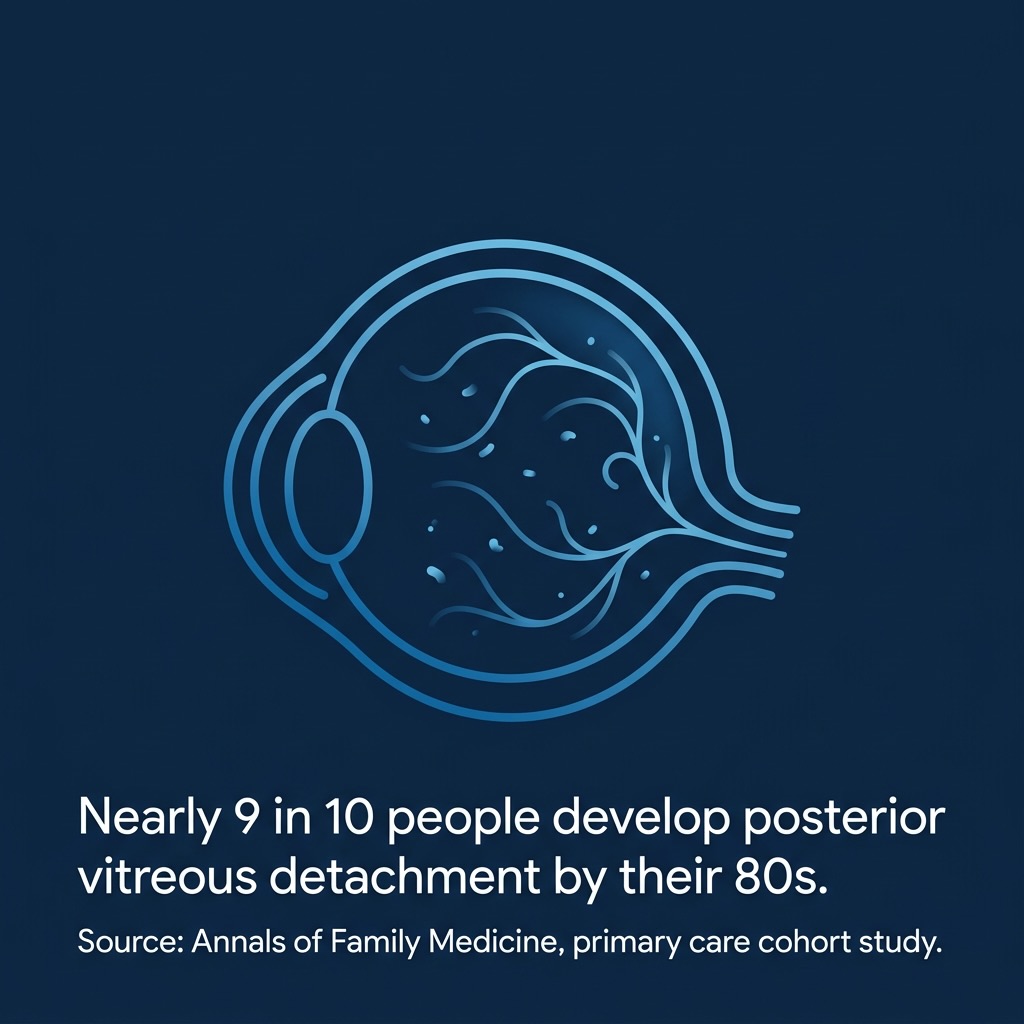
The vitreous is firmly attached to the retina at birth, but it naturally becomes more liquid and stringy with age. Eventually, it separates from the back of the eye in a process called posterior vitreous detachment, or PVD. This is not a disease. It’s a normal, expected part of aging, similar to gray hair or reading glasses, and most people experience it at some point in their 50s, 60s, 70s, or 80s.
PVD is what causes that sudden new floater or two, and sometimes flashes, that people notice out of nowhere. In most cases, the vitreous separates cleanly and the retina underneath is completely unharmed. The trouble starts when the vitreous is tugging on a spot where it’s more firmly attached than usual. That extra pull can create a small tear in the retina, and if fluid gets behind that tear, it can progress to a retinal detachment, a true emergency that threatens permanent vision loss if it isn’t treated quickly.
When Floaters and Flashes Are Usually Normal
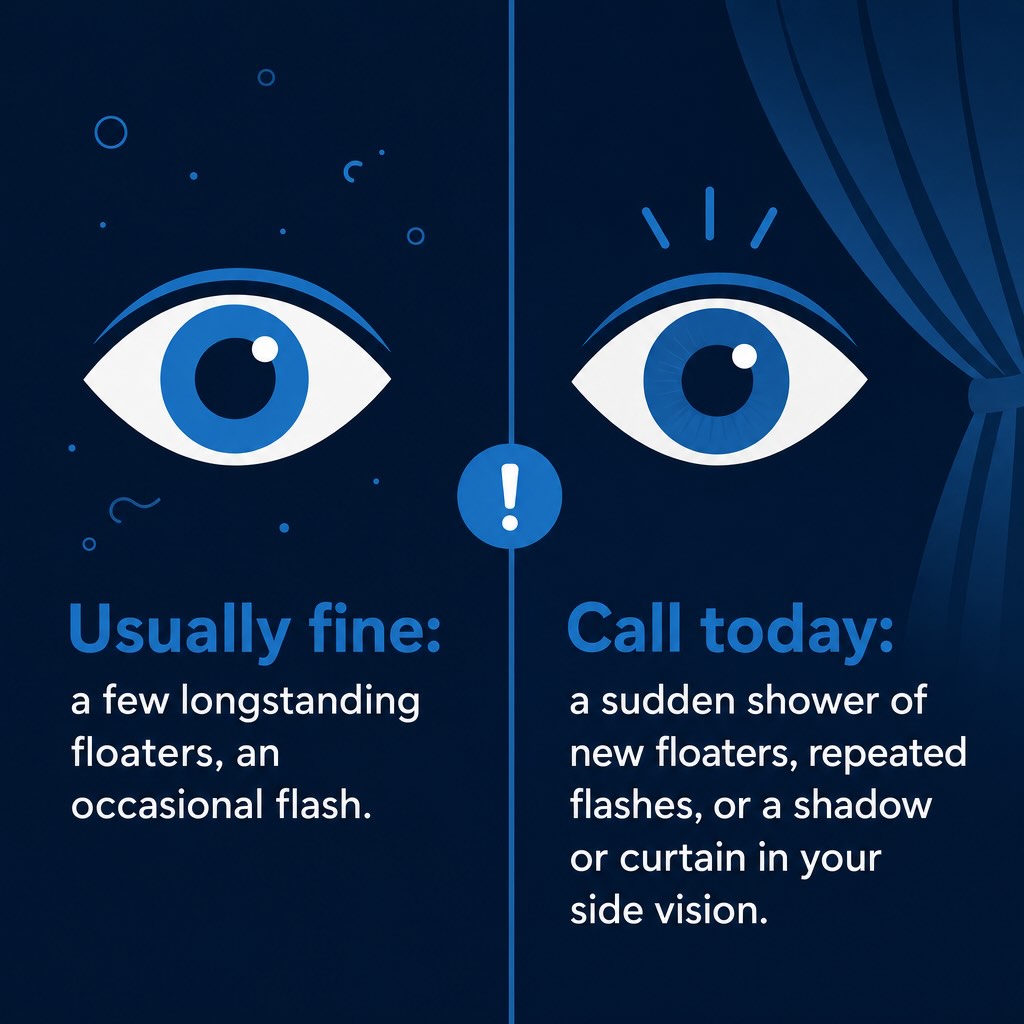
A handful of longstanding floaters that you’ve had for months or years, that stay roughly the same in number and appearance, are generally nothing to worry about. The same is true of an occasional flash that shows up when you rub your eyes, stand up quickly, or catch a bright light at an angle. These are common, everyday experiences, and they don’t usually mean anything is wrong with the retina itself.
What matters most is the word new. A slow, familiar floater you’ve lived with for years is a very different situation from a sudden shower of new specks that appeared this week. Timing and change are the two biggest clues your eyes are trying to give you, and they’re exactly what your eye doctor is trained to sort through.
Warning Signs That Need Same-Day Care
In one prospective study of patients who sought care for new floaters or flashes, close to 1 in 10 turned out to have an actual retinal tear on examination, and the risk climbed higher when flashes were involved alongside the floaters. That’s exactly why certain symptom patterns deserve a same-day call rather than a wait-and-see approach.
Call your eye doctor the same day if you notice any of the following:
- A sudden shower of new floaters: Dozens of new specks appearing over hours or days, rather than the slow accumulation of a few over months.
- New or worsening flashes: Repeated lightning bolt or camera flash sensations, especially in the side of your vision, particularly if they’re new for you.
- A shadow or curtain effect: Any dark area, veil, or curtain creeping in from the edge of your vision, which can signal an active retinal detachment.
- Sudden blurred or reduced vision: A drop in clarity that shows up alongside new floaters or flashes, rather than a gradual change.
- Symptoms after an eye injury: Any new floaters or flashes following a blow to the head or eye, which raises the odds of a traumatic retinal tear.
None of these symptoms are things to monitor at home or Google your way through. A same-day, dilated exam is the only reliable way to see the retina clearly enough to rule out a tear or detachment, and catching a tear early often means a quick in-office laser or freeze treatment instead of surgery.
Who’s at Higher Risk
Anyone can develop floaters and flashes, but a few groups are more likely to see a retinal tear when they do. People over 50 are at higher risk simply because PVD becomes far more common with age. People with moderate to high nearsightedness have a longer, more stretched eyeball shape that puts extra tension on the retina, which is one more reason a comprehensive dilated eye exam, not just a quick vision screening, matters for our nearsighted patients throughout life. A previous retinal tear or detachment in either eye, recent eye surgery, and a history of significant eye trauma also raise the odds and are worth mentioning to your doctor even if your current symptoms seem mild.
What Happens During Your Exam
If you call us with new floaters or flashes, we’ll get you into the office quickly, often the same day, because timing genuinely matters for retinal health. Your exam will include pupil dilation, which lets your doctor see all the way to the edges of the retina where most tears occur. This is a more thorough look than a basic vision screening can ever provide, since a screening checks how clearly you see, not the physical condition of the retina itself.
Most patients leave with reassuring news and a clear picture of what’s normal for their eyes going forward. If a tear is found, we can often treat it right in the office, and if everything looks healthy, you’ll know exactly which symptoms should prompt a call in the future.
Sudden new floaters or flashes? Don’t wait it out, same-day exams are available.
A quick dilated exam is the only way to know for certain what’s causing your symptoms. Our doctors see patients across three convenient Chicagoland locations. Se habla espanol.
Book online: Request an appointment
Call us: 1-888-899-0816
Addison: 1250 W Lake St #19c, (630) 543-0607
Burbank: 8525 S Harlem Ave, (708) 599-0050
Willowbrook: 6300 Kingery Hwy #116, (630) 969-2807
Hours: Mon to Thu 10am to 6pm, Fri 10am to 5pm, Sat 9am to 2pm
Frequently Asked Questions
Are floaters normal, or should I be worried?
A few longstanding floaters that have stayed roughly the same for months or years are usually normal and simply part of how the vitreous ages. A sudden increase in new floaters is different and is worth a prompt exam to rule out a retinal tear.
What do flashes of light mean?
Flashes happen when the vitreous tugs on the retina, which the retina interprets as light. Occasional flashes from rubbing your eyes or standing up quickly are typically harmless. New, repeated flashes, especially alongside new floaters, should be evaluated the same day.
When should I go to the ER for floaters and flashes?
If you notice a dark shadow or curtain spreading across part of your vision, or a sudden major loss of vision, seek emergency eye care immediately, whether that’s an eye doctor’s same-day appointment or an emergency room with ophthalmology on call. These can be signs of an active retinal detachment.
Can floaters go away on their own?
Existing floaters often become less noticeable over time as your brain adapts and the debris settles, though they rarely disappear completely. A sudden new batch of floaters should still be examined, since the underlying cause matters more than whether the floaters themselves fade.
Am I at higher risk if I’m nearsighted?
Yes. Moderate to high nearsightedness stretches the shape of the eye and adds extra tension on the retina, which raises the risk of a retinal tear when posterior vitreous detachment occurs. This is one reason comprehensive dilated exams matter throughout life for nearsighted patients, not just when new symptoms appear.