
It is two in the morning, your eye has been red and gritty since dinner, and the office does not open for hours. So you do what a lot of people now do first: you open ChatGPT and describe your symptoms. Within seconds you have a tidy list of possible causes, from allergies to pink eye to something rarer, and maybe a little more worry than you started with.
You are far from alone. Research on AI chatbots and self-diagnosis shows that most people who try this route say they would do it again, and a growing share of patients now bring a chatbot’s opinion into the exam room. AI can be a genuinely useful starting point for understanding a symptom. What it cannot do is look inside your eye, and for a lot of eye problems, that is the part that actually matters.
In this article:
- Why So Many People Ask AI About Their Eyes First
- What AI Chatbots Can Actually Get Right
- Where AI Falls Short, and Why It Matters for Your Eyes
- Symptoms That Should Never Wait on a Chatbot Answer
- What a Comprehensive Eye Exam Catches That AI Cannot
- The Bottom Line: AI as a Starting Point, Not a Diagnosis
Why So Many People Ask AI About Their Eyes First
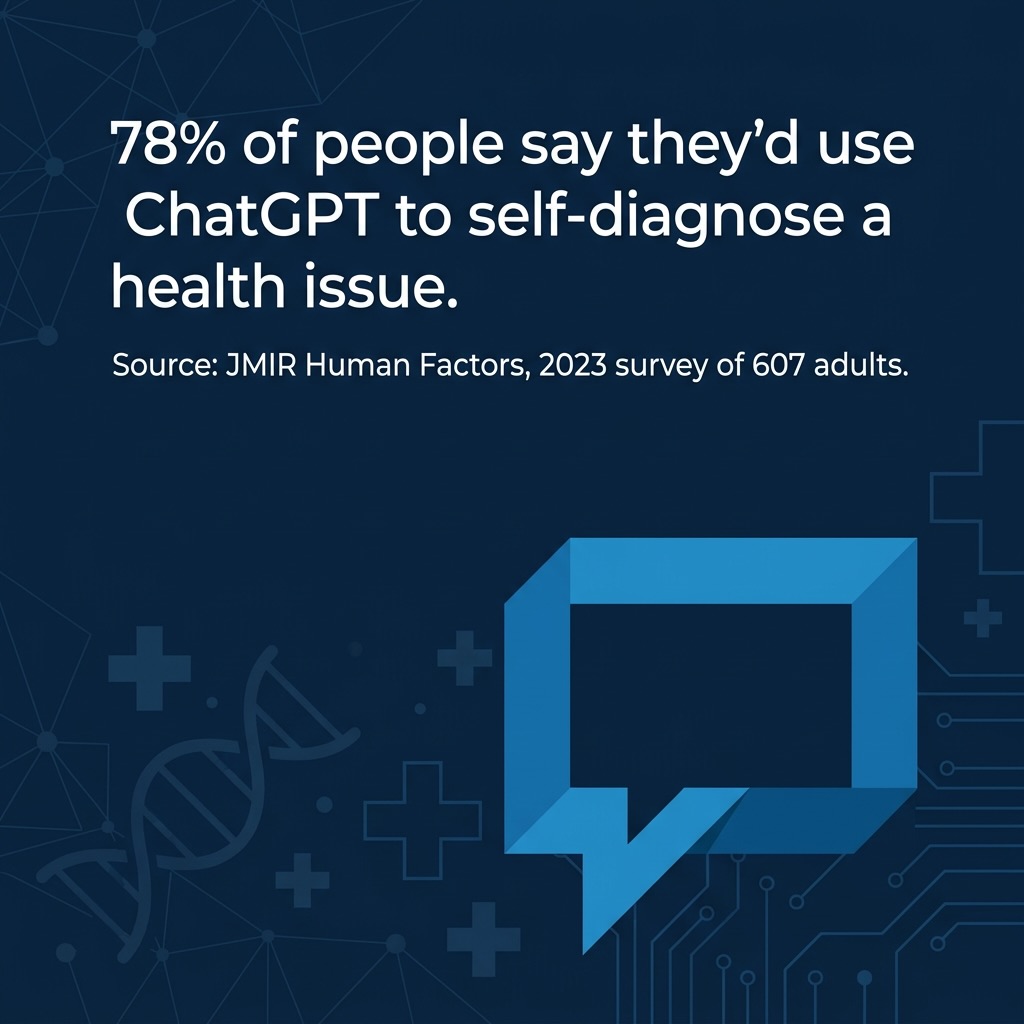
The appeal is easy to understand. AI chatbots are available at any hour, they do not make you wait on hold, and they can turn a confusing symptom into plain language in seconds. A 2023 survey published in JMIR Human Factors found that roughly 78 percent of respondents said they were willing to use ChatGPT for self-diagnosis, and separate national polling has found that about one in six adults now check symptoms or ask health questions through an AI chatbot at least once a month. For eye symptoms specifically, that instinct makes sense. Redness, itching, blurry patches, and floaters are unsettling, and a quick explanation can feel like relief even before you have seen a doctor.
The trouble is that an eye is not like most other parts of the body when it comes to describing what is wrong. Two very different conditions, one harmless and one urgent, can produce almost identical symptoms in a patient’s own words. A chatbot only has your description to work with. It cannot tell the difference between a stye and a shingles outbreak near the eye, or between ordinary eye strain and the early stage of a retinal problem, because it never actually sees your eye.
What AI Chatbots Can Actually Get Right
It would be unfair to say AI has no place in eye health. Used the right way, a chatbot can be a helpful first stop rather than a final answer. It can explain unfamiliar terms after a visit, such as what “astigmatism” or “posterior vitreous detachment” actually means. It can help you organize your symptoms and their timeline before a call to the office, which often makes triage faster on our end. It can also offer general education about common conditions like dry eye or seasonal allergies, the kind of background information that helps a patient ask better questions during their appointment.
Where this becomes risky is the jump from “here is some general information” to “here is what is wrong with you.” Large language models are built to generate a plausible, confident-sounding response to almost any question, even when the honest answer should be “this needs to be looked at in person.” That confidence is exactly what makes AI feel trustworthy, and exactly why it can be misleading for a medical decision.
Where AI Falls Short, and Why It Matters for Your Eyes
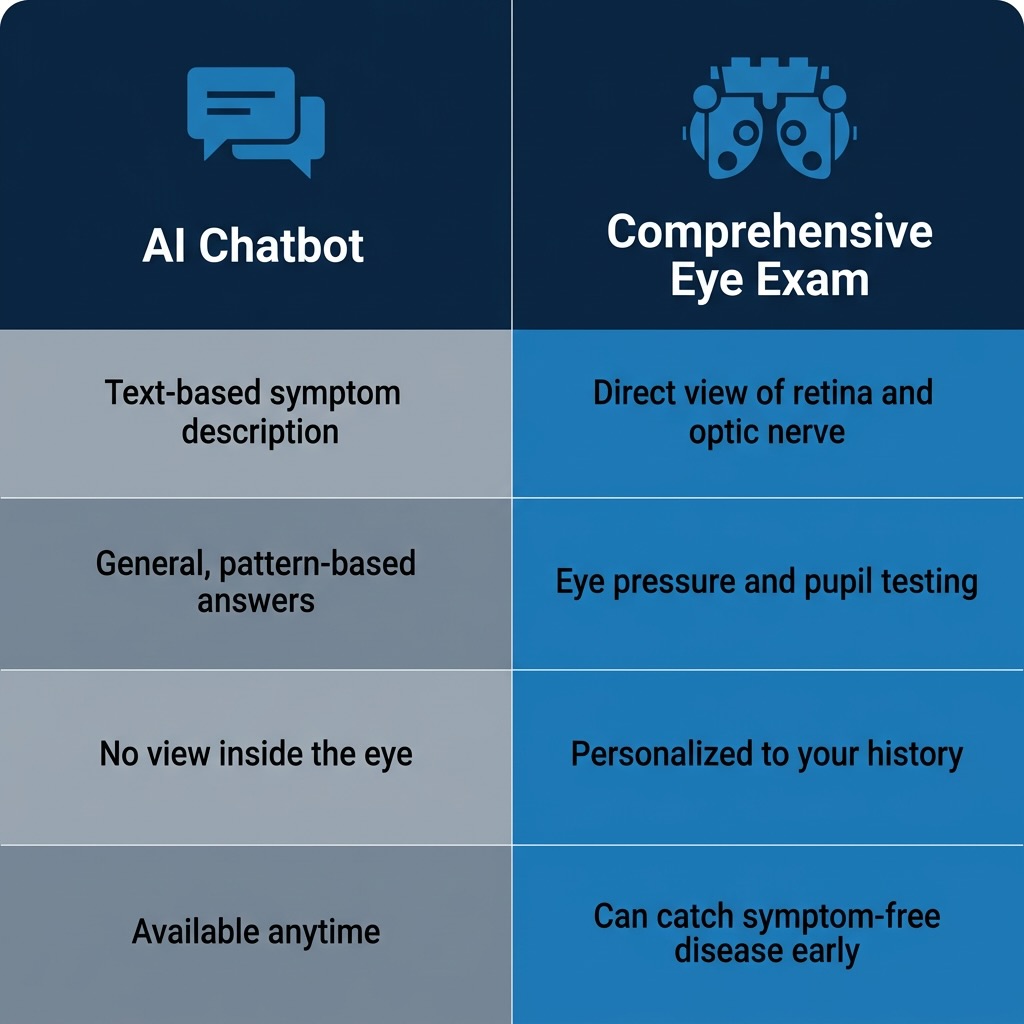
An eye exam is built around information a chatbot simply does not have access to. A doctor examines the physical structure of your eye under magnification, checks the pressure inside it, evaluates how your pupils respond to light, and looks directly at the retina and optic nerve in the back of your eye. None of that can be replicated by typing a description into a text box. The gaps tend to show up in a few consistent ways.
- No physical exam. A chatbot cannot dilate your pupils, measure eye pressure, or view your retina, which is where many serious conditions actually begin.
- No way to tell urgency apart from annoyance. “Red eye” can mean allergies or a corneal infection that threatens your vision, and the words a patient uses often sound the same for both.
- No access to your history. Your prescription, prior eye conditions, family history, and current medications all change what a symptom likely means, and a general chatbot rarely has that full picture.
- Generic, not personalized, advice. Responses are built from patterns in text, not from your specific eyes, so recommendations can miss details that matter for your particular case.
None of this makes AI useless, but it explains why it works best as a companion to care rather than a substitute for it. A comprehensive exam catches early, symptom-free damage from conditions like glaucoma specifically because it does not rely on the patient noticing something is wrong first.
Symptoms That Should Never Wait on a Chatbot Answer
Some eye symptoms are safe to research casually while you wait for a routine appointment. Others are a signal to call an eye doctor the same day, no matter what an AI summary suggests. Sudden vision loss or a curtain-like shadow across part of your vision needs urgent attention, since it can point to a retinal detachment. A sudden sharp increase in floaters or flashes of light, especially together, deserves the same urgency. Eye pain paired with nausea, a headache, and blurry vision can be a sign of an acute pressure spike and should not wait. Any eye injury, chemical exposure, or sudden double vision also belongs in front of a doctor right away, not in a chat window. If you are experiencing any of these, please call our office directly rather than searching for an explanation first.
What a Comprehensive Eye Exam Catches That AI Cannot
This is the heart of the difference. A comprehensive eye exam is not just a vision check, it is a structured look at the health of the entire eye, often finding problems before you have any symptoms at all. Glaucoma is sometimes called the “silent thief of sight” because it can progress for years without pain or noticeable vision change, and it is typically caught through pressure testing and an exam of the optic nerve, not through a symptom description. The same is true for early diabetic retinopathy, which can quietly affect the retina long before it affects your day-to-day vision. A basic vision screening, or an online questionnaire, is not built to catch either one. This is a large part of why our doctors emphasize comprehensive exams over quick screenings for every patient, regardless of age.
The Bottom Line: AI as a Starting Point, Not a Diagnosis
Asking a chatbot about a symptom is not the problem. Stopping there is. Think of AI the way you might think of a symptom checklist you fill out in a waiting room: useful for organizing your thoughts, not a substitute for the person who is actually going to look at your eye. If something feels off, whether it is new blur, redness that will not clear up, or floaters that showed up out of nowhere, the fastest way to get a real answer is still a comprehensive exam with a doctor who can see what is actually happening.
Do not let a search engine or a chatbot be the last word on your eye symptoms.
Our doctors at The Eye Care Center offer comprehensive eye exams at our Addison, Burbank, and Willowbrook locations, with same-week appointments available for new symptoms. Se habla espanol.
Book online: Request an appointment
Call us: 1-888-899-0816
Addison: 1250 W Lake St #19c, (630) 543-0607
Burbank: 8525 S Harlem Ave, (708) 599-0050
Willowbrook: 6300 Kingery Hwy #116, (630) 969-2807
Hours: Mon to Thu 10am to 6pm, Fri 10am to 5pm, Sat 9am to 2pm
Frequently Asked Questions
Is it safe to use ChatGPT to figure out what is wrong with my eye?
It is fine to use AI to understand general terms or organize your symptoms before an appointment. It is not safe to rely on it as a diagnosis, since it cannot examine your eye and often cannot tell a minor irritation apart from a more serious condition based on your description alone.
Can AI tell if my red eye is an emergency?
Not reliably. Conditions ranging from mild allergies to a serious corneal infection can all be described with similar words like redness, irritation, and sensitivity to light. A doctor needs to look directly at the eye to tell these apart, which is something a chatbot cannot do.
Why do I need a comprehensive eye exam if my vision feels fine?
Several serious eye conditions, including glaucoma and early diabetic retinopathy, often develop without any noticeable symptoms in their early stages. A comprehensive exam checks the internal health of the eye directly, which is the main way these conditions are caught early enough to protect your vision.
What symptoms mean I should call the eye doctor instead of searching online?
Sudden vision loss, a shadow or curtain across your vision, a sudden increase in floaters or flashes, eye pain with nausea or headache, an eye injury, or sudden double vision all warrant a same-day call to your eye doctor rather than an online search.
Do you offer eye exams in Spanish?
Yes. Se habla espanol at all three of our Chicagoland locations, in Addison, Burbank, and Willowbrook.