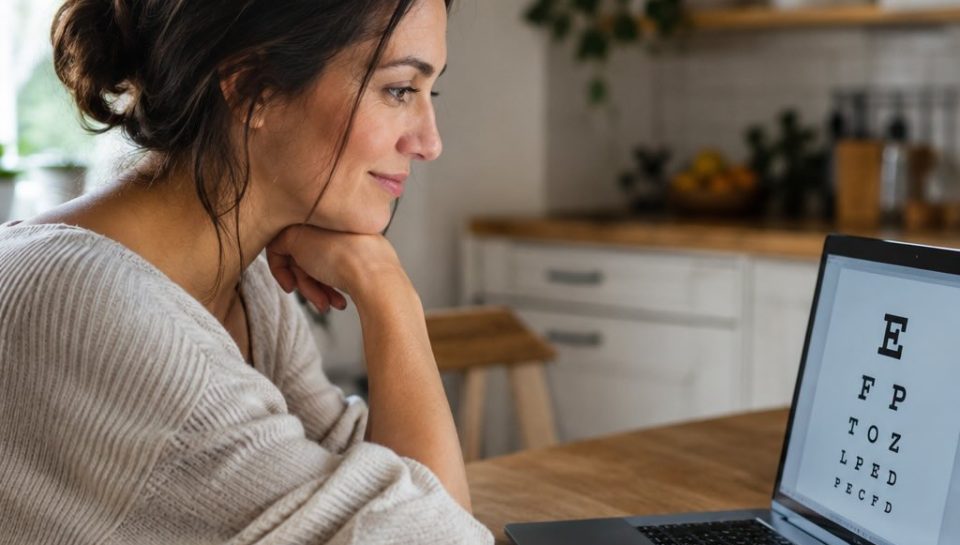
It is easy to see the appeal. Open an app, stare at a screen for a few minutes, answer some questions about which letters look clearer, and get a number that claims to tell you your prescription. No waiting room, no drive to Addison, Burbank, or Willowbrook, no co-pay. For a lot of patients, that convenience feels like it might be enough.
It is not, and the reason has nothing to do with whether the technology works as advertised. Even the best online vision test or AI powered screening app is built to answer one narrow question: how clearly can you read letters on a screen right now. A comprehensive eye exam is built to answer a much bigger one: is everything about your eyes actually healthy. Those are different questions, and mixing them up is where patients can get into trouble.
In this article:
What Online Vision Tests and AI Apps Actually Measure
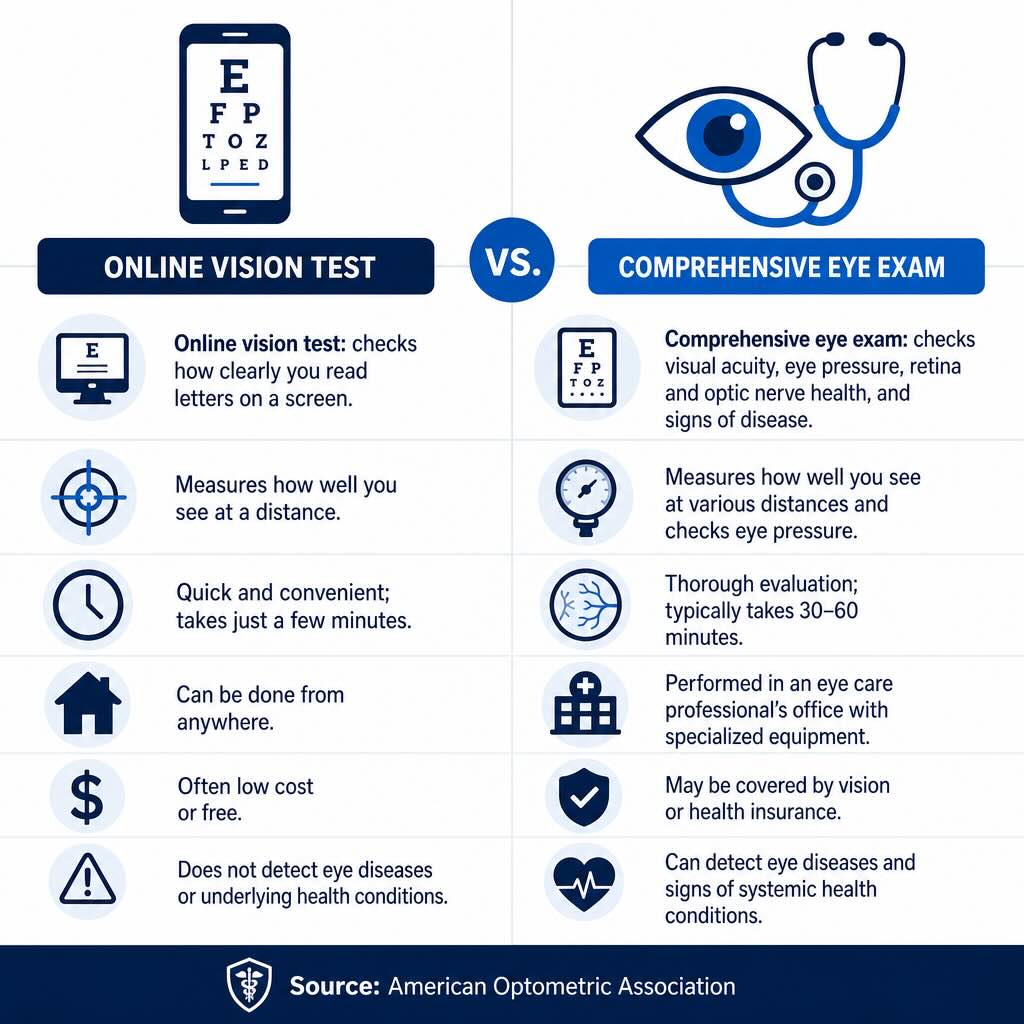
Most online vision tests and AI powered apps are designed to do one thing well: estimate visual acuity, meaning how sharply you can see at a given distance, and in some cases estimate a refractive error, meaning your glasses prescription. A handful of these tools have actually received FDA clearance for that narrow purpose. That clearance means the tool has been reviewed for whether it measures what it claims to measure, not that it has been approved as a substitute for a doctor’s exam.
A systematic review and meta-analysis of mobile app based visual acuity tests, published in the Journal of Medical Internet Research, found these apps can perform reasonably well at the specific job of estimating acuity, with pooled sensitivity around 86 percent when compared to in-clinic testing. That is a meaningful number, and it is also the ceiling of what these tools are built to do. They are not designed to look at the health of the eye itself.
Where These Tools Fall Short
No dilation, no view inside the eye. The retina, optic nerve, and blood vessels stay unseen.
No intraocular pressure check. Early glaucoma risk goes unmeasured entirely.
No screening for diabetic or age related eye disease. Conditions that damage vision silently stay silent.
Your device and environment change the result. Screen size, distance, and lighting are not medically calibrated.
That last point matters more than most people realize. A comprehensive exam uses calibrated clinical instruments and a trained doctor’s judgment. An app is working with whatever screen, camera, and lighting happen to be in your kitchen that day. Small differences in how far you are sitting from the screen or how bright the room is can shift the result enough to matter, especially for anyone who needs a higher or more irregular prescription. And none of these tools can examine the physical structures of your eye, which is where most serious eye disease actually shows up first.
Why a Screening Is Not the Same as a Comprehensive Exam
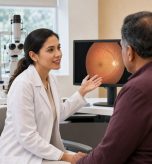
This is the distinction that matters most, and it is worth saying plainly. A screening tells you whether one specific measurement falls inside or outside a normal range. A comprehensive eye exam evaluates the whole system: your prescription, yes, but also your eye pressure, your retina, your optic nerve, your eye muscle coordination, and any early signs of conditions like glaucoma, diabetic retinopathy, or macular degeneration. Many of these conditions cause no symptoms at all in their early stages, which is exactly when treatment does the most good.
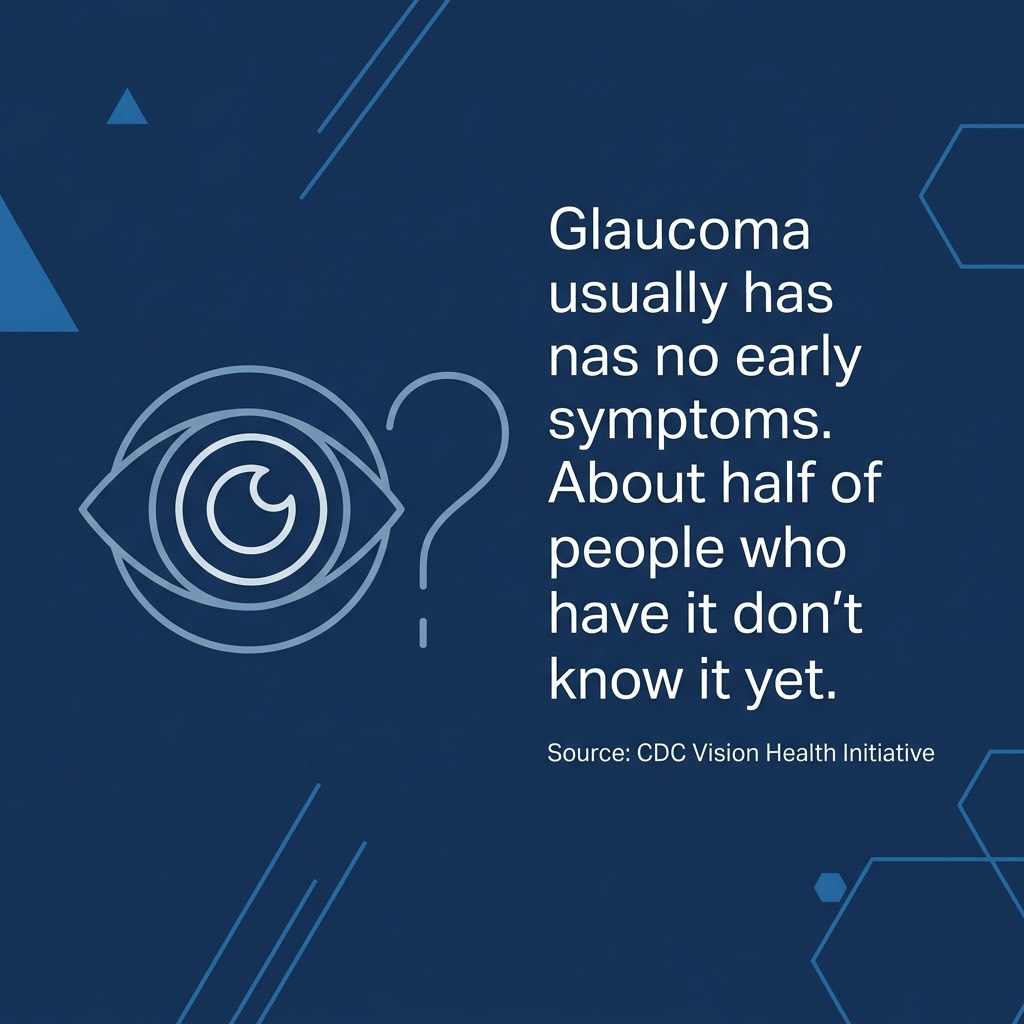
The CDC’s Vision Health Initiative puts this plainly for glaucoma specifically: because the disease usually has no early warning signs, roughly half of the people who have it do not yet know it. A normal result on an online vision test cannot rule that out, because the test was never designed to look for it in the first place. A clean at-home result can feel like reassurance, but it is really just one narrow piece of a much bigger picture.
The American Optometric Association’s current guidance reflects how seriously the field takes that gap. Its updated clinical practice guideline now recommends an annual comprehensive eye exam for all adults 18 and older, a shift from older guidance that reserved yearly visits mainly for adults 65 and up or those with known risk factors. That is not a small update. It is a recognition that waiting for symptoms, or relying on a quick acuity check, means missing problems while they are still easiest to treat.
When an At-Home Check Can Still Be Useful
None of this means online vision tests are worthless. Between comprehensive exams, they can be a reasonable way to notice a change worth mentioning to your doctor, or a quick gut check before deciding whether an appointment is worth moving up. They are simply not a substitute for the exam itself, and most vision insurance plans agree, since many do not cover glasses or contacts issued from an online test result alone. Think of these apps as a smoke detector, not a fire inspection. They can flag that something might be worth a closer look. They cannot tell you the building is actually safe.
The Bottom Line
Technology has made a lot of healthcare more convenient, and vision care is no exception. But convenience and completeness are not the same thing. An online vision test or AI vision app can give you a rough read on how clearly you see today. Only a comprehensive eye exam, with a doctor who can look at the actual health of your eyes, can tell you whether everything back there is working the way it should. If it has been a while since your last visit, our recent guide on how often you really need a comprehensive eye exam walks through the current recommendations by age and risk factor.
Skip the guesswork and get a real answer about your eyes.
Book a comprehensive eye exam at one of our three Chicagoland locations and get a full picture of your vision and eye health, not just a screen based estimate. Se habla espanol.
Book online: Request an appointment
Call us: 1-888-899-0816
Addison: 1250 W Lake St #19c, (630) 543-0607
Burbank: 8525 S Harlem Ave, (708) 599-0050
Willowbrook: 6300 Kingery Hwy #116, (630) 969-2807
Hours: Mon to Thu 10am to 6pm, Fri 10am to 5pm, Sat 9am to 2pm
Frequently Asked Questions
Can an online eye exam give me a new eyeglass prescription?
Some online tools can estimate a prescription, and a few have FDA clearance for that specific purpose. However, most optical retailers and many insurance plans will not fill a prescription based solely on an online test, and the estimate can be less reliable for higher or more irregular prescriptions. A comprehensive exam remains the most reliable way to get a prescription you can count on.
Are AI vision test apps accurate?
For the narrow task of estimating visual acuity, research shows these apps can perform reasonably well compared to in-clinic testing. Accuracy depends heavily on your device, lighting, and how carefully you follow the instructions, and it drops for smaller prescription changes. Accuracy for detecting eye disease is a separate question entirely, since most of these tools are not designed to check for disease at all.
What can’t an online vision test check for?
Online tests cannot examine the physical health of your eye. They cannot check eye pressure, view your retina or optic nerve, or detect conditions like glaucoma, diabetic retinopathy, cataracts, or macular degeneration. Many of these conditions have no early symptoms, which is exactly why a comprehensive exam looks for them directly rather than waiting for you to notice something is wrong.
Is a “20/20” result from an app the same as healthy eyes?
No. A clear result means you can read letters at a certain size at a certain distance under the conditions of that test. It does not mean your eyes are free of disease. Sharp vision and healthy eyes are related, but they are not the same thing, and serious conditions can be present even when your day to day eyesight still feels normal.
How often should I get a comprehensive eye exam instead of relying on an online test?
Current guidance from the American Optometric Association recommends an annual comprehensive eye exam for adults 18 and older. If you have risk factors such as diabetes, a family history of eye disease, or you are over 40, your doctor may recommend a different schedule based on your individual risk.