
You Could Spend Thousands on Prescription Dry Eye Drops and Never Actually Fix the Problem — Here’s What Most Patients Are Never Told
By Dr. Quentin Park, O.D. | The Eye Care Center LTD
Prescription dry eye drops like Xiidra and Cequa represent a genuine advance in treating one part of the dry eye equation. They reduce inflammation on the ocular surface, and for many patients they provide real, meaningful symptom relief. But there is a critical problem that most patients are never told: these drops do not address the underlying cause of dry eye in the majority of people who have it. They manage the fire, but they never find the source of the smoke. And at several hundred dollars per month, continuing them indefinitely without treating the root cause is one of the most expensive non-solutions in eye care.
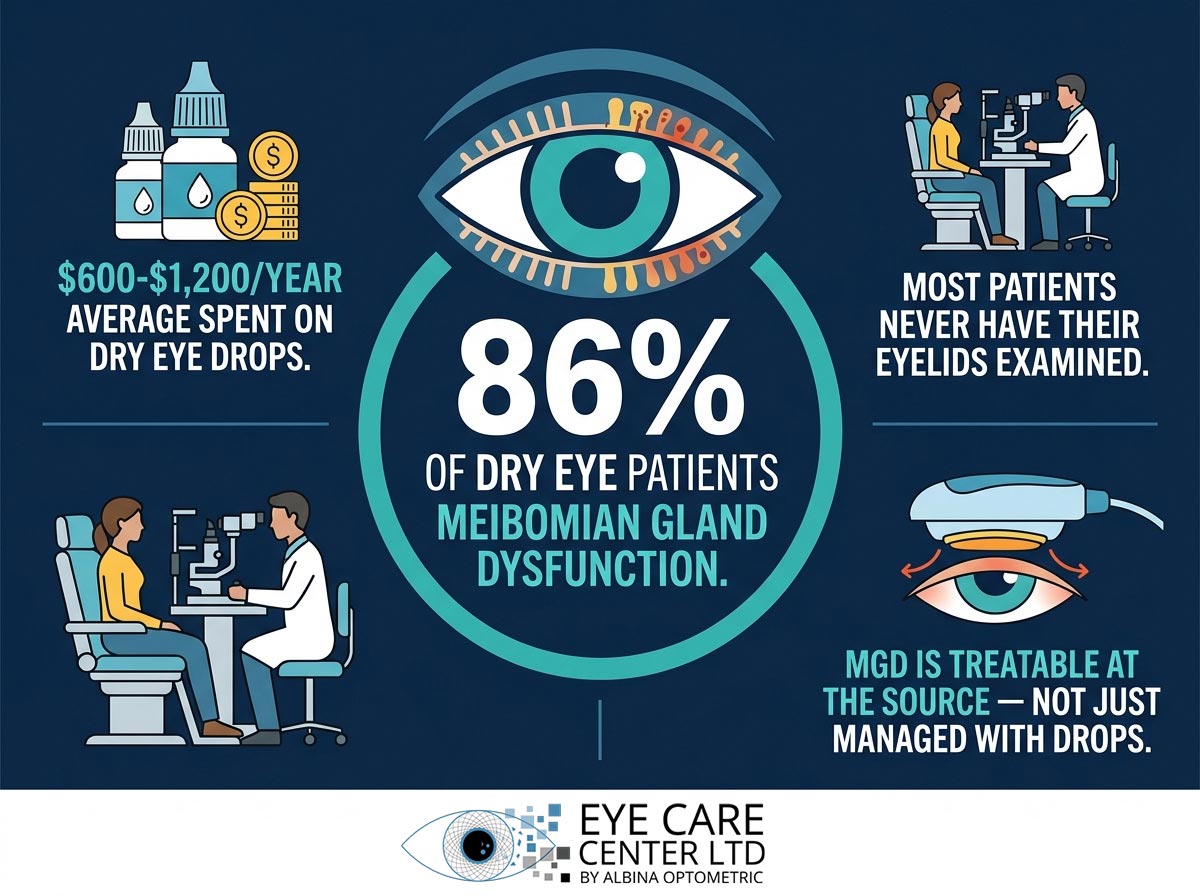
The root cause, in approximately 86% of dry eye cases, is meibomian gland dysfunction, or MGD. The meibomian glands are small oil-producing glands embedded in your eyelids that are almost certainly failing to do their job right now. When these glands become clogged or atrophied, the protective oil layer of your tear film breaks down, your tears evaporate too fast, and your eyes burn, sting, and feel permanently irritated. No amount of anti-inflammatory drops can restore a degraded lipid layer. Only treating the glands themselves can do that.
This article is for every patient who has been on Xiidra or Cequa for months or years without ever having their eyelids examined — and for anyone who has a cabinet full of artificial tears and is still miserable. Read more about how we approach dry eye care at Eye Care Center in our related article, Why Your Eyes Feel Like Sandpaper by 3 PM.
Mind-boggling fact: The average dry eye patient spends between $600 and $1,200 per year on prescription drops and over-the-counter artificial tears — often for years — without ever receiving a proper eyelid evaluation. Meibomian gland dysfunction, the cause of dry eye in 86% of patients, can be identified in minutes with a slit lamp exam and treated with in-office procedures that produce lasting improvement.
What Xiidra and Cequa actually do
Xiidra and Cequa are the two most commonly prescribed dry eye medications in the United States, and both are legitimate, FDA-approved medications with genuine evidence behind them. Understanding what they do, and what they don’t do, is the foundation for understanding why so many patients using them are still struggling.
Xiidra (lifitegrast 5%) works by blocking a specific protein interaction involved in the inflammatory cascade that damages the ocular surface in dry eye disease. Clinical trials showed meaningful reduction in both signs and symptoms of dry eye, with some benefit as early as two weeks and more substantial benefit over three months of twice-daily use. It was the first dry eye medication approved by the FDA for both the signs and symptoms of the disease.
Cequa (cyclosporine 0.09%) is a newer, higher-concentration formulation of cyclosporine A delivered in a nano-micellar vehicle designed to improve ocular penetration. It works as a calcineurin inhibitor, suppressing T-cell mediated inflammation on the ocular surface and lacrimal gland. It demonstrated superior corneal staining improvements versus vehicle in clinical trials and is considered an advance over the older Restasis formulation in both concentration and delivery.
What both medications share:
- Twice-daily dosing, intended for long-term or indefinite use
- List price of approximately $600 to $700 per month without insurance
- Symptom return when discontinued, because the underlying cause has not been addressed
- No effect on meibomian gland function or the lipid layer of the tear film
That last point is the critical one.
The treatment gap: inflammation vs. root cause
Inflammation is a real and important part of dry eye disease. When the tear film is chronically unstable, the ocular surface becomes inflamed, damaged cells produce more inflammatory mediators, and a self-reinforcing cycle develops. Breaking this cycle with Xiidra or Cequa is a legitimate therapeutic goal. The problem is that it addresses only half the issue for the majority of patients.
Evaporative dry eye accounts for roughly 65% of all dry eye cases and is driven primarily by MGD. In this form, the tear film breaks down not because of insufficient tear production but because the oily lipid layer sitting on top of the aqueous tears is inadequate. This lipid layer prevents rapid evaporation. When it is thin, degraded, or absent, tears evaporate within seconds of a blink.
The result: the ocular surface dries out, inflammation develops, Xiidra or Cequa address the inflammation — but the glands are still blocked. The lipid layer is still deficient. Every blink still results in rapid evaporation. Inflammation returns the moment the drops stop, and the underlying glandular disease continues to progress, with meibomian glands undergoing irreversible atrophy in the meantime.
This is not a criticism of the medications themselves. The gap is in the diagnostic process that precedes the prescription. A patient with dry eye symptoms who receives a Xiidra or Cequa prescription without a meibomian gland evaluation has received treatment for a symptom without a diagnosis of the cause.
What meibomian glands are and why they fail
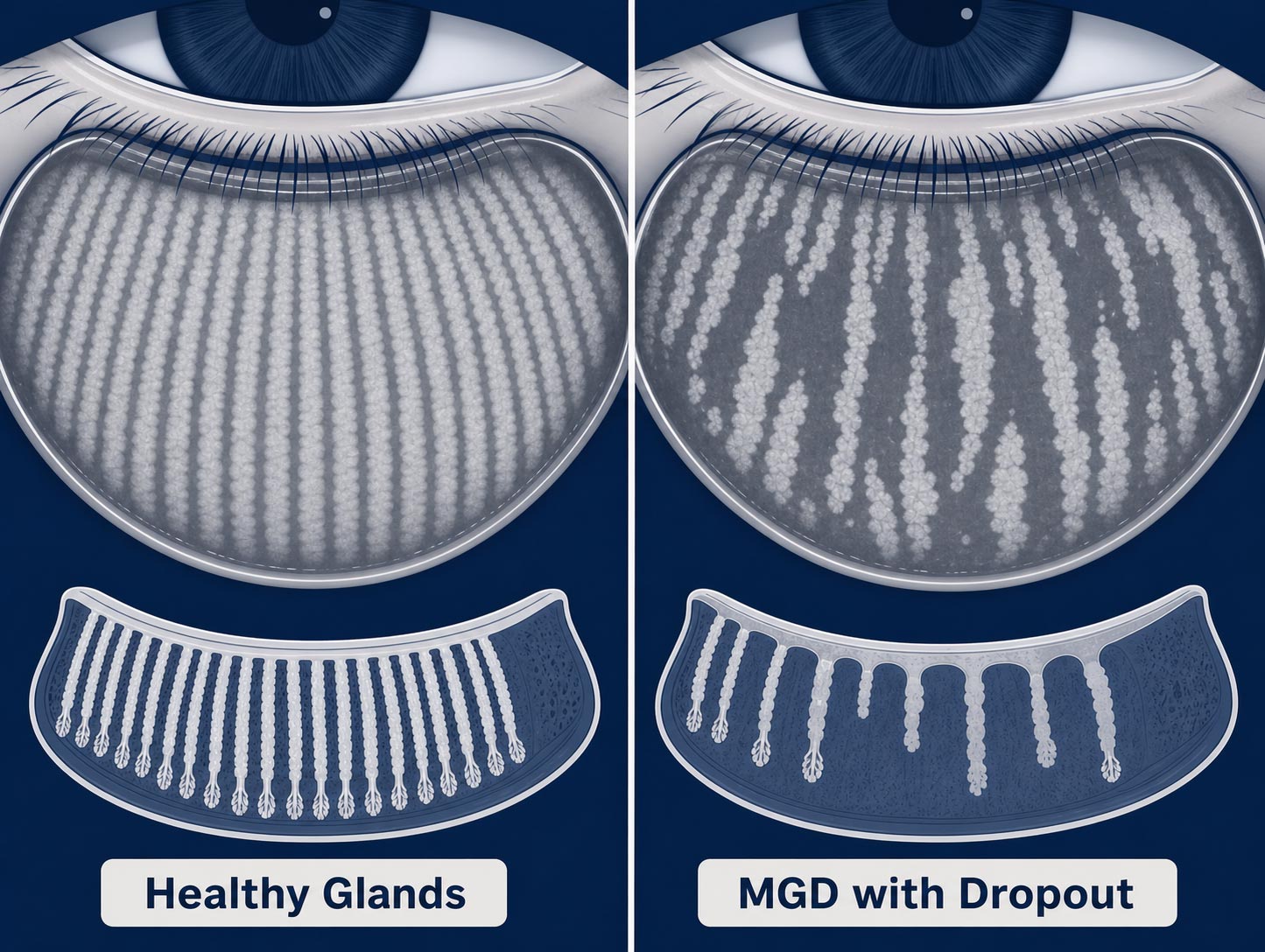
Your eyelids contain between 25 and 40 meibomian glands on the upper lid and 20 to 30 on the lower lid. These are long, modified sebaceous glands embedded vertically in the tarsal plate, opening at the eyelid margin just behind the lash line. With every complete blink, they express a thin layer of meibum, a complex lipid mixture that spreads across the tear film and prevents evaporation.
In MGD, the gland orifices narrow and the meibum thickens and changes in composition, becoming waxy and stagnant. Chronically obstructed glands eventually undergo glandular dropout, where secretory cells are replaced by fibrotic tissue. This dropout is irreversible and visible on meibography imaging. It is the structural end-stage of the disease, and it is the reason that early intervention matters so much.
According to the Tear Film and Ocular Surface Society DEWS II report, the gold-standard international consensus on dry eye, MGD is found in the majority of dry eye patients globally and is significantly underdiagnosed in primary care settings.
Recognizing MGD symptoms
The symptoms of MGD overlap almost entirely with other forms of dry eye, which is why it goes undiagnosed so often without a proper eyelid exam. Common symptoms include:
- Burning, stinging, or gritty sensation in the eyes
- Persistent eye fatigue or awareness that worsens through the day
- Excessive tearing or watery eyes (reflex tearing from an unstable tear film)
- Eyelids that feel sticky or crusted on waking
- Transient blurring with sustained reading or screen use that clears with blinking
- Redness along the eyelid margin
- Recurrent styes or chalazia at the same locations
- Worsening symptoms in air-conditioned, windy, or low-humidity environments
The excessive tearing surprises many patients. When the tear film evaporates too quickly, the eye triggers a reflex tearing response. These watery tears are not the same quality as a stable baseline tear film and don’t solve the evaporative problem, which is why eyes can feel simultaneously dry and watery.
If any of these symptoms sound familiar and you have only ever treated them with drops, a meibomian gland evaluation is overdue.
Who is most at risk for MGD?
MGD is increasingly common across all age groups, not just older patients. Key risk factors include:
- Screen use: Blink rate drops 50% to 70% during screen-focused activities. Incomplete blinking fails to express meibum, causing it to stagnate and thicken in the gland ducts.
- Age: Meibomian gland secretion naturally declines and thickens over time. MGD-related changes are present in the majority of people over 60.
- Contact lens wear: Associated with significantly higher rates of MGD due to mechanical disruption of the lid margin and altered tear dynamics.
- Eyeliner on the inner lid margin: Can directly block meibomian gland orifices.
- Rosacea and seborrheic dermatitis: Strongly linked to meibomian gland disease and often require parallel skin and eyelid treatment.
- Medications: Isotretinoin (Accutane), antihistamines, certain antidepressants, diuretics, and hormone therapies all alter meibomian gland secretion or meibum quality.
Patients with a history of avoiding regular comprehensive eye exams are also at higher risk of late MGD diagnosis, simply because the eyelid evaluation that catches it early is part of a complete eye exam.
How we diagnose MGD
Diagnosing MGD requires a direct eyelid evaluation, not just a symptom questionnaire. At our practice the eyelid exam is part of every comprehensive evaluation, and for patients presenting with dry eye symptoms we go further. The full workup includes:
- Slit lamp eyelid exam: We examine the eyelid margin for irregularity, gland orifice plugging, telangiectasia along the lash line, and meibum quality expressible with gentle lid pressure. Healthy glands produce clear, fluid oil. MGD glands produce cloudy, thickened material or nothing at all.
- Meibography: Infrared imaging through the eyelid that maps gland structure and reveals dropout areas invisible to the naked eye. Critical for staging severity and monitoring treatment response over time.
- Tear breakup time (TBUT): How quickly the tear film destabilizes after a blink. Short TBUT is a hallmark of evaporative dry eye and supports the MGD diagnosis.
- Lipid layer assessment: Interferometry imaging that evaluates the quality of the lipid layer across the tear film surface.
This evaluation takes minutes and should precede any dry eye prescription. If you have been diagnosed with dry eye and have never had your eyelids specifically examined, that is the starting point for us.
Treating MGD at the source
The goal of MGD treatment is to restore meibum quality and flow, stabilize the tear film lipid layer, and prevent further irreversible glandular dropout. For patients already on Xiidra or Cequa, the goal is not necessarily to eliminate those medications but to add gland-targeted treatment so that inflammation management and root cause treatment work together. Many patients find their reliance on prescription drops decreases significantly once MGD is well managed.
Treatment options by severity:
- Warm compresses (mild MGD): Must reach and maintain 40°C for a full 10 minutes to sufficiently soften thickened meibum. Purpose-designed heated eye masks are far more effective than washcloths, which cool below the therapeutic threshold within 90 seconds. Daily use is required; sporadic application produces minimal benefit.
- Eyelid hygiene: Daily cleansing of the lid margin using hypochlorous acid sprays or appropriate lid scrubs removes biofilm and excess secretions. For patients with associated demodex mite infestation, targeted treatment is incorporated into the plan.
- Omega-3 fatty acid supplementation: High-quality re-esterified triglyceride (rTG) form omega-3s at 2,000 to 3,000 mg combined EPA and DHA daily improve meibum quality over six to twelve weeks of consistent use.
- Intense Pulsed Light (IPL) therapy: Applied to the skin around the eyelids, IPL reduces eyelid vascular inflammation, liquefies thickened meibum, and improves gland function. A standard course of four sessions produces meaningful improvement in most candidates, with maintenance every 6 to 12 months. We offer IPL at our practice, and results are often significantly better than anything achievable with drops alone, particularly for patients with rosacea. Learn more about our IPL dry eye treatment.
- Thermal pulsation (e.g., LipiFlow): Delivers controlled heat to the inner eyelid surface with simultaneous pulsatile pressure to mechanically express obstructed glands. Clinical data shows sustained improvement for up to 12 months following a single in-office session.
- Prescription medications: Topical azithromycin, low-dose oral doxycycline (for its anti-inflammatory effect on meibum quality), or topical cyclosporine may be incorporated alongside in-office procedures for moderate to severe cases.
The American Optometric Association recommends a structured, step-based approach to dry eye management, beginning with identification and treatment of the underlying cause before escalating to pharmaceutical intervention.
What you can do at home starting today
While in-office treatment is often necessary for moderate to severe MGD, these home steps provide a meaningful foundation and make clinical treatments more effective and longer lasting:
- Apply a heated eye compress for 10 full minutes every day
- Follow warm compresses with lid hygiene using an appropriate eyelid cleanser
- Perform slow, deliberate complete blinks every 20 minutes during screen use
- Take regular screen breaks using the 20-20-20 rule as a minimum
- Remove all eye makeup thoroughly each night
- Avoid eyeliner applied to the inner lid margin
- Start high-quality omega-3 supplementation and commit to at least 8 to 12 weeks of consistent use
- Stay well hydrated throughout the day
- Discuss your contact lens type and schedule with us — daily disposables often reduce MGD-related irritation significantly
If you wear contact lenses and are experiencing dry eye symptoms, also see our guide on managing dry eye as a contact lens wearer.
Stop Managing Symptoms. Start Treating the Cause.
If you have been living with dry eye and relying on drops for relief, the most important next step is finding out whether meibomian gland dysfunction is driving your symptoms. A proper eyelid evaluation at Eye Care Center LTD takes minutes and can completely change how your dry eye is treated. Schedule at any of our three Illinois locations.
Schedule Your Dry Eye Evaluation
Addison: (630) 543-0607 | Burbank: (708) 599-0050 | Willowbrook: (630) 969-2807
Monday – Thursday 10am-6pm | Friday 10am-5pm | Saturday 9am-2pm
Related reading on myeccltd.com:
- Why Your Eyes Feel Like Sandpaper by 3 PM
- What Really Happens During a Comprehensive Eye Exam
- Eye Pressure and Glaucoma: What Your Numbers Really Mean
Frequently asked questions
Is Xiidra or Cequa better than treating MGD directly?
These are not competing approaches; they address different parts of the dry eye problem. Xiidra and Cequa reduce ocular surface inflammation, which is a real component of dry eye disease. But they do not restore meibomian gland function or improve the lipid layer of the tear film. For patients with evaporative dry eye driven by MGD, treating the glands directly produces more fundamental and lasting improvement. Many patients benefit from both approaches simultaneously, particularly early in treatment when inflammation is significant alongside gland dysfunction.
Can I stop Xiidra or Cequa if I treat my MGD?
Some patients are able to reduce or discontinue prescription drops once their MGD is well managed, because the underlying evaporative cycle and resulting inflammation have been addressed at the source. Others continue to benefit from ongoing anti-inflammatory therapy alongside MGD treatment. This is an individualized decision made based on your exam findings and symptom response over time, not a blanket recommendation.
What is the difference between MGD and regular dry eye?
Dry eye disease is the broad condition; MGD is the most common underlying cause of evaporative dry eye, its most prevalent subtype. In evaporative dry eye, the tear film breaks down too quickly because the lipid layer produced by the meibomian glands is insufficient or poor quality. Most patients who describe “dry eye” have evaporative dry eye, and most of those patients have MGD as the primary driver.
Are warm compresses really effective for MGD?
Yes, but consistency and technique are everything. The compress must reach and maintain approximately 40 degrees Celsius for a full 10 minutes. Most washcloths cool well below this threshold within 90 seconds. Purpose-designed heated compresses that maintain therapeutic temperature throughout the session are far more effective. Daily use is required; sporadic application provides minimal benefit.
Does IPL therapy work for MGD?
IPL has a strong and growing evidence base for MGD, particularly in patients with associated rosacea or significant eyelid inflammation. Multiple randomized controlled trials have demonstrated improvements in meibomian gland function, tear breakup time, and dry eye symptoms following a course of IPL treatments. Skin type, medications, and MGD severity are factors we evaluate before recommending it.
Can I wear contact lenses if I have MGD?
Many contact lens wearers continue successfully with appropriate MGD management in place. Daily disposable lenses reduce deposit buildup that exacerbates eyelid inflammation. Reducing wearing time, using preservative-free rewetting drops, and maintaining consistent lid hygiene all help. Some patients find contact lens tolerance improves substantially once MGD is actively treated.
What medications can make MGD worse?
The following medications are associated with altered meibum quality or reduced gland function:
- Isotretinoin (Accutane) — the most well-documented, with potential for permanent glandular changes
- Antihistamines — including common OTC allergy medications
- Certain antidepressants (SSRIs and tricyclics)
- Diuretics
- Hormone therapies including oral contraceptives and hormone replacement therapy
Always mention your full medication list at your appointment so we can incorporate this into your assessment.
How long does it take to see improvement with MGD treatment?
Timeline varies by treatment type:
- Warm compresses and lid hygiene: Noticeable improvement typically within 2 to 4 weeks of consistent daily use
- IPL therapy: Cumulative improvement across a course of sessions; most patients notice meaningful change after session 2 or 3
- Omega-3 supplementation: 6 to 12 weeks of consistent use before full benefit is apparent
- In-office gland expression: More immediate relief, though most durable when paired with ongoing home maintenance