

Cataracts at 50? Why Modern Cataract Surgery Is Nothing Like Your Grandparents’ Experience
By Dr. Quentin Park, O.D. | The Eye Care Center LTD
When I tell a 52-year-old patient they are developing cataracts, the reaction is almost always the same: disbelief, followed by a little fear. Cataracts are something that happens to your grandmother, right? The word conjures images of thick glasses, long hospital stays, weeks of recovery, and elderly relatives who waited until they could barely see before doing anything about it.
Here is what I want every patient over 45 to understand: essentially everything you think you know about cataract surgery is outdated. The procedure your grandparents had and the procedure performed today share a name and almost nothing else. Modern cataract surgery takes about 15 minutes, requires no stitches and no hospital stay, and in many cases leaves patients seeing better than they have in decades, sometimes better than they saw before the cataract ever formed. It is also one of the safest and most commonly performed surgeries in all of medicine, with millions of procedures done every year in the United States.
At our practice, we diagnose cataracts, monitor their progression, help you decide when surgery makes sense, coordinate your care with trusted surgical partners, and manage your recovery afterward. This article walks through what cataracts actually are, why they are showing up earlier than people expect, what modern surgery involves, and how the newest lens technology can do far more than just remove a cloudy lens.
In this article:
- What cataracts actually are
- Why cataracts are showing up at 50
- Then vs. now: how the surgery changed
- What the modern procedure looks like
- Premium lens implants: fixing more than the cataract
- Recovery: what to actually expect
- How we manage your cataract care
- When is the right time for surgery?
- Frequently asked questions
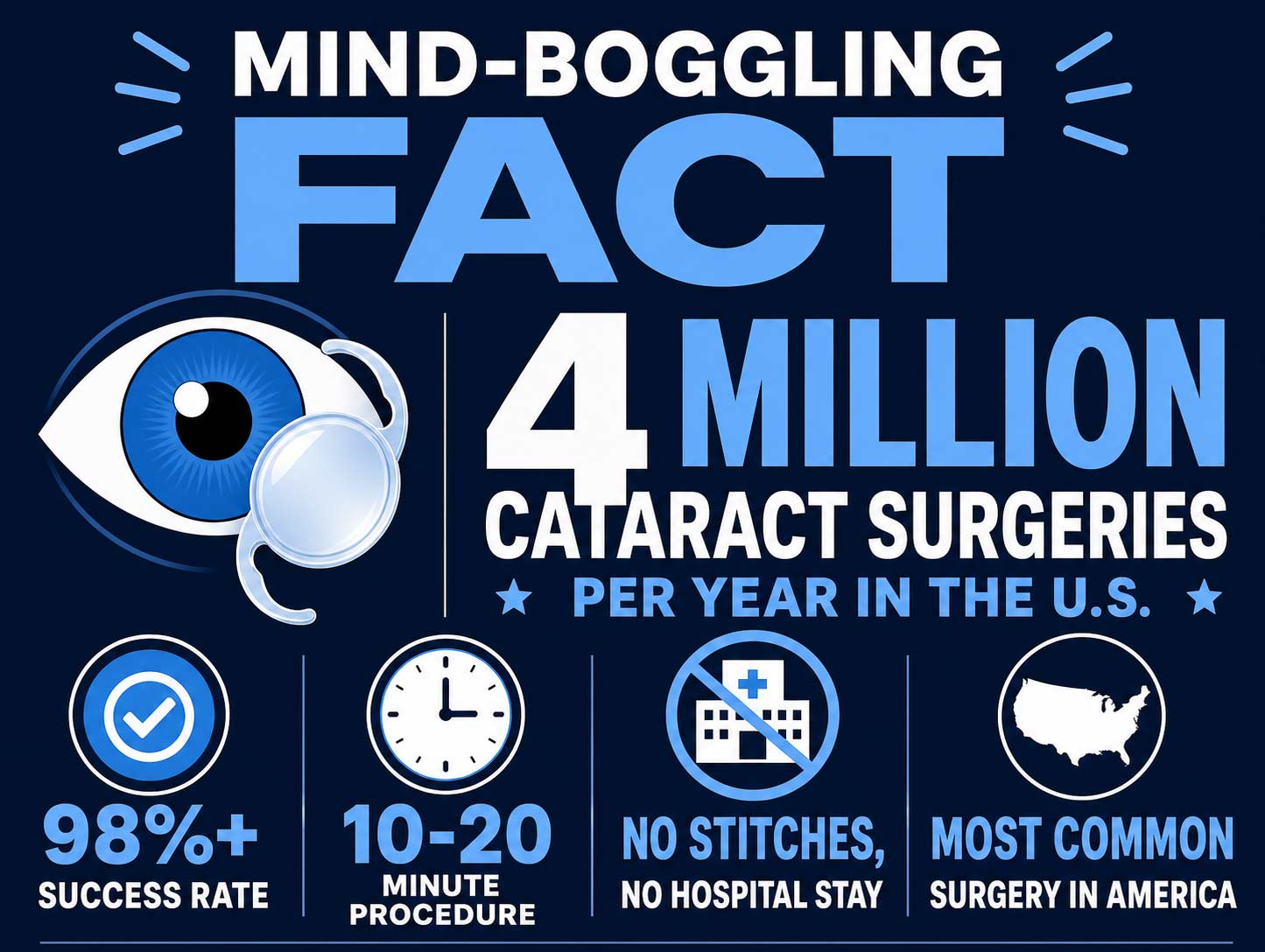
Mind-boggling fact: Cataract surgery is the most commonly performed surgery in the United States, with nearly 4 million procedures each year, and it has a success rate above 98%. The entire operation typically takes 10 to 20 minutes, and many patients notice dramatically improved vision within 24 to 48 hours. In the 1970s, the same diagnosis meant a multi-day hospital stay, stitches in the eye, and weeks of lying still.
What cataracts actually are
Inside your eye, just behind the iris, sits a natural crystalline lens about the size of an M&M. Its job is to focus light precisely onto your retina. In youth, this lens is perfectly clear and flexible. Over time, the proteins within the lens gradually clump together and the lens becomes progressively cloudy, yellowed, and rigid. That clouding is a cataract.
A cataract is not a growth, a film, or a disease in the contagious sense. It is a natural aging change of the lens itself, and it will eventually happen to virtually everyone who lives long enough. The clouding scatters and blocks light before it reaches the retina, which produces the characteristic symptoms:
- Gradually blurring or hazy vision, like looking through a dirty windshield
- Increasing glare and halos around lights, especially while driving at night
- Colors appearing faded, washed out, or yellowed
- Needing progressively more light to read comfortably
- Frequent prescription changes that no longer fully sharpen your vision
- Double vision or ghosting in one eye
Because the change is gradual, many patients do not realize how much vision they have lost until after surgery, when the difference is suddenly obvious. I have had patients tearful in my chair at their post-operative visit, not because anything was wrong, but because they had forgotten what white actually looked like.
Why cataracts are showing up at 50
While cataracts have traditionally been associated with patients in their 70s and beyond, we are diagnosing visually significant cataracts in patients in their early 50s, and sometimes their 40s, with increasing regularity. Several factors contribute:
- UV exposure: Cumulative ultraviolet light exposure accelerates lens protein damage. Decades of unprotected sun exposure show up in the lens at midlife.
- Diabetes: Elevated blood sugar accelerates cataract formation significantly, and Type 2 diabetes is being diagnosed at younger ages than ever before.
- Steroid medications: Long-term use of corticosteroids, including inhalers and oral medications for asthma, autoimmune conditions, and skin conditions, is a well-established cause of early cataracts.
- Smoking: Smokers develop cataracts earlier and more severely than non-smokers.
- High myopia: Highly nearsighted eyes tend to develop certain cataract types earlier.
- Better detection: Modern imaging and more frequent comprehensive exams mean we catch lens changes years earlier than previous generations did.
An early cataract diagnosis is not an emergency and does not mean immediate surgery. Many patients live comfortably with mild cataracts for years. What it does mean is that monitoring matters, and that when your vision starts interfering with the things you care about, an excellent solution exists.
Then vs. now: how the surgery changed
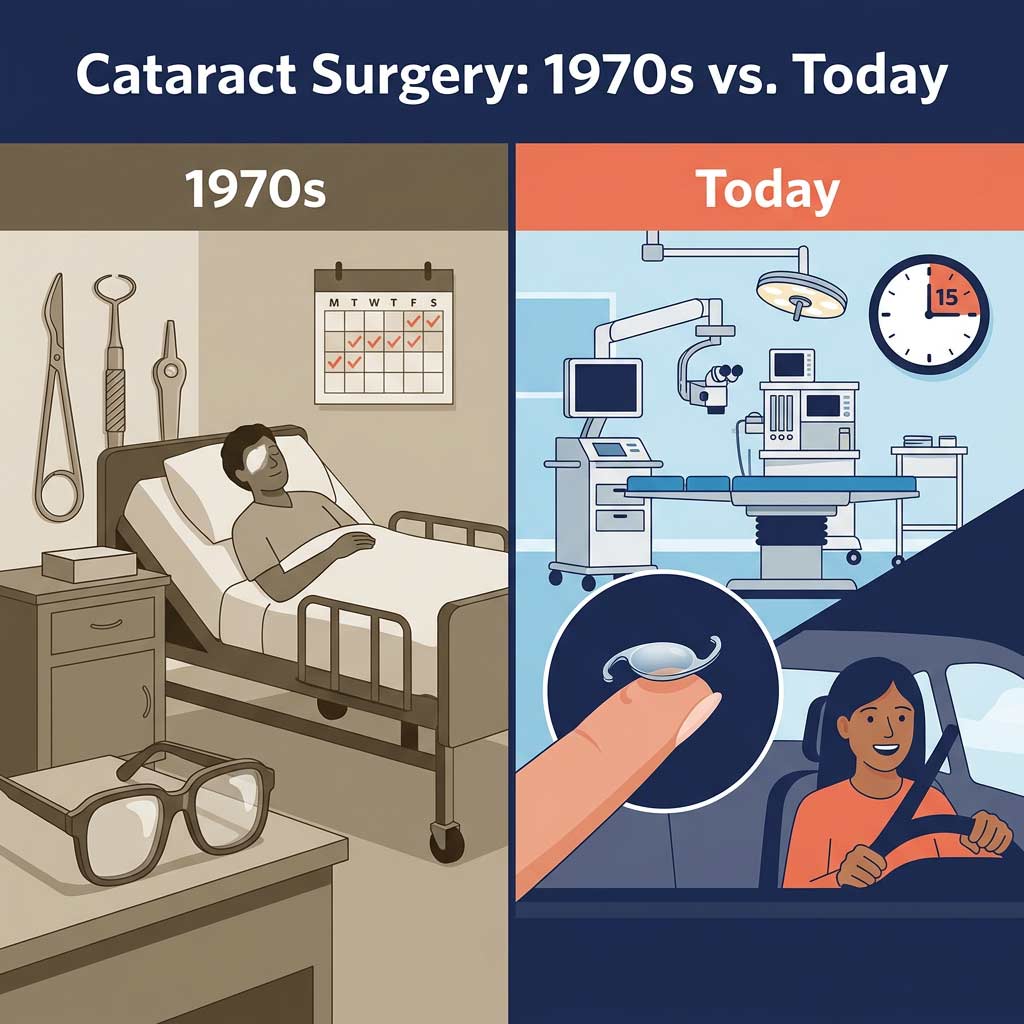
To appreciate how far this procedure has come, it helps to see the two eras side by side:
- Then: The entire cloudy lens was removed through a large incision requiring multiple stitches. Now: The lens is broken up with ultrasound (phacoemulsification) and removed through a self-sealing incision under 3 millimeters wide. No stitches in the vast majority of cases.
- Then: Multi-day hospital admission, with patients sometimes sandbagged in place to prevent head movement. Now: Outpatient procedure. You walk out roughly an hour after you arrive.
- Then: No lens implant existed, so patients wore extremely thick “cataract glasses” or hard contact lenses for the rest of their lives. Now: A folded artificial intraocular lens (IOL) is inserted through the tiny incision and unfolds into place, permanently replacing the natural lens.
- Then: Recovery took weeks to months with significant activity restrictions. Now: Most patients resume normal activities within a day or two, with only brief restrictions on heavy lifting and eye rubbing.
- Then: Surgery was delayed until the cataract was “ripe” and vision was severely impaired. Now: Surgery is appropriate whenever the cataract meaningfully interferes with your life, and earlier surgery is often technically easier and safer.
What the modern procedure looks like
Here is what actually happens on surgery day, so you know exactly what to expect:
- Arrival and preparation: You arrive at an outpatient surgical center. Dilating and numbing drops are placed. Most patients receive light oral or IV relaxation, but you remain awake. General anesthesia is almost never needed.
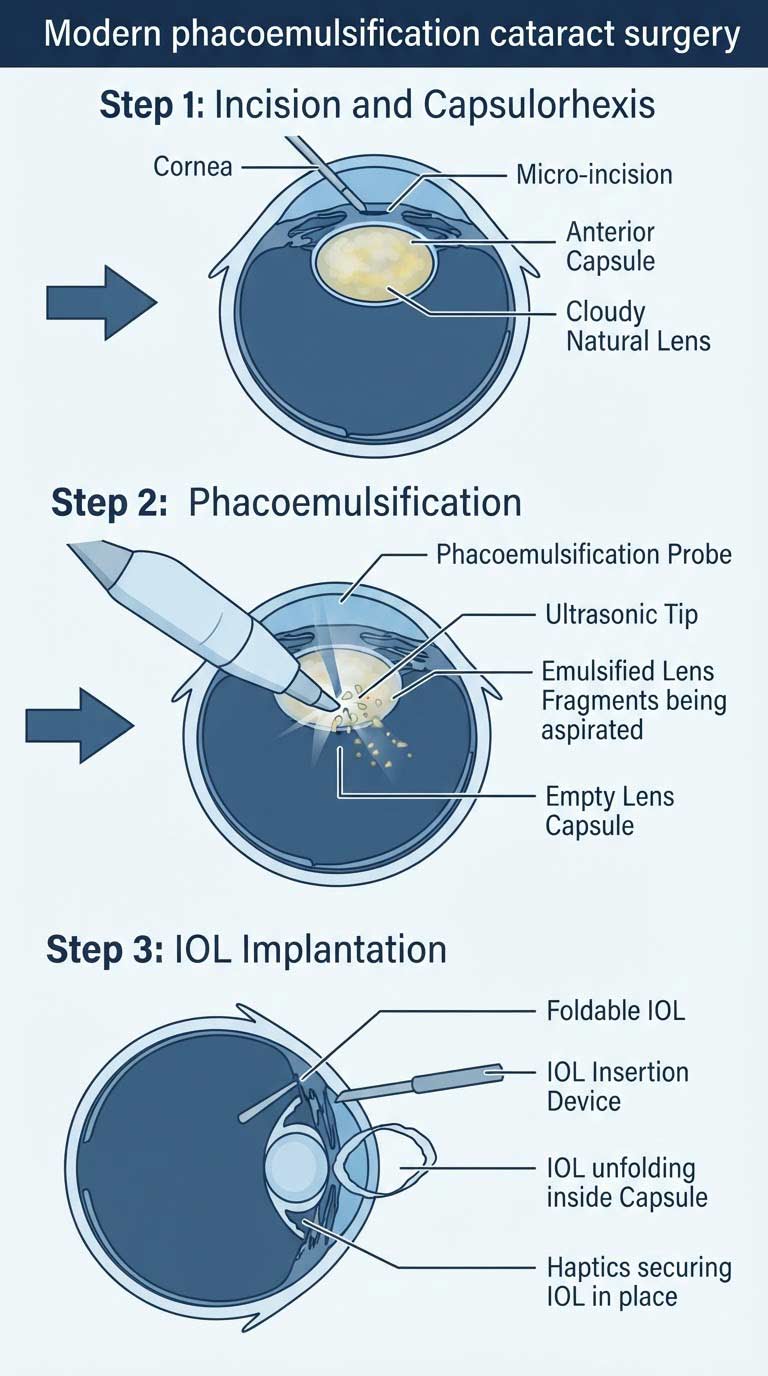
- The procedure itself: The surgeon makes a micro-incision under 3mm, uses ultrasound energy to gently break up and vacuum away the cloudy lens, then inserts the folded replacement lens, which opens into position. Total surgical time is typically 10 to 20 minutes.
- Going home: After a short recovery period, someone drives you home. There is no patch in most modern cases, just a clear protective shield for sleeping.
- The next day: You are seen for a post-operative check, frequently at our office as part of your co-managed care. Many patients are already noticing brighter, clearer vision at this visit.
Some surgical centers also offer laser-assisted cataract surgery, in which a femtosecond laser performs several of the initial steps with computer-guided precision. Whether laser assistance provides meaningfully better outcomes than expert manual surgery remains an active discussion in the field, and we help patients understand the tradeoffs, including cost, when the option is available.
Premium lens implants: fixing more than the cataract
This is where modern cataract surgery becomes genuinely remarkable. The artificial lens that replaces your cloudy natural lens is a permanent optical device, and choosing the right one is one of the most consequential vision decisions you will ever make. Today’s options include:
- Standard monofocal IOLs: Excellent, sharp vision at one distance, usually set for distance vision, with reading glasses needed for near work. This is what insurance typically covers in full.
- Toric IOLs: Correct astigmatism at the time of surgery. Patients who have worn glasses for astigmatism their entire lives can walk away from surgery with that correction built into their eye permanently.
- Multifocal and trifocal IOLs: Provide functional vision at distance, intermediate (computer), and near (reading) simultaneously, dramatically reducing or eliminating dependence on glasses. Some patients notice halos around lights at night, which typically diminish as the brain adapts.
- Extended depth of focus (EDOF) IOLs: A newer category providing a continuous range of clear vision from distance through intermediate, with fewer nighttime visual side effects than traditional multifocals.
- Light-adjustable lenses (LAL): The newest frontier. This lens can be fine-tuned with UV light treatments after surgery, allowing your final prescription to be customized once your eye has healed. It is the only lens that lets you test drive your vision before locking it in.
 –>
–>
The right lens depends on your visual priorities, your ocular health, your occupation and hobbies, and your tolerance for tradeoffs. A patient who drives at night professionally has different priorities than an avid reader or a golfer. This is exactly the conversation we have during your cataract evaluation, and having your own optometrist who knows your eyes and your life guide this decision, rather than making it in a single rushed surgical consult, is one of the most valuable parts of co-managed cataract care.
Recovery: what to actually expect
Modern cataract recovery is remarkably fast, but knowing the honest timeline sets proper expectations:
- Day 1: Vision is often noticeably better already, though it may fluctuate. Mild grittiness or scratchiness is normal. You will use prescription eye drops on a schedule.
- Week 1: Most patients drive, work, read, and watch TV comfortably. Avoid heavy lifting, bending with your head below your waist, eye rubbing, and swimming.
- Weeks 2 to 4: Vision continues sharpening as the eye heals and the brain adapts, particularly with multifocal and EDOF lenses. Drop schedules taper.
- Week 4 to 6: Final refraction. If any glasses prescription is needed for residual correction or reading, it is finalized now. If your second eye needs surgery, it is typically scheduled 1 to 3 weeks after the first.
Serious complications are rare, occurring in well under 1% of cases, but our post-operative visits exist precisely to catch and manage anything early. Symptoms that warrant an immediate call include significant pain, sudden vision loss, increasing redness, or a curtain or shadow across your vision.

How we manage your cataract care at Eye Care Center
Cataract surgery itself is performed by an ophthalmologist at a surgical center, but the majority of your cataract journey happens with us, before and after the operation. This partnership model is called co-management, and here is what it looks like at our practice:
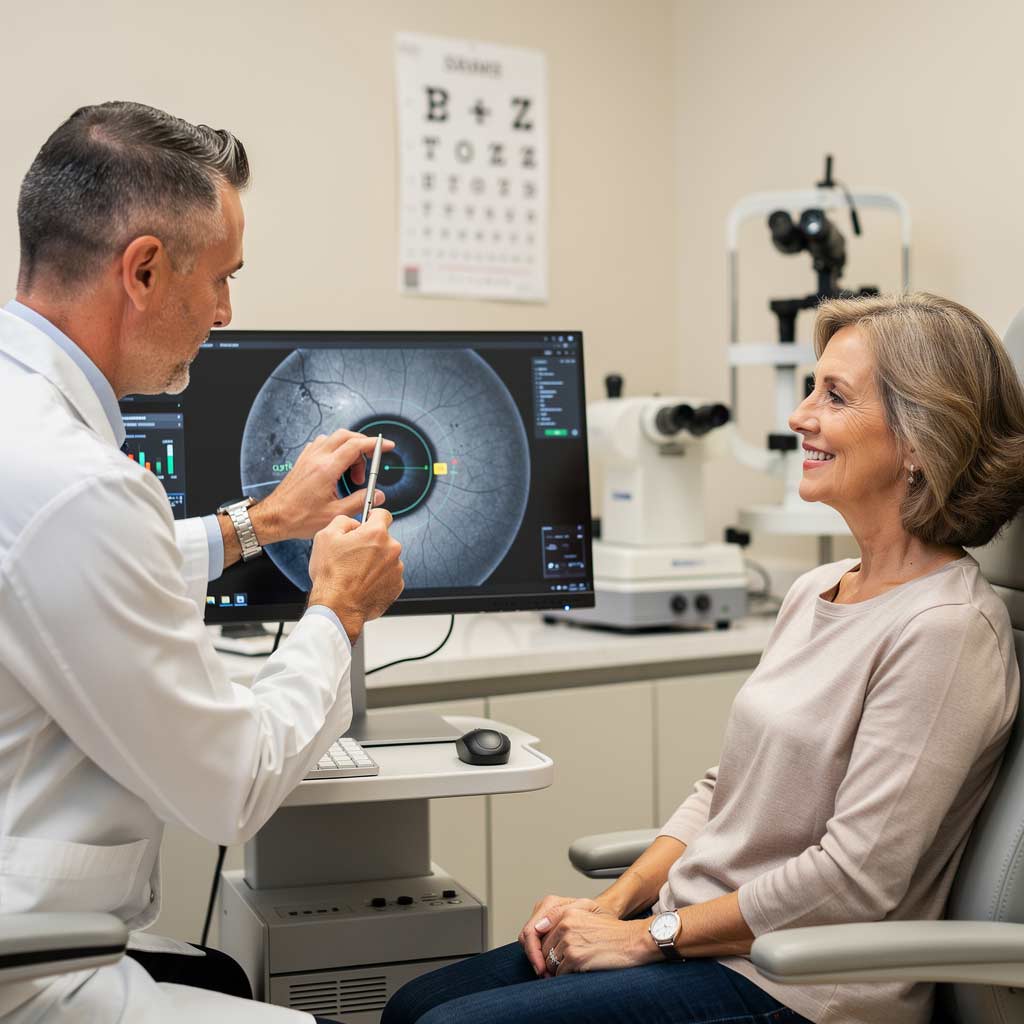
- Detection and monitoring: We identify cataracts during your comprehensive exams, often years before surgery is needed, and track their progression with imaging at each visit. Learn what a full evaluation includes in our article on what really happens during a comprehensive eye exam.
- Timing guidance: We help you decide when surgery genuinely makes sense for your life, not too early and not too late.
- Surgeon referral: We refer you to trusted, high-volume cataract surgeons we know personally and whose outcomes we see in our own chairs.
- Lens selection counseling: We walk you through the IOL options in the context of your eyes, your prescription history, and your lifestyle, so you arrive at the surgical consult informed.
- Post-operative care: Your follow-up visits happen at our Addison, Burbank, or Willowbrook office, close to home, with the doctors who know your history. We manage your drops, monitor healing, finalize any remaining prescription, and coordinate directly with your surgeon.
When is the right time for surgery?
The old rule was to wait until a cataract was “ripe.” That standard is obsolete. The modern answer is simpler and more personal: surgery is appropriate when the cataract meaningfully interferes with the activities that matter to you. For a commercial driver, that threshold arrives early, the moment night glare becomes a safety issue. For someone else, it might be when reading, golfing, or recognizing faces across a room becomes frustrating.
There is also a practical case against waiting too long. Very dense, advanced cataracts are harder to remove, require more ultrasound energy, and carry modestly higher surgical complexity. Acting when the cataract is moderately advanced, rather than severely so, generally means an easier surgery and a faster recovery.
If you are over 45 and noticing night glare, dimming colors, or prescription changes that no longer fully help, the next step is a comprehensive dilated evaluation. We will tell you whether a cataract is present, how advanced it is, and whether it is time to think about surgery or simply time to watch it.

One more note on prevention: while no intervention stops lens aging entirely, consistent UV protection meaningfully slows it. Quality sunglasses with full UV blocking, worn from as young an age as possible, are one of the simplest long-term investments in your lens health. Our article on modern sunglasses technology covers what to look for.

Noticing Glare, Faded Colors, or Blurry Night Vision?
A comprehensive dilated evaluation at Eye Care Center LTD will tell you exactly what is going on with your lenses and whether a cataract is behind your symptoms. If surgery is in your future, we will guide the entire process, from surgeon selection and lens counseling through every post-operative visit, at whichever of our three Illinois offices is closest to you.
Schedule Your Cataract Evaluation
Addison: (630) 543-0607 | Burbank: (708) 599-0050 | Willowbrook: (630) 969-2807
Monday – Thursday 10am-6pm | Friday 10am-5pm | Saturday 9am-2pm
Se habla espanol.
Related reading on myeccltd.com:
- What Really Happens During a Comprehensive Eye Exam
- Eye Pressure and Glaucoma: What Your Numbers Really Mean
- AMD Awareness: Protecting Your Central Vision
- Trending Sunglasses Tech: What Your Lenses Can Now Do
Frequently asked questions about modern cataract surgery
How long does modern cataract surgery take?
The surgical procedure itself typically takes 10 to 20 minutes per eye. Including check-in, preparation, and recovery time at the surgical center, plan on roughly two to three hours for the full visit. You go home the same day, and someone else drives you.
Is cataract surgery painful?
No. The eye is fully numbed with anesthetic drops, and most patients receive light sedation to stay relaxed. Patients typically describe seeing shifting lights and colors during the procedure but feeling no pain. Mild scratchiness or grittiness for a day or two afterward is common and manageable.
Can both eyes be done at the same time?
In the United States, surgeons typically operate on one eye at a time, with the second eye scheduled one to three weeks later. This allows the first eye to begin healing and confirms the lens power calculation performed exactly as expected before the second procedure. Some surgeons offer same-day bilateral surgery in select cases.
What is the difference between standard and premium lens implants?
A standard monofocal IOL provides excellent vision at a single focal distance, usually set for distance, with reading glasses needed afterward. Premium IOLs, including toric lenses for astigmatism, multifocal and EDOF lenses for a range of vision, and light-adjustable lenses, correct additional vision problems and reduce dependence on glasses. Insurance typically covers standard lenses in full, while premium lenses involve an out-of-pocket upgrade cost.
Will my cataract grow back after surgery?
No. The cloudy natural lens is removed entirely and cannot regrow. However, in roughly 20 to 30% of patients, the thin capsule holding the artificial lens becomes cloudy months or years later, a condition called posterior capsule opacification. It is treated permanently with a painless, five-minute in-office laser procedure called a YAG capsulotomy.
How soon can I drive after cataract surgery?
Many patients are cleared to drive within 24 to 48 hours, once vision in the operated eye meets legal driving standards at the post-operative check. Night driving comfort often improves dramatically compared to before surgery, since cataract-related glare and halos are eliminated.
Does insurance or Medicare cover cataract surgery?
Yes. Cataract surgery with a standard monofocal lens implant is covered by Medicare and virtually all health insurance plans when the cataract is visually significant. Premium lens upgrades and laser-assisted surgery typically involve out-of-pocket costs. Our team helps you understand your specific coverage during the evaluation process.
Can I have cataract surgery if I have had LASIK?
Yes. Previous LASIK does not prevent cataract surgery, but it does make the lens power calculation more complex, since LASIK reshaped your cornea. Providing your original LASIK records, if available, improves calculation accuracy, and modern formulas handle post-LASIK eyes far better than older methods did. This is a detail we flag and manage during co-management planning.
What happens if I just leave my cataract alone?
Cataracts progress gradually and are not dangerous in the early stages, so watchful waiting is a legitimate choice while vision remains functional. However, vision will continue to slowly decline, and very advanced cataracts become technically harder to remove. Untreated severe cataracts are also a major fall risk in older adults and can mask other retinal conditions we need to monitor. Regular exams let us track progression and time surgery well.