
It usually starts with something small. The restaurant menu looks a little fuzzy in dim light. You catch yourself holding your phone farther away to read a text. The tiny print on a medicine bottle suddenly feels impossible. If you’re in your 40s and this sounds familiar, you’re not imagining it, and you’re definitely not alone.
This change has a name: presbyopia. It’s a normal part of aging, not a disease, and it eventually affects nearly everyone. The good news is that there have never been more ways to see clearly up close again, from simple reading glasses to multifocal contacts to new prescription eye drops. Here’s what’s happening inside your eyes, and how to choose the option that fits your life.
In this article
What Is Presbyopia?
Presbyopia is the gradual loss of your eye’s ability to focus on nearby objects. The word comes from Greek roots meaning “old eye,” which sounds harsher than it is. It typically becomes noticeable in the early to mid 40s and keeps progressing slowly for years, which is why many people find they need a little more reading help every so often.
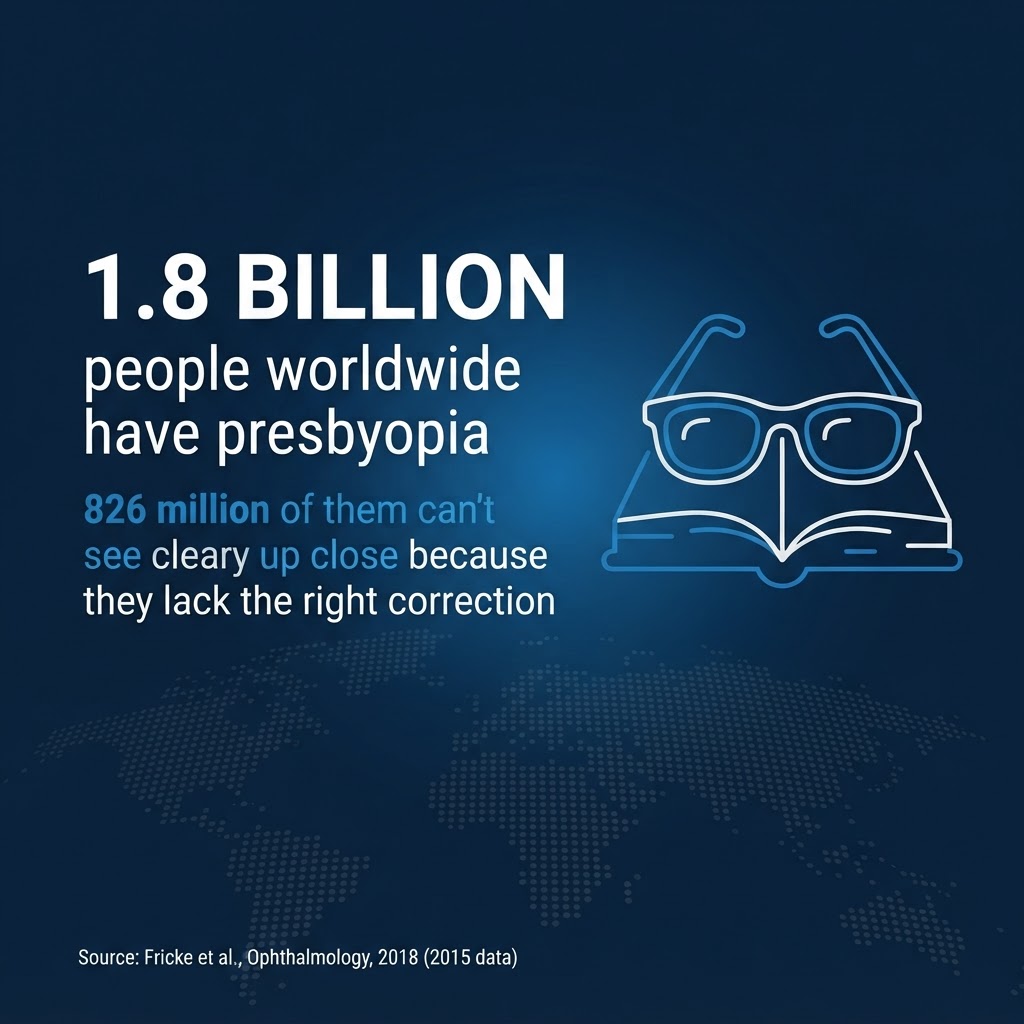
It’s also incredibly common. A study published in the journal Ophthalmology estimated that 1.8 billion people worldwide had presbyopia in 2015, and that 826 million of them didn’t have adequate correction to see clearly up close.
Presbyopia is different from farsightedness, even though the two often get confused. Farsightedness (hyperopia) comes from the shape of the eye and can show up at any age, including childhood. Presbyopia comes from the lens inside the eye losing flexibility over time. You can have presbyopia on top of nearsightedness, farsightedness, or astigmatism, which is one reason a one-size-fits-all fix doesn’t always work.
Signs You May Be Developing Presbyopia
The early signs are easy to brush off. Many people first notice they’re holding books, menus, or their phone at arm’s length to bring the words into focus. Others find that reading feels fine in the morning but becomes tiring by evening, or that they need much brighter light than they used to.
Eyestrain, headaches after close work, and squinting at small print are also common. If you’re nearsighted and wear glasses for distance, you may notice that you suddenly see up close better with your glasses off. That’s a classic clue that presbyopia has arrived.
Why It Happens After 40
Inside each eye sits a clear, flexible lens. When you’re young, a ring of muscle called the ciliary muscle changes the lens’s shape, letting it round out to focus on things up close. This automatic focusing ability is called accommodation, and in childhood it’s remarkably strong.
Over the decades, the lens keeps adding new layers and gradually becomes thicker and stiffer. By your 40s, it can’t change shape as easily, so close-up objects stay blurry no matter how hard your eyes work. Nothing you did caused it, and no amount of eye exercises will reverse it.
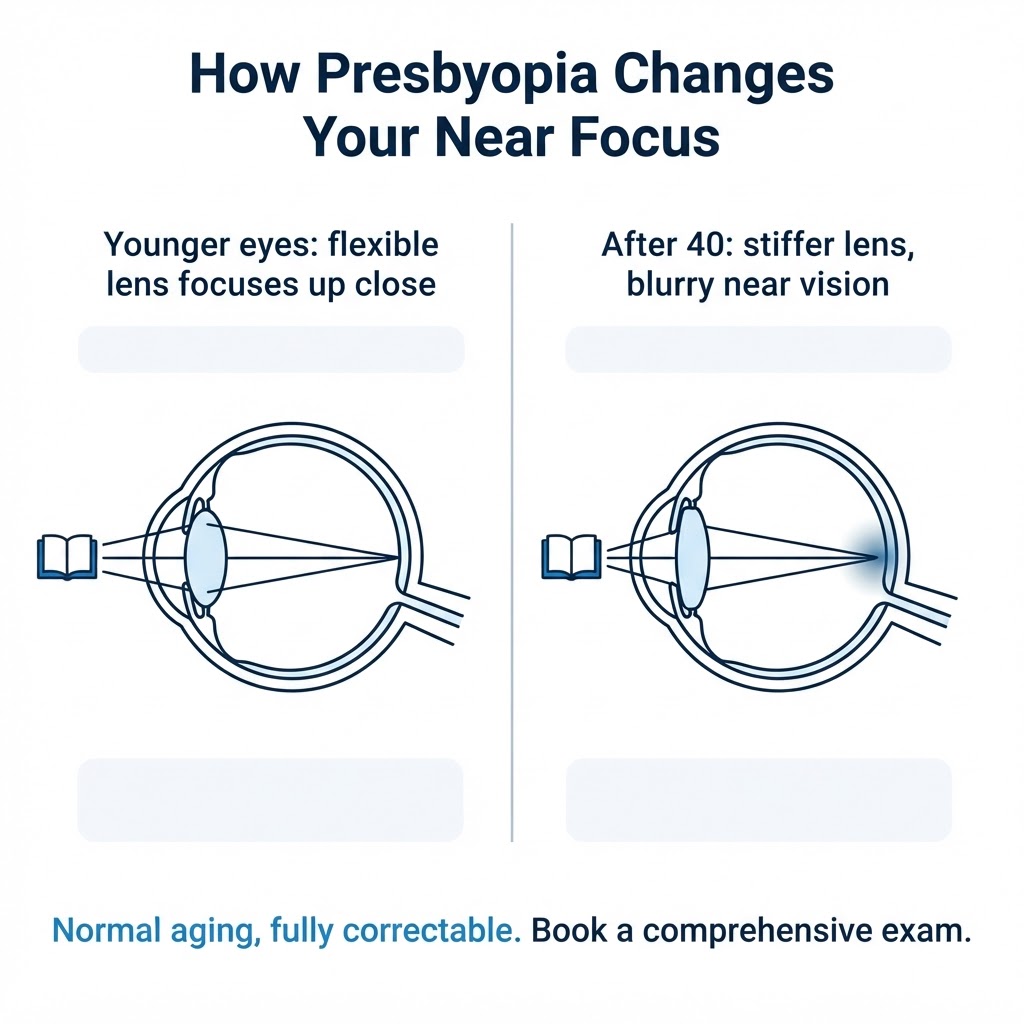
Some factors can bring symptoms on earlier, including existing farsightedness, certain medications, and some health conditions such as diabetes. If you notice near vision changes well before 40, mention it at your next exam so we can rule out other causes.
Your Options for Clear Near Vision
There’s no single best fix for presbyopia. The right choice depends on your prescription, your eye health, and how you spend your day. Here are the main paths patients take:
- Reading glasses: simple, affordable magnification for close-up tasks.
- Progressive or bifocal lenses: one pair of glasses for every distance.
- Computer or office lenses: built for screens and desk work.
- Multifocal contact lenses: near and far vision without glasses.
- Monovision contacts: one eye set for distance, the other for near.
- Prescription eye drops: hours of sharper near vision, no glasses needed.
- Surgical approaches: longer-term solutions for the right candidates.
Reading glasses are often the first stop. Drugstore readers work well enough for some people, but they use the same power in both eyes and don’t correct astigmatism or differences between your eyes. Prescription readers are made for your exact eyes, which can mean less strain during long reading sessions.
Progressive lenses blend distance, intermediate, and near vision into one lens with no visible line, while bifocals have a distinct reading segment. Today’s progressive designs are much easier to adapt to than older versions. If you spend hours on a computer, a dedicated office pair can be a game changer, since that arm’s-length screen distance is exactly where standard readers fall short.
Contact lens wearers have good options too. Multifocal contacts build several focusing zones into each lens, and monovision fits one eye for distance and the other for near so your brain learns to use whichever eye is clearer. Both take a short adjustment period, and a careful fitting makes a big difference in comfort and clarity.
Prescription eye drops are the newest option. Drops such as Vuity, Qlosi, and VIZZ, approved by the FDA in 2021, 2023, and 2025, temporarily make the pupil smaller. That creates a pinhole-like effect that sharpens near vision for several hours. They aren’t right for everyone: side effects can include headache, dimmer vision in low light, and in rare cases retinal tears or detachment, which is why a dilated exam comes before any prescription. Learn more in our guide to presbyopia eye drops.
Standard laser vision correction fixes distance vision, not presbyopia itself, but approaches like monovision LASIK and lens replacement procedures can reduce dependence on readers for some patients. Because The Eye Care Center co-manages LASIK and SMILE rather than selling them, we can give you an honest read on whether surgery makes sense for you, and support your care before and after the procedure.
Why a Comprehensive Exam Comes First
It’s tempting to grab a pair of readers at the pharmacy and call it done. But your 40s are also when the risk of several serious eye conditions starts to rise, including glaucoma, which often causes no symptoms until vision is lost. That’s why the American Academy of Ophthalmology recommends a baseline eye exam at age 40, even for adults with no symptoms.
A comprehensive exam goes well beyond reading letters on a chart. We measure your prescription at every distance you use, check eye pressure, examine the retina and optic nerve, and talk through your daily routine, whether that’s spreadsheets, sewing, or reading bedtime stories, so your solution fits how you actually live. Wondering how often you should be checked? Our guide on how often to get an eye exam breaks it down.
One important note: presbyopia comes on gradually and affects both eyes. If your vision changes suddenly, blurs in only one eye, or comes with flashes, floaters, or pain, call us right away, because that points to something other than presbyopia.
Ready to read the menu without the arm’s-length stretch?
Our optometrists will find the near-vision solution that fits your eyes and your lifestyle at any of our three Chicagoland locations in Addison, Burbank, and Willowbrook. Se habla espanol.
Book online: Request an appointment
Call us: 1-888-899-0816
Addison: 1250 W Lake St #19c, (630) 543-0607
Burbank: 8525 S Harlem Ave, (708) 599-0050
Willowbrook: 6300 Kingery Hwy #116, (630) 969-2807
Hours: Mon to Thu 10am to 6pm, Fri 10am to 5pm, Sat 9am to 2pm
Frequently Asked Questions
At what age does presbyopia usually start?
Most people start noticing presbyopia in their early to mid 40s. It then progresses gradually for years, so your near vision prescription may need updating every so often.
Can presbyopia be prevented or reversed?
No. Presbyopia is a natural result of the eye’s lens stiffening with age, and eye exercises or supplements won’t reverse it. The good news is that it’s easy to correct with glasses, contacts, eye drops, or surgical options.
Are drugstore reading glasses okay to use?
For some people, over-the-counter readers work fine for occasional use. However, they use the same power in both eyes and don’t correct astigmatism. Skipping an exam also means missing early signs of conditions like glaucoma, which become more common after 40.
Can eye drops replace my reading glasses?
For some adults, prescription presbyopia drops can reduce the need for readers for several hours at a time. They aren’t right for everyone and carry possible side effects, so an optometrist needs to examine your eyes before prescribing them.
Can LASIK fix presbyopia?
Standard LASIK corrects distance vision, not presbyopia. Approaches like monovision LASIK or lens replacement can reduce reliance on readers for some patients. The Eye Care Center co-manages LASIK and SMILE and can help you decide if you’re a good candidate.