
You hold the menu a little farther away. You tilt your phone toward the window. Somewhere in your 40s, small print starts to blur, and drugstore reading glasses begin to multiply in your car, on your desk, and on your nightstand. So when headlines started calling a new class of prescription eye drops “reading glasses in a bottle,” a lot of people paid attention.
The drops are real, and the options have grown quickly. There are now four FDA-approved brands, plus a generic, designed to sharpen near vision for several hours at a time. They are not a cure, and they are not right for everyone. Here is an honest look at how they work, what the research shows, and how to tell whether they belong in your daily routine.
In this article
Why Near Vision Fades After 40
Inside your eye sits a flexible lens that changes shape to focus on close objects. Over the decades, that lens gradually stiffens, and the muscle that adjusts it has a harder time doing its job. The result is presbyopia, the age-related loss of near focus. It is not a disease, and it is not caused by anything you did. It happens to virtually everyone, usually becoming noticeable between ages 40 and 45, and it keeps progressing into the early 60s.
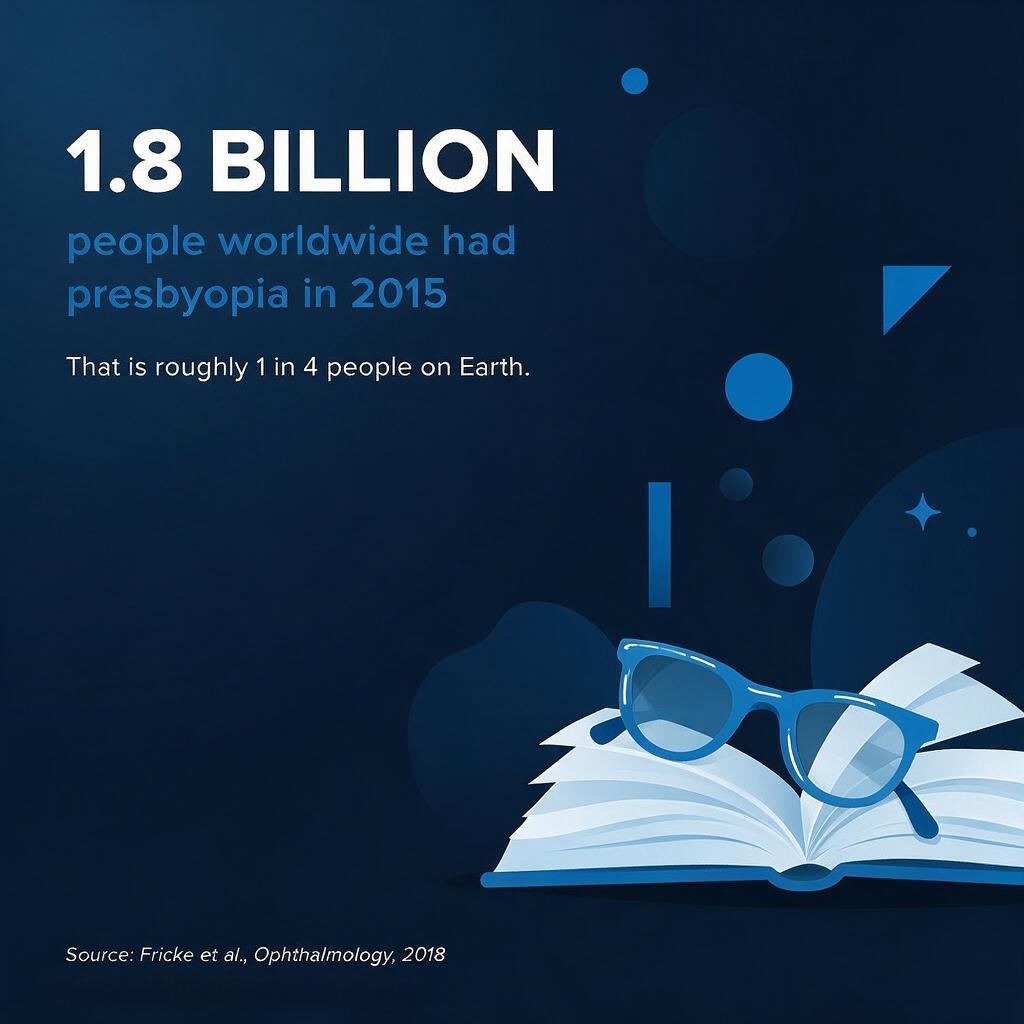
You are far from alone. A large analysis published in Ophthalmology estimated that about 1.8 billion people worldwide had presbyopia in 2015, roughly a quarter of the global population. For a deeper look at the symptoms and every way to correct them, see our guide, Why You Can’t Read Up Close After 40.
How Presbyopia Eye Drops Work
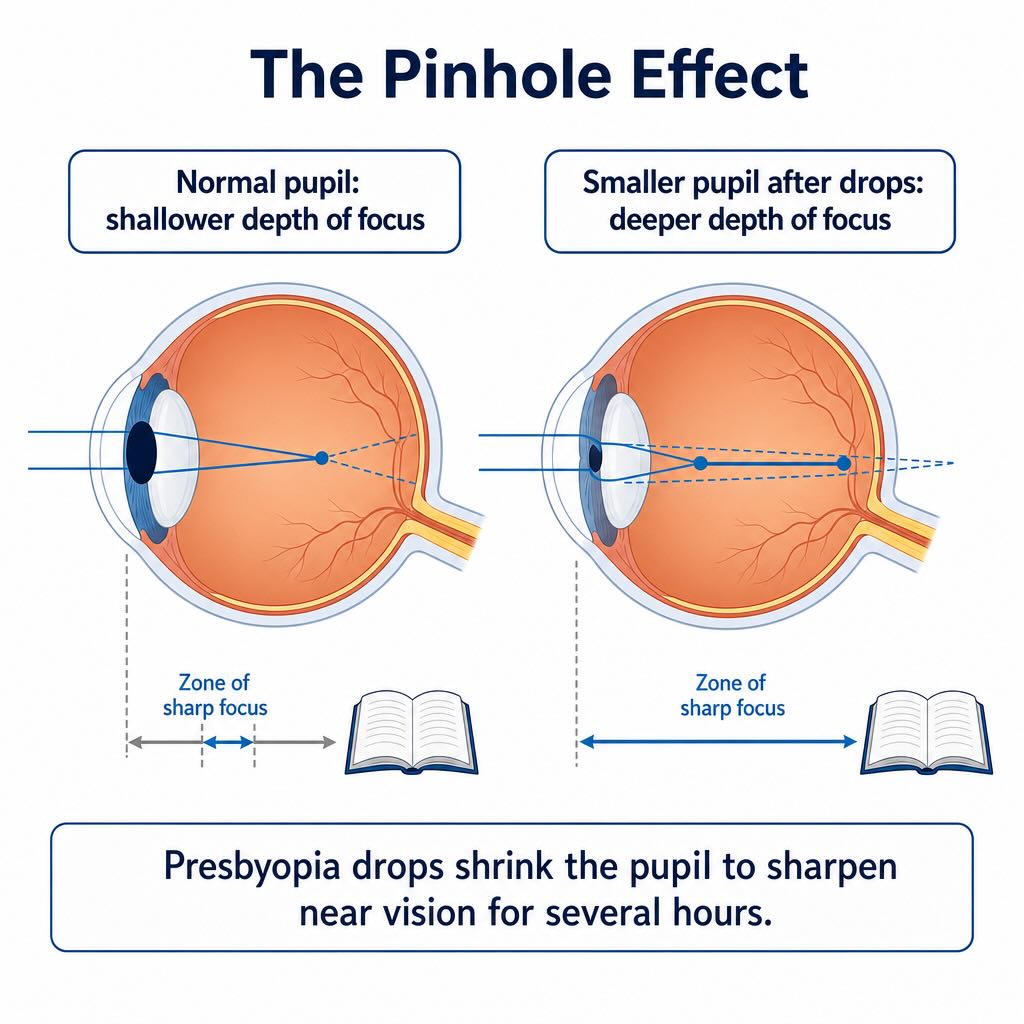
Most of these drops belong to a family of medications called miotics, which gently shrink the pupil. A smaller pupil works like the aperture on a camera: it increases depth of focus, so nearby objects come into sharper view while distance vision stays largely the same. Eye doctors often call this the pinhole effect.
Some formulations also nudge the eye’s focusing muscle, and the newest options combine ingredients to extend how long the effect lasts or to ease side effects. None of them reverse the stiffening of the lens. When a drop wears off, your near vision returns to where it was, which is why these are used daily, as needed, rather than as a one-time treatment.
The FDA-Approved Options Today
- Vuity (pilocarpine 1.25%): the first presbyopia drop, approved in 2021.
- Generic pilocarpine 1.25%: a lower-cost version of Vuity, launched in 2025.
- Qlosi (pilocarpine 0.4%): a lower-strength option that can be dosed twice daily.
- VIZZ (aceclidine 1.44%): a once-daily drop with effects reported up to 10 hours.
- Yuvezzi (carbachol and brimonidine): the first two-ingredient presbyopia drop, approved in 2026.
Vuity opened the category when the FDA approved it in 2021, and a generic version of the same 1.25% pilocarpine launched in August 2025, which may lower the cost for some patients. Qlosi, approved in 2023 and launched in 2025, uses a lower concentration of pilocarpine and allows a second dose later in the day for people who need near focus into the evening.
VIZZ, approved in July 2025, uses aceclidine, a medication designed to act mainly on the pupil rather than the focusing muscle. The manufacturer reports that it begins working in about 30 minutes and can improve near vision for up to 10 hours. Yuvezzi, approved in January 2026 and launched that March, pairs carbachol with brimonidine. It is also a once-daily drop, with near vision improvement reported for up to 10 hours.
Results vary from person to person. Clinical trials measure average improvement under controlled conditions, and your own response depends on your age, your prescription, your natural pupil size, and how you use your eyes during the day.
Who Is a Good Candidate?
Presbyopia drops tend to work best for adults in their 40s and early 50s with mild to moderate near blur who already see well at a distance, whether naturally, with contact lenses, or after LASIK. Think of the professional who wants to read a phone during a meeting without hunting for readers, or the contact lens wearer who is tired of stacking reading glasses on top of contacts.
They are usually a weaker fit for people whose presbyopia has advanced, typically in their late 50s and 60s, because a smaller pupil can only add so much focusing range. They may also not be appropriate for people with certain retinal conditions, a history of retinal tears, or active eye inflammation. Anyone who needs crisp vision in dim light for work, such as a night-shift driver, should talk through that trade-off carefully with their doctor first.
Side Effects and Safety
The most common side effects reported across these drops include headache, eye redness, brief stinging, and vision that looks slightly dimmer. That last one makes sense: a smaller pupil lets in less light. For that reason, labeling advises caution with night driving and with hazardous activities in poor lighting, especially while you learn how your eyes respond.
There is also a rare but serious warning. Retinal detachment has been reported with miotic eye drops, so anyone using them should seek care right away for sudden flashes of light, a shower of new floaters, or a curtain over part of their vision. Our guide to eye floaters and flashes explains those warning signs in detail. This is a major reason a dilated retinal exam should come before your first prescription, not after.
Drops vs. Readers, Contacts, and Surgery
Drops are one tool, not a replacement for every other option. Reading glasses and progressive lenses remain the most reliable and affordable way to see up close all day. Multifocal contact lenses offer near and distance focus in one lens, and they can be a great fit for active patients. If your current lenses already feel scratchy or tired by afternoon, read our post on why contact lenses feel uncomfortable before adding anything new.
Some patients explore surgical approaches, such as monovision vision correction. The Eye Care Center co-manages LASIK and SMILE with trusted surgical partners, which means we can evaluate whether you are a candidate and handle your care before and after the procedure. In practice, many of our patients mix and match: drops for a dinner out or a business presentation, readers for a long evening with a book.
Cost matters too. Coverage for presbyopia drops varies widely and is often limited, so it is worth checking your plan and asking about manufacturer savings programs or the generic option before you fill a prescription.
Start With a Comprehensive Eye Exam
Blurry near vision after 40 is usually presbyopia, but not always. Early cataracts, dry eye, and diabetes-related changes can all blur up-close vision, and some of them need treatment of their own. A comprehensive eye exam, rather than a quick screening, checks your focusing ability, measures your pupils, and examines your retina so we can recommend the option that fits your eyes and your lifestyle. Not sure when you were last checked? See how often you should really get an eye exam.
Curious whether presbyopia eye drops could work for you?
Book a comprehensive eye exam at any of our three Chicagoland locations in Addison, Burbank, or Willowbrook, and our doctors will walk you through every near vision option, from drops to multifocal contacts. Se habla espanol.
Book online: Request an appointment
Call us: 1-888-899-0816
Addison: 1250 W Lake St #19c, (630) 543-0607
Burbank: 8525 S Harlem Ave, (708) 599-0050
Willowbrook: 6300 Kingery Hwy #116, (630) 969-2807
Hours: Mon to Thu 10am to 6pm, Fri 10am to 5pm, Sat 9am to 2pm
Frequently Asked Questions
Do presbyopia eye drops replace reading glasses?
For some people, part of the time. Drops can sharpen near vision for several hours, which may be enough for everyday tasks like reading a phone or a menu. Most patients still keep reading glasses or multifocal lenses for long reading sessions, dim lighting, or the hours after a drop wears off.
How long do presbyopia eye drops last?
It depends on the drop. Pilocarpine drops such as Vuity typically last several hours, and Qlosi can be dosed a second time later in the day. VIZZ and Yuvezzi are once-daily drops with near vision improvement reported for up to 10 hours. Individual results vary.
Are presbyopia eye drops safe?
They are FDA-approved and generally well tolerated. Common side effects include headache, eye redness, and dimmer vision in low light, so use caution driving at night. Retinal detachment has rarely been reported with this class of drops, which is why a dilated eye exam is important before starting.
Does insurance cover presbyopia eye drops?
Coverage varies and is often limited, since many plans treat these drops as optional. Check with your plan, and ask your doctor about the generic pilocarpine option or manufacturer savings programs that may lower your cost.
Can I use presbyopia eye drops with contact lenses?
Often, yes. Labeling for these drops generally advises removing contact lenses before applying them and waiting about 10 minutes before putting your lenses back in. Follow the specific directions for the drop your doctor prescribes.