Screen Time Rules That Actually Work: An Eye Doctor’s Realistic Guide for Modern Families
By Dr. Jenna Bacerra, O.D. | The Eye Care Center LTD
You already know your kids spend too much time on screens. The iPad before breakfast, the phone at the dinner table, the laptop for homework that somehow becomes an hour of YouTube. You have tried setting limits. You have read the articles. You have had the arguments. And you are still not sure whether the rules you are enforcing are actually the right ones, or just the ones that were easiest to remember.
As a pediatric optometrist, I see the effects of our screen-saturated world every single day in our Addison, Burbank, and Willowbrook offices. Children who need stronger glasses every six months. Kids with eye strain symptoms at age seven. A myopia epidemic that is accelerating faster than any generation before it. These are real clinical consequences, and they are directly tied to how children are using their eyes in 2025. But I also have children. I understand the reality. Screens are not going away, blanket bans are not sustainable, and the goal is not to make family life a constant battle over technology.
What follows is the guide I actually give to parents in my exam lane. Evidence-based, practical, and built for families who live in the real world. The framework I use is what I call the 20-20-2 approach, and it is more effective than any app-based screen time limiter I have ever seen.
In this article:
- What the research actually shows
- Understanding digital eye strain in children
- The 20-20-2 framework explained
- Age-appropriate screen time guidelines
- The myopia and screen time connection
- Blue light: facts versus marketing
- Practical rules that work in real families
- How to enforce limits without constant battles
- When to bring your child in
- Frequently asked questions
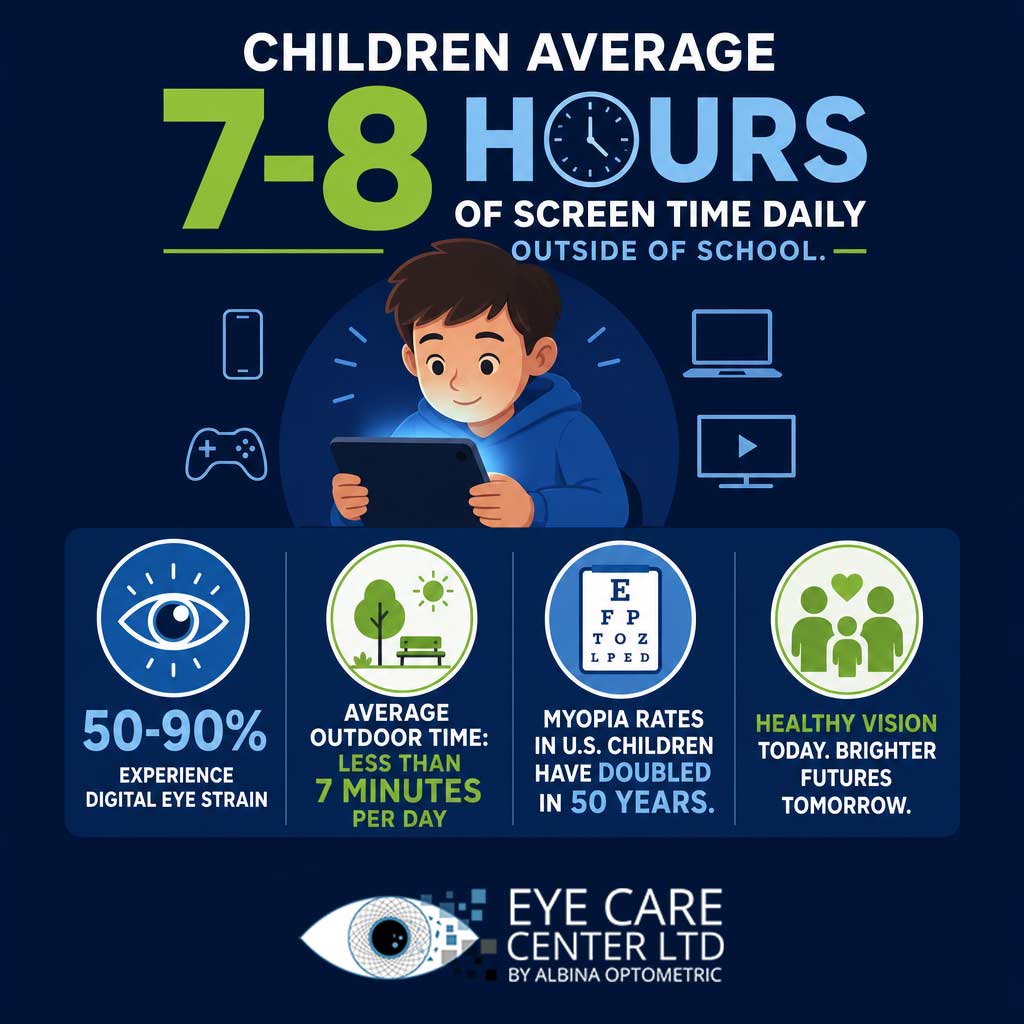
Mind-boggling fact: Children today spend an average of 7 to 8 hours per day looking at screens outside of school. Studies show that 50 to 90% of children who use screens for extended periods experience digital eye strain symptoms. Meanwhile, the average American child spends only 4 to 7 minutes in unstructured outdoor play per day – a number that has dropped 50% since the 1970s.
What the research actually shows
Before we talk about rules, I want to give you the honest version of what the science says, because a lot of what circulates on parenting blogs is either overstated or incomplete.
The core findings that I rely on clinically are these:
- Near work increases myopia risk – each additional daily hour raises risk by 2 to 3%
- Outdoor time is powerfully protective – 2+ hours daily cuts myopia onset risk by about 50%
- Digital eye strain is nearly universal – 50 to 90% of children with extended screen use have symptoms
- The combination is the epidemic – more near work plus less outdoor time, starting younger
Two clarifications worth making. Screens are not uniquely dangerous compared to books, but they are typically used at closer distances, for longer stretches, and with fewer natural breaks. And the outdoor protection works through a specific mechanism: bright outdoor light stimulates retinal dopamine release, which directly inhibits the axial eye elongation that causes myopia. Indoor light, even bright indoor light, does not replicate it.
Understanding this picture is important because it tells us where the interventions that actually work are: outdoor time first, structured breaks second, ergonomics third. Rules that focus only on limiting minutes without addressing these factors miss most of the benefit.
Understanding digital eye strain in children
Digital eye strain, also called computer vision syndrome, is not a single symptom. It is a cluster of complaints that arise from the way we use screens compared to how our visual system was designed to operate. Children are particularly vulnerable because their visual systems are still developing and they are less likely to self-regulate or take spontaneous breaks.
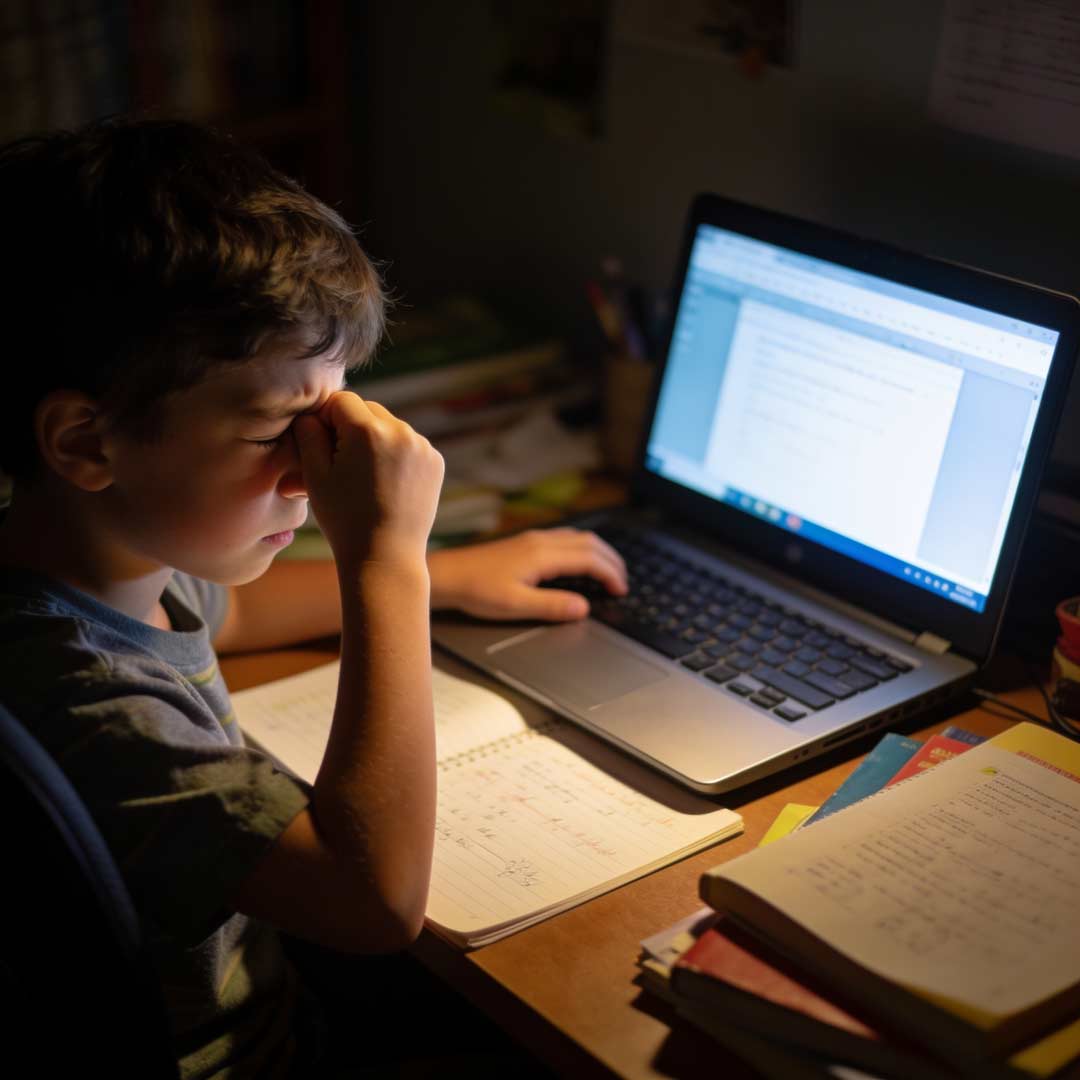
Common digital eye strain symptoms in children include:
- Eye fatigue, soreness, or heaviness – especially in the evening
- Headaches during or after screen use
- Blurry or double vision that clears after rest
- Difficulty refocusing from near to distance
- Dry, gritty, or burning eyes (screen use significantly reduces blink rate)
- Squinting at screens or holding devices unusually close
- Complaining that reading is hard or that words move on the page
- Becoming irritable or tired after relatively short screen sessions
Many parents assume these complaints are behavioral or attention-related. They are often not. A child who resists reading after school, complains of headaches by Wednesday, or seems unfocused during homework may have a real, treatable visual problem that a screen use pattern has either caused or is aggravating. A comprehensive eye exam is the starting point for any child showing these signs. See our guide on what happens during a comprehensive eye exam to understand what we look for.
The 20-20-2 framework explained
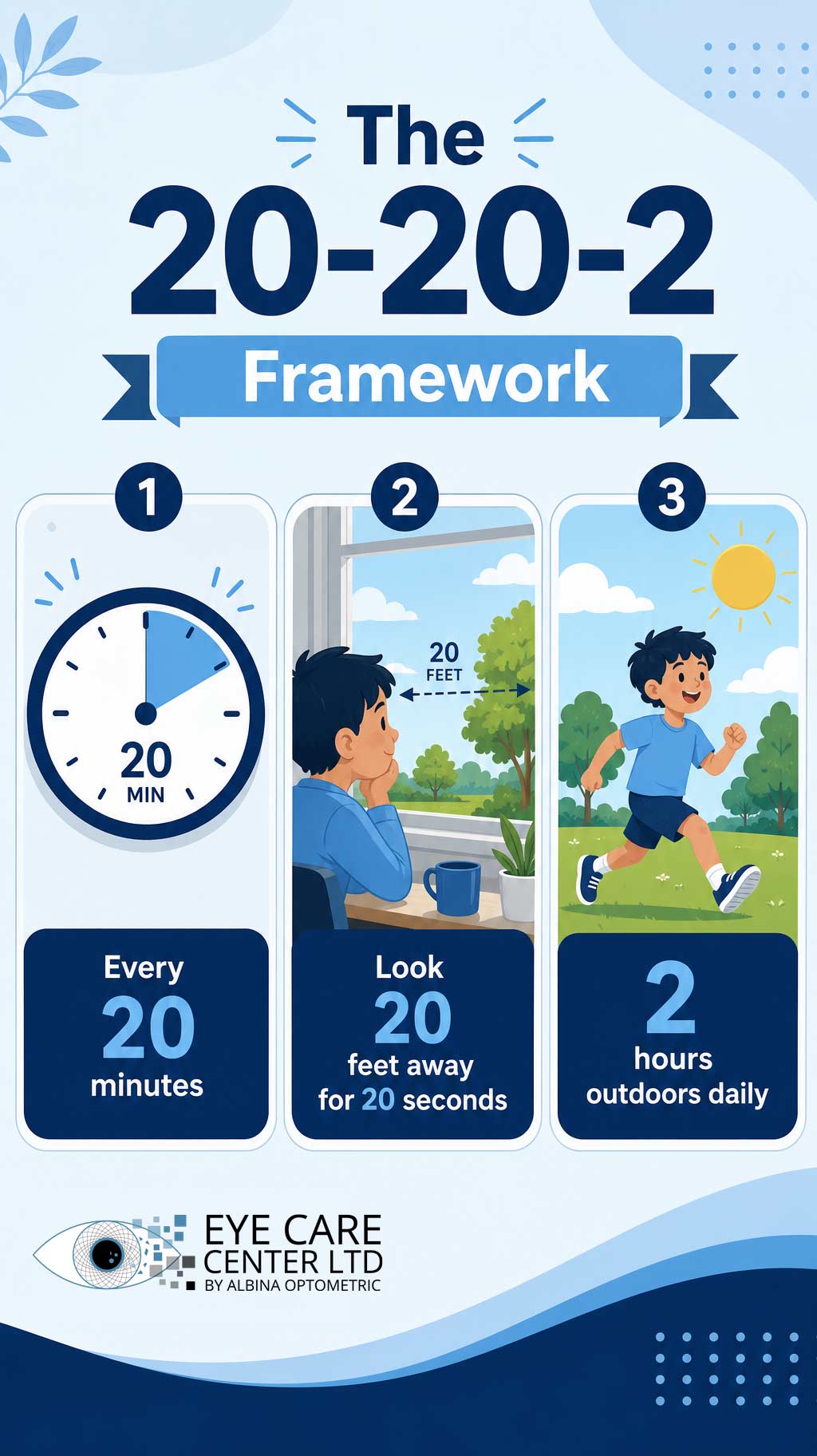
The 20-20-20 rule is well known and clinically supported: every 20 minutes of screen use, look at something 20 feet away for at least 20 seconds. This allows the ciliary muscle, which contracts to maintain near focus, to relax temporarily and reduces cumulative eye strain. Research supports it as an effective way to manage digital eye strain symptoms when consistently applied.
But I add a second component that I believe is equally important: 2 hours of outdoor time per day. Together, these two elements form what I call the 20-20-2 framework:
- Every 20 minutes on a screen, take a 20-second distance vision break
- 2 hours outdoors every day, which provides the bright light exposure that protects against myopia progression
The reason I emphasize the outdoor time component so strongly is that the research on outdoor time and myopia protection is more robust than almost anything else in pediatric eye care right now. The Wu et al. study published in Ophthalmology showed that adding just 40 minutes of outdoor time during school recess significantly reduced myopia onset compared to controls. Two or more hours daily is the current evidence-based target, and it should be thought of as the most important eye health habit your child can build, not just a nice-to-have.
Age-appropriate screen time guidelines
The American Academy of Pediatrics (AAP) provides evidence-based screen time recommendations that I use as a starting framework with families:
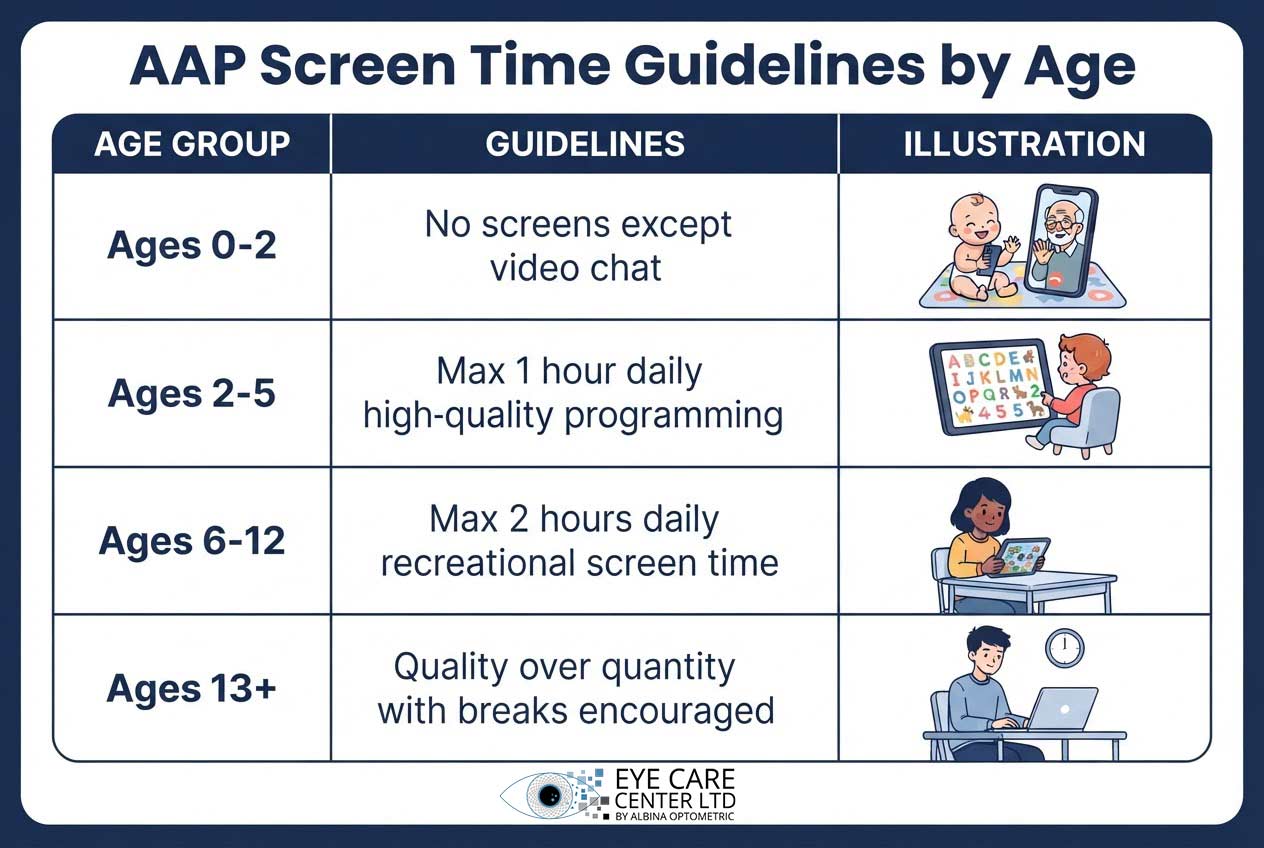
- Ages 0-2: No recreational screens. Video chatting with family is fine.
- Ages 2-5: Max 1 hour daily of high-quality programming, ideally co-viewed with a parent.
- Ages 6-12: Max 2 hours of recreational screen time daily, homework excluded.
- Ages 13+: Quality over quantity, with protected sleep, outdoor time, and consistent 20-20-20 breaks.
The 2-hour daily outdoor time requirement applies at every age from 2 upward. And a practical note: these limits apply to recreational screens only. Homework screen use is mitigated with the 20-20-20 rule, good ergonomics, and outdoor time around the school day rather than time limits.
A practical note: these guidelines apply to recreational screen time. Homework-required screen use is a different category and most families cannot realistically limit it. The mitigation strategy for homework screens is the 20-20-20 rule applied consistently, good ergonomics, and ensuring adequate outdoor time before and after the school day.
The myopia and screen time connection
Myopia is not just needing glasses. I want every family to understand this clearly, because it shapes why the screen time conversation matters beyond daily eye comfort. Myopia is a structural change in the eye where the eyeball grows longer than it should. Once that elongation happens, it is permanent. And progressive myopia in childhood, which is becoming more common and more severe, carries lifetime consequences.
Children with high myopia, defined as a prescription of -6.00 diopters or more, face a significantly elevated lifetime risk of:
- Retinal detachment
- Glaucoma
- Cataracts at younger ages
- Myopic macular degeneration
These are not hypothetical risks. They are the reason that childhood myopia management has become one of the most important areas in pediatric eye care. If your child’s prescription is getting stronger every year, this is the conversation to have with their eye doctor. We offer myopia management options including orthokeratology (the overnight lens treatment Carol uses – read her story here ), low-dose atropine drops, and soft multifocal lenses designed to slow axial elongation. Read more in our articles on childhood myopia and outdoor time and low-dose atropine for myopia control.
Screen time matters in this context because it reduces outdoor time, increases sustained near work, and is typically used at shorter distances than print reading. The goal is not to eliminate screens but to structure their use in ways that protect developing eyes.
Blue light: facts versus marketing
Blue light glasses have become a multibillion-dollar industry built largely on parental anxiety. I want to give you an honest clinical perspective before you spend money on products that may not deliver what they promise.
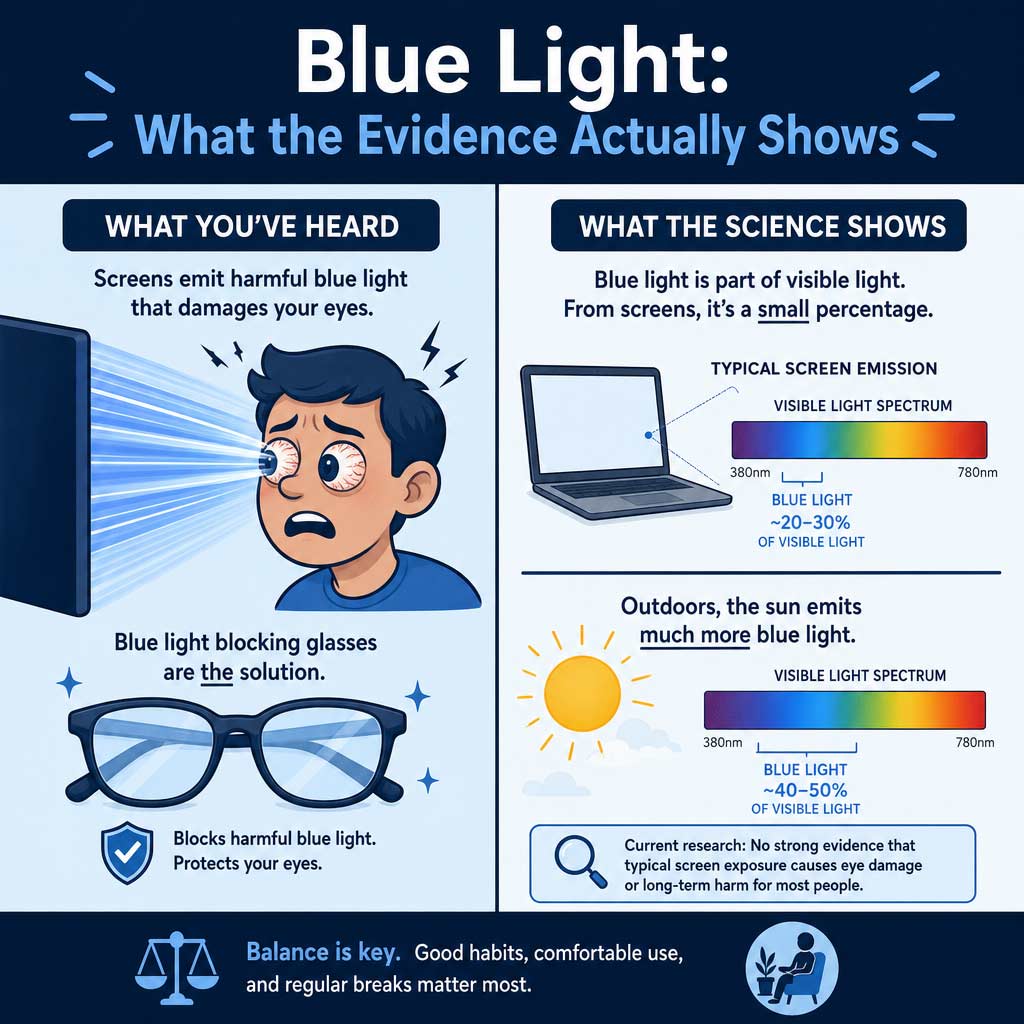
Here is what the current evidence supports:
- Screens do not cause permanent eye damage – no peer-reviewed evidence supports retinal harm from screen-level blue light
- Blue light does disrupt sleep – melatonin suppression before bedtime is real and well-documented
- Blue light glasses have weak evidence – a 2021 Cochrane Review found they probably do not reduce screen eye strain
For perspective, the blue light your child receives from the sun outdoors is orders of magnitude greater than anything a screen emits. The symptoms people attribute to blue light are more likely caused by reduced blinking, sustained near focus, and poor ergonomics – which is why the interventions that work target those factors instead.
What I recommend instead of blue light glasses:
- Activate the night mode or warm display setting on all devices after sunset
- No screens for 60 minutes before bedtime
- Ensure the room has adequate ambient lighting when using screens (the screen should not be the only light source)
- Apply the 20-20-20 rule consistently to address the actual cause of eye strain
If blue light glasses provide a placebo benefit that makes a child more likely to take breaks or comply with screen rules, they are not harmful. But they are not a substitute for the behavioral interventions that have actual evidence behind them.
Practical rules that work in real families
Based on both the clinical evidence and conversations with hundreds of families at our practice, here are the rules that make the most difference for children’s eye health and are realistic to actually maintain:
- Outdoor time before screens – 2 hours outside before recreational screens begin. The most impactful single rule.
- 20-20-20 becomes automatic – timers and apps, not willpower. Every 20 minutes, 20 seconds out the window.
- Screen-free zones, not hours – dinner table and bedrooms. Places are easier to enforce than timers.
- Arm’s length, slightly below eye level – 18 to 24 inches. Phones at 6 to 8 inches are a major strain source.
- Night mode on every device – five minutes to set up once, runs automatically forever.
- Parents follow the same rules – kids reliably call out hypocrisy, and the rules collapse when they do.
The outdoor-first rule deserves emphasis because it accomplishes the most important vision protection goal while reframing screens as a reward rather than a battleground. After-school outdoor play before the iPad comes out is the simplest version of it in practice.
How to enforce limits without constant battles
The most common failure point in screen time management is enforcement that depends entirely on parental willpower and memory. The rules that stick are the ones built into systems, not the ones that require a negotiation every evening.
- Use built-in device controls – Screen Time (iOS) and Family Link (Android) enforce limits so you don’t have to.
- Routine, not negotiation – fixed screen windows (say 4:30 to 6:30 PM) end the daily bargaining.
- Stock attractive alternatives – Lego, sports gear, art supplies, and board games ready at transition times.
- Enforce outdoor time first – it protects vision more, meets less resistance, and naturally displaces screen time.
- Let older kids help set the rules – rules children help create are rules they actually follow.
The device controls point is worth expanding: when the tablet itself says time is up, it is not the parent saying it. That removes an enormous amount of friction from the daily conversation, and it is why I tell families to set the controls up once and let the technology be the enforcer.

When to bring your child in for an eye exam
Screen time management protects developing eyes, but it does not replace a professional evaluation. There are specific situations where I want families to schedule an appointment rather than wait for their next annual visit:
- Your child complains of eye strain, headaches, or blurry vision after screen use
- Your child squints at screens or holds devices unusually close
- Your child’s glasses prescription has changed significantly in the past year
- Your child avoids reading or complains that reading is hard or uncomfortable
- You notice your child tilting their head, covering one eye, or sitting very close to the television
- Your child has not had a comprehensive eye exam in the past 12 months
The American Optometric Association recommends children receive a comprehensive eye exam before starting school and annually thereafter. Children in active myopia management should be seen every six months.
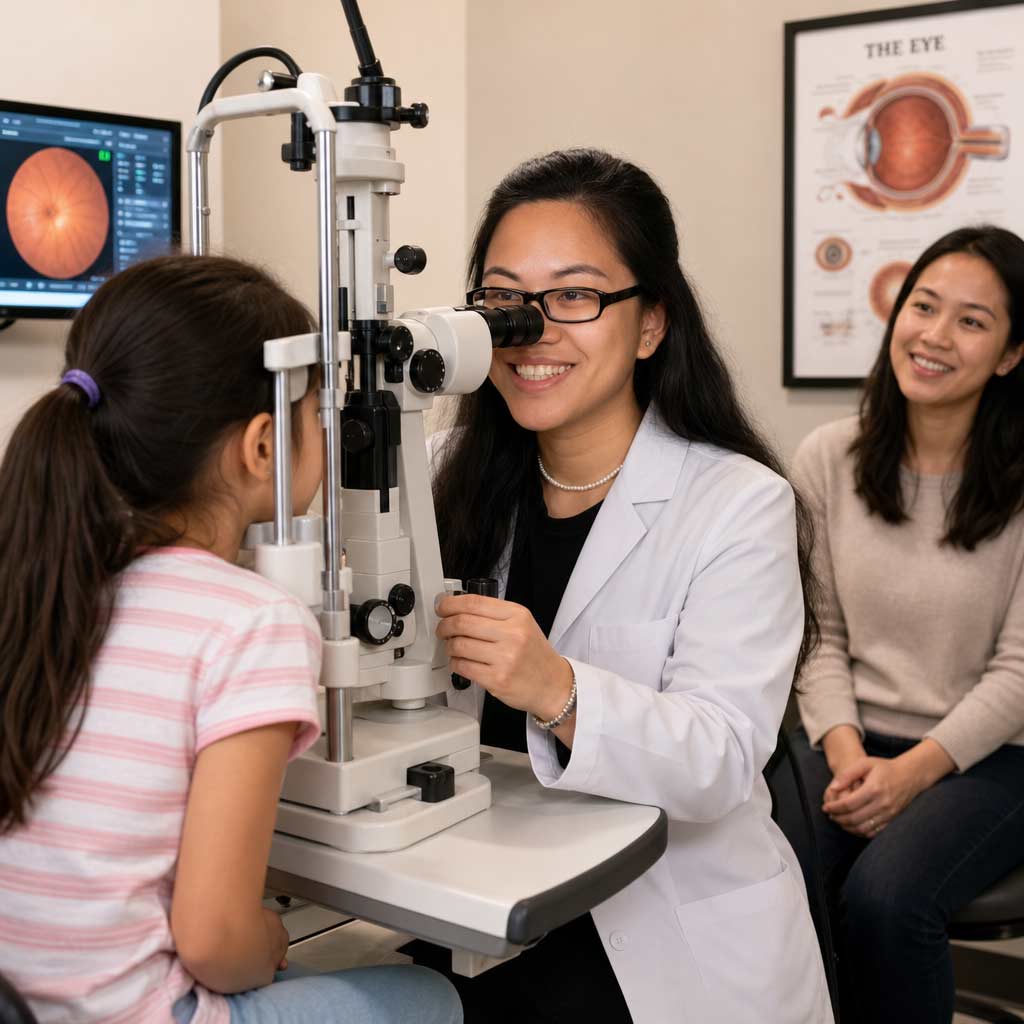
Your Child’s Next Eye Exam Should Include a Screen Time Conversation
At Eye Care Center LTD, pediatric eye exams go beyond checking the prescription. We evaluate your child’s entire visual system, screen for myopia progression, and help families build realistic screen time strategies tailored to their child’s specific risk profile. Schedule at any of our three Illinois locations – same-week appointments available.
Schedule Your Child’s Eye Exam
Addison: (630) 543-0607 | Burbank: (708) 599-0050 | Willowbrook: (630) 969-2807
Monday – Thursday 10am-6pm | Friday 10am-5pm | Saturday 9am-2pm
Se habla espanol.
Related reading on myeccltd.com:
- Childhood Myopia and the Outdoor Time Connection
- The Hidden Cost of High Myopia in Children
- Low-Dose Atropine: Slowing Your Child’s Worsening Eyesight
- Patient Story: Carol’s Ortho-K Myopia Treatment
Frequently asked questions about screen time and children’s vision
How much screen time is safe for kids?
The American Academy of Pediatrics recommends no recreational screens for children under 2 (video chatting is fine), a maximum of 1 hour daily for ages 2 to 5, and a maximum of 2 hours of recreational screen time daily for ages 6 to 12. For teenagers, the emphasis shifts to quality and ensuring adequate breaks and outdoor time. That said, 2 or more hours of daily outdoor time is more protective against myopia than limiting screens alone, and it is where I focus first with every family.
Do screens cause myopia in children?
Screens contribute to myopia risk primarily through two mechanisms: they involve sustained near work, which stresses the focusing system of the developing eye, and they displace outdoor time, which is the most protective factor we have against myopia onset and progression. Screens are not uniquely harmful compared to books held close, but they are typically used at shorter distances, for longer durations, and with fewer natural breaks. The combination of more near work and less outdoor time is what drives the myopia epidemic.
What is the 20-20-20 rule and does it work?
The 20-20-20 rule: every 20 minutes of screen use, look at something at least 20 feet away for 20 seconds. This allows the ciliary muscle to relax from sustained near focus and reduces digital eye strain symptoms. Clinical research supports it as an effective tool for managing eye fatigue when applied consistently. I combine it with a 2-hours-outdoors-daily requirement to form the 20-20-2 framework, which addresses both daily eye strain and long-term myopia protection.
Should my child wear blue light glasses?
The evidence for blue light glasses reducing eye strain is limited. A 2021 Cochrane Review found that blue light filtering lenses probably do not meaningfully reduce digital eye strain symptoms. The more evidence-backed interventions are the 20-20-20 break rule, good ergonomics, proper lighting, and activating night mode on devices after sunset. Night mode suppresses the sleep-disrupting effect of blue light before bedtime, which is the most well-documented concern, and it is built into every modern device for free.
How much outdoor time do children need for eye health?
Research consistently supports 2 or more hours of outdoor time daily as the most protective intervention against myopia onset in children. The mechanism is well understood: bright outdoor light (typically 10,000 lux or more) stimulates retinal dopamine release, which inhibits the axial eye elongation responsible for myopia progression. Indoor lighting, even bright indoor lighting, does not produce the same effect. Recess, outdoor sports, walks, and backyard play all count toward this total.
Can screens permanently damage my child’s eyes?
Screens do not cause retinal damage or blindness. However, excessive near work including screen use contributes to myopia development, which is a permanent structural change in the eye. Progressive myopia, particularly if it reaches high levels, increases lifetime risk of retinal detachment, glaucoma, cataracts at younger ages, and macular degeneration. Digital eye strain symptoms – headaches, blurry vision, dry eyes – are uncomfortable but reversible with rest. The focus should be on preventing myopia progression through outdoor time and break habits, not on fear of screen-induced blindness.
What is the best screen distance for children?
Screens should be held at approximately arm’s length from the face – about 18 to 24 inches for school-age children – and positioned slightly below eye level. Phones and tablets held at 6 to 8 inches from the face represent a significantly higher near work demand than print reading at the same distance. Ensuring the room has adequate ambient lighting so the screen is not the only light source also reduces eye strain substantially. Good posture – feet flat on the floor, back supported – reduces the tendency to hunch forward and hold devices too close.
How do I get my child to actually follow the 20-20-20 rule?
The most effective approach is to build it into a system rather than relying on the child to self-initiate. For younger children, set a kitchen timer or use a smartwatch to alert them every 20 minutes. For school-age children, apps like Eye Care 20 20 20 or simple phone timer alarms work well. Making it a family practice rather than a rule only for children significantly improves compliance. Framing it as “the window break” and having them look at a specific distant object – a tree, a fence, a building across the street – makes it concrete and habit-forming.
When should my child have their first eye exam?
The American Optometric Association recommends a first comprehensive eye exam at 6 months of age, a second at age 3, then annually once school begins. Children in active myopia management should be seen every 6 months to assess progression and adjust treatment. Do not wait for a child to complain about their vision – many children with significant refractive errors have never known anything different and do not know what “clear vision” should feel like.
My child’s glasses prescription keeps getting stronger. Is that normal?
Myopia typically progresses throughout childhood and adolescence, with the most rapid progression occurring between ages 8 and 14. Annual prescription changes are common and expected. However, rapid progression or prescriptions that worsen significantly more than 0.50 diopters per year warrant a conversation about myopia management. Options including orthokeratology, low-dose atropine drops, and soft multifocal contact lenses have strong evidence for slowing progression and protecting long-term eye health. Schedule a myopia management consultation to discuss your child’s specific risk profile and options.